Why Wellness Brands Need SEO to Grow Online
Why Wellness Brands Need SEO to Grow Online

SEO is the primary tool wellness brands use to reach health-conscious consumers at the exact moment they search for products and services. Without it, your brand stays invisible while competitors capture that demand. The wellness industry is growing fast, and consumers do serious online research before they buy. Understanding why wellness brands need SEO is the first step toward building a digital presence that actually converts.
Why wellness brands need SEO differently than other industries
Wellness SEO is not the same as general ecommerce SEO. Google classifies health and wellness content under YMYL, which stands for “Your Money or Your Life.” YMYL pages cover topics that can directly affect a person’s health, safety, or financial wellbeing. Google holds these pages to a much higher standard than a page selling furniture or clothing.
AI Overviews appear on 16% of ecommerce searches, but wellness brands face even lower visibility because Google’s algorithms apply harm prevention filters that prioritize institutional trust over brand recognition. That means a well-funded wellness brand with strong social media can still rank below a lesser-known competitor that has better technical SEO and credentialed content.
The contrast with generic ecommerce SEO is sharp. A shoe brand can rank well with good product descriptions and backlinks. A supplement brand needs all of that plus:
- Expert author attribution with verifiable credentials
- FDA-compliant product claims and safety language
- Structured data schemas that signal medical or health authority
- Content reviewed or co-authored by licensed professionals
Wellness brands must shift from generic SEO tactics toward building institutional trust through licensed partnerships and regulatory compliance. That shift is not optional. It is the baseline Google expects before it will rank your content competitively.
How does E-E-A-T shape wellness brand authority online?

E-E-A-T stands for Experience, Expertise, Authoritativeness, and Trustworthiness. Google’s quality raters use this framework to evaluate whether a page deserves to rank for health-related queries. For wellness brands, E-E-A-T is not a checklist item. It is the foundation of your entire content strategy.
Here is how to build E-E-A-T into your wellness site architecture:
-
Add credentialed author bios to every health-related page. Include the author’s professional title, certifications, and a link to their professional profile. A registered dietitian’s byline on a nutrition article carries real weight with Google’s quality raters.
-
Implement structured data schemas. MedicalCondition, Physician, and LocalBusiness schemas chained with Person and Article schemas tell Google’s algorithms exactly who wrote your content and what credentials they hold. Most wellness sites skip this entirely.
-
Cite authoritative sources. Link to peer-reviewed studies, government health agencies like the NIH or CDC, and recognized medical institutions. These outbound links signal that your content exists within a trusted information ecosystem.
-
Earn and display third-party validation. Press mentions, professional association memberships, and verified customer reviews all contribute to your site’s perceived authority.
Leading medical sites like Mayo Clinic pass YMYL standards through decades of citations and detailed author credential schemas. Most wellness sites fail at the architecture level, not the content level. That is a fixable problem, and fixing it is where the biggest SEO gains live.
Pro Tip: Run a schema validation test using Google’s Rich Results Test tool on your top five pages. If your author and organization schemas return errors, that is the first thing to fix before any content work.
The most valuable SEO improvements come from investing in schema and authoritative metadata architecture. It is the most involved work, but it delivers the highest return over time.
What are the real SEO benefits for wellness brands?
The concrete benefits of SEO for wellness brands go well beyond traffic numbers. SEO builds credibility and connects brands to consumers who are actively researching before they purchase. These are not casual browsers. They are high-intent buyers who have already decided they want a solution.
Here is what wellness brands gain from a well-executed SEO strategy:
- Targeted organic traffic. Ranking for searches like “best supplements for energy” or “yoga studio near me” puts your brand in front of people ready to act. Paid ads stop the moment you stop paying. Organic rankings keep delivering.
- Higher conversion rates. Visitors from organic search convert at higher rates than social media traffic because they arrived with a specific need. Your content answers that need directly.
- Long-term brand equity. A wellness brand that ranks consistently for trusted health topics builds a reputation that compounds over time. That reputation is an asset no algorithm update can fully erase.
- Local customer acquisition. LocalBusiness schema, neighborhood-targeted content, and review velocity shape local rankings for studios, spas, gyms, and clinics. Appearing in Google Maps results for “acupuncture near me” is a direct revenue driver.
Wellness businesses lacking SEO often lose customers to competitors that rank higher on Google. Signs of weak SEO include dependency on paid advertising, low inquiry volume despite decent traffic, and complete absence from local search results. Each of those symptoms has a specific fix.
SEO in wellness is not about just driving traffic but converting ethical, conscious buyers by aligning your content with brand trust and consumer education. That distinction matters. Wellness consumers are skeptical. They research. They compare. They trust brands that educate them, not brands that just sell to them.
How can wellness brands improve SEO in 2026?
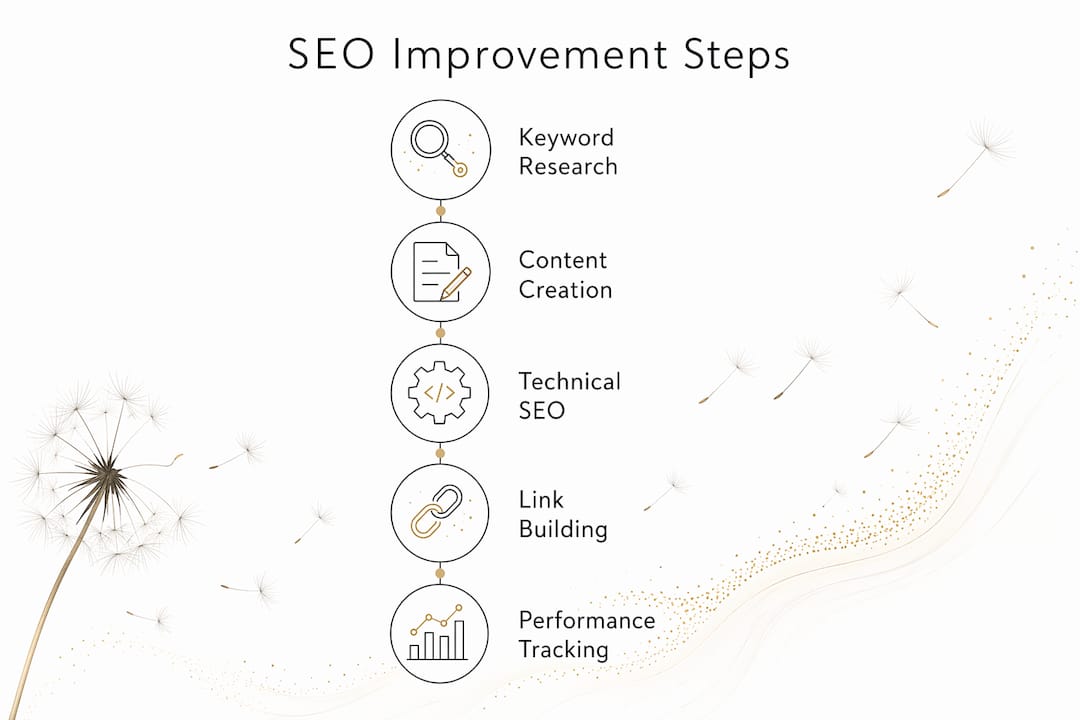
Practical SEO for wellness brands in 2026 requires four coordinated efforts: keyword research, content creation, technical SEO, and ongoing measurement.
Keyword research for wellness
Start with high-intent, condition-specific searches. Tools like Google Search Console, Ahrefs, and Semrush reveal what your audience actually types. Focus on long-tail queries like “magnesium glycinate for sleep” rather than broad terms like “supplements.” AI-powered tools detect emerging wellness trends like “adaptogen benefits” before they peak, giving you a content advantage.
Content creation that builds trust
Content strategies should be stratified by search intent. Educational content serves early-stage researchers. Safety-compliant product information serves buyers ready to purchase. Both must be attributed to credentialed authors. A blog post explaining how ashwagandha affects cortisol levels needs a different tone and structure than a product page for an ashwagandha supplement.
Technical SEO comparison: common gaps vs. best practice
| Area | Common gap | Best practice |
|---|---|---|
| Schema markup | No structured data | MedicalCondition + Author schemas implemented |
| Author attribution | Anonymous content | Named, credentialed author bios on every page |
| Mobile performance | Slow load times | Core Web Vitals passing on mobile |
| Local SEO | No Google Business Profile | Optimized profile with review strategy |
| Product claims | Unverified health claims | FDA-compliant language with source citations |
Most wellness websites fail to rank because of poor technical SEO architecture, not content quality. Good writing on a poorly structured site is invisible to search engines. Fix the architecture first.
Pro Tip: Connect your site to Google Search Console and filter for pages with high impressions but low click-through rates. Those pages already have Google’s attention. Improving their title tags and meta descriptions is the fastest way to increase traffic without writing new content.
For wellness professionals building their online presence from scratch, establishing credibility online fast requires the right technical foundation from day one, not as an afterthought. Pairing that foundation with marketing automation basics helps wellness brands stay consistent without burning out their teams.
Key Takeaways
Wellness brands that invest in SEO architecture, expert attribution, and intent-matched content consistently outrank competitors and earn the trust of health-conscious buyers.
| Point | Details |
|---|---|
| YMYL standards are non-negotiable | Google holds wellness content to higher trust standards than general ecommerce. |
| Schema markup is the biggest gap | Most wellness sites fail at architecture, not content. Implement MedicalCondition and Author schemas first. |
| E-E-A-T drives rankings | Credentialed author bios, citations, and third-party validation signal authority to Google. |
| SEO targets high-intent buyers | Organic search visitors arrive with a specific need, which produces higher conversion rates than social traffic. |
| Local SEO drives direct revenue | LocalBusiness schema and review velocity determine whether you appear in Google Maps results. |
What I have learned about wellness SEO that most guides skip
The wellness SEO conversation gets stuck on content quality. Write more blog posts. Add more keywords. Publish more consistently. That advice is not wrong, but it misses the real problem.
The brands I see struggle most have perfectly readable, genuinely helpful content that Google simply does not trust. Not because the writing is bad. Because the site architecture sends no trust signals. No schema. No author credentials. No structured data connecting the writer to the content. Google’s quality raters cannot verify who wrote it or why they should be believed.
The shift that actually moves rankings is treating your site’s technical layer as a trust document. Every schema tag, every author bio, every structured citation is a statement to Google that says: “This content comes from a real, qualified person, and here is the proof.” Wellness brands that make that investment early build a compounding advantage. Brands that skip it keep paying for ads to compensate for organic invisibility.
My honest recommendation: before you write another piece of content, audit your existing pages for schema errors and missing author attribution. Fix those first. The content you already have will perform better almost immediately.
— Christopher
Build your wellness brand’s online presence with Moderatemurmurations
Wellness brands need more than good content. They need a technically sound, search-ready website that signals trust from the first page load.

Moderatemurmurations builds fast, clean websites with SEO foundations built in from the start. That includes schema implementation, mobile performance, and clear content architecture designed to meet the standards Google expects from health and wellness brands. If you are ready to stop relying on ads and start building organic visibility that lasts, launch your wellness brand online with a team that understands both the technical and trust requirements of wellness SEO. You can also explore the full range of website and digital services built specifically for brands ready to grow.
FAQ
What is YMYL and why does it affect wellness SEO?
YMYL stands for “Your Money or Your Life.” Google applies stricter ranking standards to wellness content because inaccurate health information can directly harm readers.
How does E-E-A-T apply to wellness brands?
E-E-A-T requires wellness brands to demonstrate Experience, Expertise, Authoritativeness, and Trustworthiness through credentialed author bios, structured data schemas, and authoritative citations on every health-related page.
Why do wellness brands lose rankings despite good content?
Poor technical SEO architecture is the primary cause. Missing schema markup and anonymous content fail Google’s YMYL quality standards regardless of writing quality.
What schema types matter most for wellness websites?
MedicalCondition, Physician, LocalBusiness, Person, and Article schemas are the core types. Chaining them together to attribute content to credentialed authors is what passes Google’s quality rater review.
How long does SEO take to show results for a wellness brand?
Technical fixes like schema and Core Web Vitals improvements can show results within weeks. Content authority and ranking gains from E-E-A-T investment typically build over three to six months.