Why AI Tools Speed Up Launches for Product Teams
Why AI Tools Speed Up Launches for Product Teams

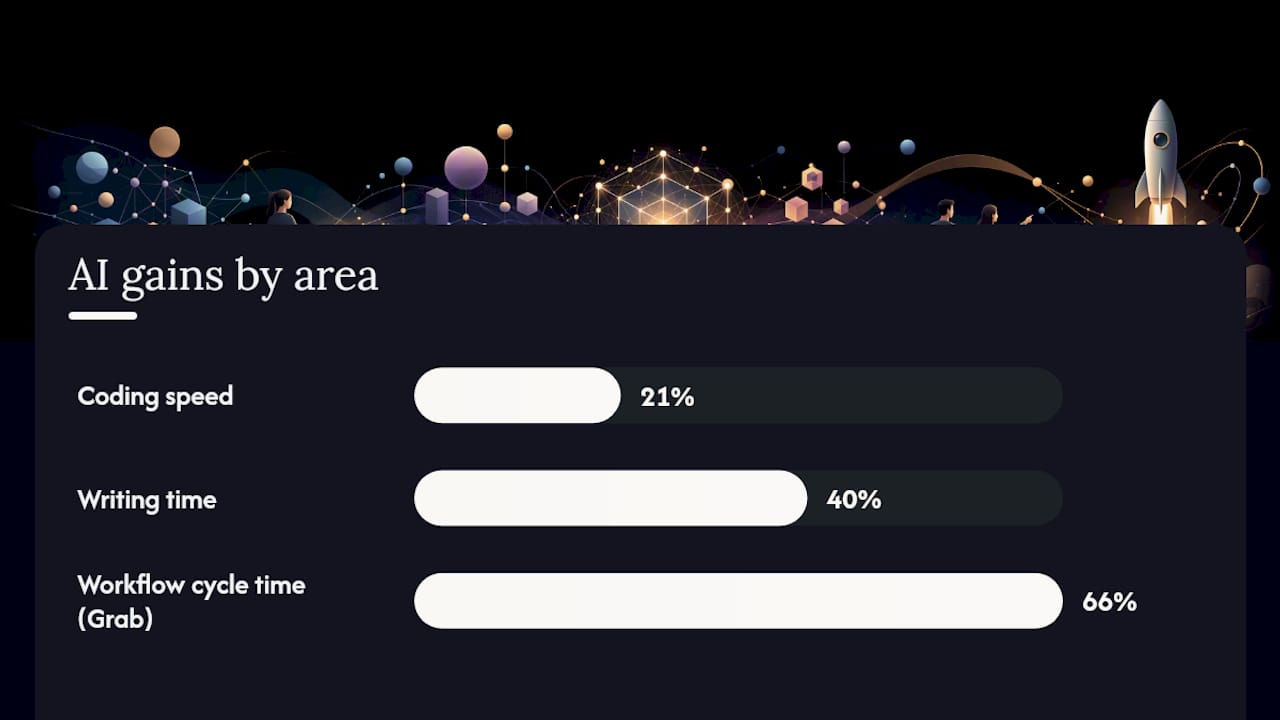
AI shortens launch cycle time when it’s embedded across every stage of the workflow, not just bolted onto one task, and the effect is measurable rather than anecdotal. The OECD’s review of generative AI found it lowers entry barriers for early-stage work, especially when a skilled user directs it. A large randomized study on coding assistants found roughly a 21% speed boost on iterative tasks, and a pre-registered writing experiment saw professionals finish tasks about 40% faster with better output.
The gap between task speed and launch speed: individual productivity gains only become faster launches when teams also fix verification, integration, and release bottlenecks. Moderatemurmurations sees this pattern constantly in client builds: the code or copy gets faster, but the launch date doesn’t move until the whole pipeline changes.
Key Takeaways
AI tools shorten launch cycle time most reliably when embedded across the full pipeline and paired with automated review, not when used as an isolated coding or writing aid.
| Point | Details |
|---|---|
| Coding speed gains are real but partial | Studies show roughly a 21% speed boost on coding tasks, which doesn’t automatically shorten the whole launch. |
| Writing tasks see bigger relative gains | A pre-registered study found ChatGPT cut writing time by about 40% with an 18% quality gain. |
| Workflow-wide AI beats single-tool AI | Embedding AI across editor, CI, and review compounds savings, as seen in Grab’s roughly 66% cycle-time cut. |
| Review and QA are the real bottleneck | Faster code generation without automated review just shifts delays downstream, per LaunchDarkly’s engineering research. |
| Moderatemurmurations builds the whole pipeline | Applying AI-assisted drafting, scaffolding, and testing together is how Moderatemurmurations shortens client time-to-launch. |
Table of Contents
- Why AI Tools Speed Up Launches at Every Stage
- How Much Faster Do Launches Actually Get?
- Why Faster Coding Doesn’t Always Mean Faster Launches
- Turning AI Productivity Into Faster Launch Cycles
- Which AI Tools Fit Where in a Launch Workflow
- Metrics That Prove AI Is Actually Speeding Up Launches
- How Moderate Murmurations Applies This to Client Launches
- What Product Teams Get Wrong About AI-Driven Speed
- Launch Faster Without Hiring a Full Agency Team
- Frequently Asked Questions
- Sources
Why AI Tools Speed Up Launches at Every Stage
Launches slow down at predictable points: drafting, building, testing, reviewing, releasing, and measuring. AI tools attack each one differently, which is why the cumulative effect on a launch timeline is bigger than any single tool’s headline number suggests.
At the idea and prototyping stage, a model like ChatGPT or Claude can turn a rough concept into a working spec, a landing page outline, or a first-draft course curriculum in minutes instead of days, as explained in this practical guide on automating workflows for business teams. During implementation, coding assistants like GitHub Copilot scaffold boilerplate and generate unit tests so engineers spend less time on repetitive setup and more time on the logic that’s actually novel. In QA, AI can triage incoming bug reports, cluster duplicates, and flag likely root causes before a human ever opens the ticket. At release, AI-assisted summarization turns a sprawling pull request into a two-sentence changelog a reviewer can approve fast. After launch, the same tools summarize user feedback and support tickets so a product team knows what to fix next without reading every thread manually.
The most frequent, highest-payoff targets teams hand to AI include:
- Boilerplate code and repetitive configuration
- Test scaffolding for known patterns
- First-draft marketing and UX copy
- Documentation and internal wikis
- Pull request and code review summaries
- Initial bug triage and duplicate detection
Pro Tip: Start with documentation and PR summaries before touching your codebase. They carry almost no blast radius if the AI gets something wrong, and the time saved compounds every single day the project runs.
How Much Faster Do Launches Actually Get?
The numbers vary by task, but the direction is consistent. The GitHub Copilot evaluation found close to a 21% improvement in coding speed on iterative development work. A separate pre-registered experiment published in Science found ChatGPT cut time on professional writing tasks by about 40% while raising output quality by roughly 18%, with the biggest gains going to less-experienced writers.
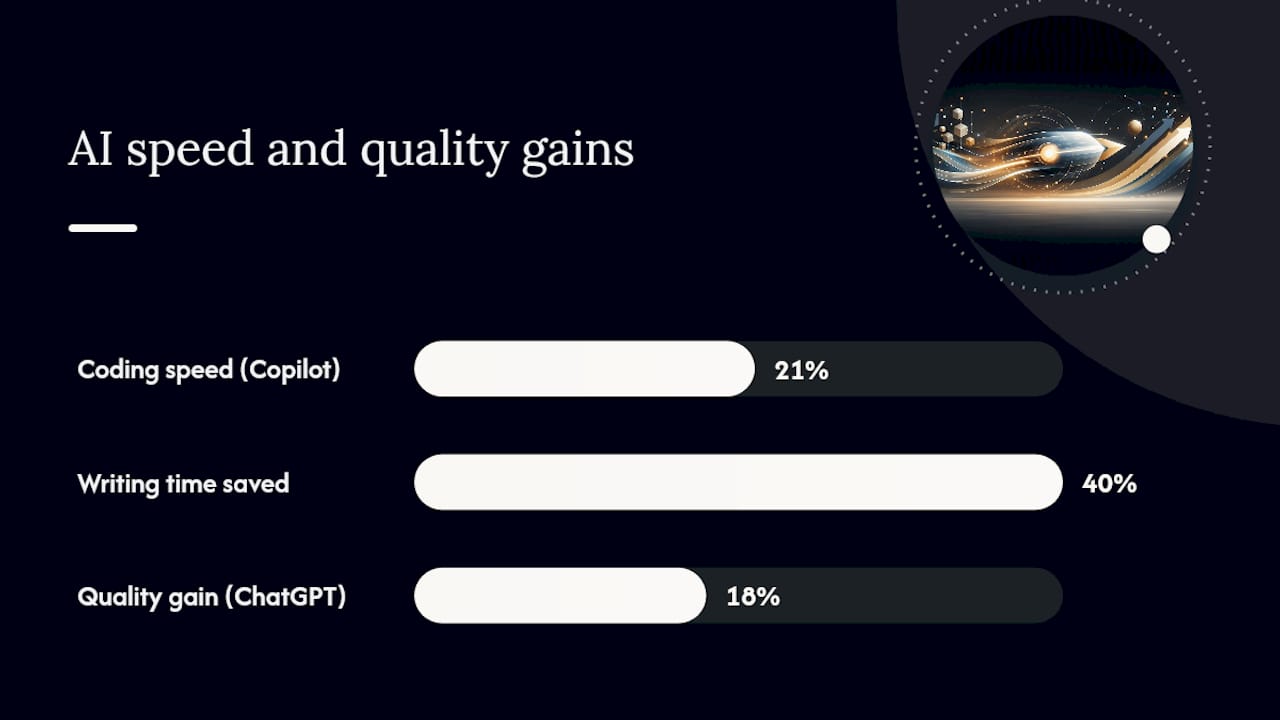
Industry write-ups point to bigger numbers when AI gets embedded across an entire delivery workflow instead of one tool at a time. Reporting on Grab’s engineering org describes AI cutting development cycle time by around 66% and helping teams ship roughly multiple times faster.
A few patterns show up repeatedly across these studies:
- Gains are largest on pattern-heavy, repetitive tasks, not novel architecture decisions
- Less-experienced users often see bigger relative improvements than experts
- Individual task speed and full launch-cycle speed are related but not identical metrics
That last point matters more than any single percentage. It means the coding stage got faster; whether the whole pipeline speeds up depends on what happens next.
Why Faster Coding Doesn’t Always Mean Faster Launches
This is the part most teams get wrong. Speeding up one stage of the pipeline without touching the rest just moves the bottleneck downstream. If engineers write code and tests faster with AI assistance but pull request review still takes the same three days, the launch date doesn’t move at all.
Common places where individual speed gains get absorbed instead of converted into launch speed:
- Review queues that weren’t sized for a higher volume of pull requests
- Manual QA processes that can’t scale with faster development
- Release gating and approval chains that still run on the old cadence
- Model drift and tooling churn that require ongoing retraining or prompt maintenance
- Risk-averse sign-off processes on payments, auth, or compliance-sensitive code
LaunchDarkly’s engineering research describes this directly: teams shipping roughly three times more pull requests without automating review and guardrails just move the bottleneck to human reviewers, which lengthens rather than shortens the path to release.
Pro Tip: Put your mandatory human checkpoint where the blast radius is highest, not where it’s most convenient. Automate the review gate for low-risk changes like copy edits and internal tools, and reserve human sign-off for anything touching authentication, payments, or user data.
Turning AI Productivity Into Faster Launch Cycles
Capturing the gain requires a sequence, not a single tool purchase.
- Map your pipeline and time it. Measure current cycle time stage by stage, from first commit to production release, before adding any AI tool.
- Find the low-risk, repeatable work first. Boilerplate code, test scaffolding, documentation, and first-draft copy are the safest places to start.
- Embed AI across the flow, not just the editor. The same assistant working in your code editor, your CI pipeline, and your triage queue compounds the time savings because it eliminates handoffs and context switching.
- Instrument everything. Track cycle time and defect rate before and after, not just anecdotal “it feels faster” impressions.
- Automate review, not just generation. Guarded releases, feature flags, and automated checks let you absorb a higher volume of changes without a corresponding spike in risk.
- Iterate on one bottleneck at a time. Fix the slowest stage, remeasure, then move to the next.
Teams building this kind of AI workflow design into their process tend to see compounding returns precisely because they’re not treating AI as a single point tool.
Pro Tip: Pick one pipeline stage, put a stopwatch on it, and measure cycle time before and after AI adoption. Trying to fix five stages at once makes it impossible to tell which change actually worked.
Which AI Tools Fit Where in a Launch Workflow
Different tools solve different stage-specific problems, and matching the tool to the task matters more than picking a single favorite.
- ChatGPT (OpenAI) works best for drafting specs, marketing copy, and course content early in the pipeline.
- Claude (Anthropic) handles longer documents and nuanced summarization well, useful for research synthesis and stakeholder communication.
- GitHub Copilot / Microsoft Copilot scaffolds boilerplate code, generates tests, and summarizes pull requests for faster review.
- Multimedia generators fill in launch assets like images and short video without a separate production cycle.
Add mandatory human review anywhere the output touches security, payments, or compliance, regardless of which tool produced it.
Metrics That Prove AI Is Actually Speeding Up Launches
Track a handful of numbers, not dozens:
- Cycle time / lead time to release — the primary outcome metric
- Release frequency and time-to-first-release for new experiments
- Defect rate in production to confirm speed isn’t costing quality
- Review latency to catch the bottleneck described above
Measure a two-week baseline before AI adoption, then compare the same window after rollout.
How Moderate Murmurations Applies This to Client Launches
Our own build pattern mirrors the research: AI-assisted drafts for copy and structure, rapid landing-page scaffolding, and automated testing before release. Clients moving through this pattern typically see their time-to-launch shrink from weeks to days. Book a free consultation to see how it applies to your project.
What Product Teams Get Wrong About AI-Driven Speed
Every team I’ve studied that adopted AI expecting an instant launch-date miracle got surprised by where the real constraint was hiding. It was rarely the code. It was almost always the review queue, the sign-off chain, or a QA process built for a slower era. The teams that actually launch faster treat AI as a pipeline-wide change and measure cycle time relentlessly, not as a productivity toy for individual contributors.
Launch Faster Without Hiring a Full Agency Team
Most teams trying to capture these gains either hire a full agency for months or attempt a DIY build with mismatched tools that never quite connect. Moderatemurmurations builds the middle path: AI-assisted websites, landing pages, and brand copy delivered in days instead of months, using the same embedded-workflow approach described above rather than a single point tool.
We handle the drafting, the scaffolding, and the testing as one connected process, so your launch timeline shortens the same way the case examples in this article show. If you’re planning a launch and want to see what that looks like for your specific project, book a free consultation and we’ll map your pipeline together.
Frequently Asked Questions
Why do AI tools speed up launches more when used across the whole pipeline instead of one stage? Because a speedup in one stage just shifts the wait to the next stage if that stage isn’t also faster. Embedding AI in the editor, CI, and review process removes handoffs and compounds the time savings instead of stranding them in one silo.
What’s a realistic launch speed improvement to expect from AI tools?
Do AI tools help non-engineering teams launch faster too? Yes. Product managers and marketers use AI for research summarization, first-draft copy, and prioritization, all of which shorten the pre-launch planning phase even before a single line of code gets written.
What’s the biggest mistake teams make when adopting AI to speed up launches? Treating it as a single-tool upgrade instead of a pipeline change. Without automated review and guarded releases, faster output just creates a backlog somewhere else in the process.