What Is a Digital Strategy? A 2026 Guide for Business Owners
What Is a Digital Strategy? A 2026 Guide for Business Owners

A digital strategy is a formal plan that aligns your organization’s use of digital technologies with specific business goals. The term is sometimes used interchangeably with “digital marketing strategy,” but the industry standard definition, as framed by Gartner and IMD, is broader. It covers every decision about where you compete digitally and how you win. For business owners and decision-makers, understanding this distinction is the difference between spending money on tools and actually growing.
What is a digital strategy and what does it include?
A digital strategy defines the “where-to-play and how-to-win” choices that guide how your business uses digital resources to reach its goals. It is not a list of software subscriptions or a social media calendar. It is a structured plan that connects every digital decision to a measurable business outcome.
IMD emphasizes that a strong digital strategy anchors decisions in value creation, customer experience, and measurable operational impact. That framing matters. Too many business owners build a “strategy” that is really just a collection of tactics with no unifying logic.
A digital strategy overview typically covers three layers. First, it defines what success looks like for your business. Second, it identifies which digital channels and tools will get you there. Third, it sets up the measurement systems that tell you whether it is working.

What are the key components of an effective digital strategy?
Gartner identifies the following as core components every effective digital strategy must include:
- Vision and goals: Clear objectives tied to enterprise outcomes, not just marketing metrics
- Audience segmentation: Defined personas based on real customer data, not assumptions
- Channel management: A deliberate plan for which digital platforms you use and why
- Data privacy and security: Policies that protect customer data and meet legal requirements
- Performance measurement: Specific metrics and reporting cadences to track progress
- Roadmap with responsibilities: A timeline that assigns ownership of each initiative to a named person or team
- Capability assessment: An honest audit of your current skills, tools, and processes
Each component depends on the others. A goal without a roadmap stays a wish. A roadmap without a capability assessment leads to stalled execution.
Pro Tip: Before writing your strategy, audit what you already have. Map your current digital activities, tools, and team skills. Gaps you find there will shape every decision that follows.
Defining consistent multichannel measurement is one of the most common challenges leaders face. That is not a technical problem. It is a planning problem. Build your measurement framework before you launch any campaign, not after.
For practical examples of how small businesses structure their digital plans, the content strategy examples from Moderatemurmurations offer a useful starting point.
How does digital strategy differ from digital transformation and IT strategy?
These three terms describe related but distinct concepts. Confusing them leads to misaligned budgets and the wrong people in the room.
| Concept | Focus | Scope | Primary Question |
|---|---|---|---|
| Digital strategy | Goals and competitive positioning | Business level | Where do we compete and how do we win? |
| Digital transformation | Organizational change through technology | Enterprise wide | How do we fundamentally redesign how we operate? |
| IT strategy | Technology infrastructure and efficiency | Systems level | How do we run our current tech better? |
IT strategy optimizes existing technology for efficiency and cost reduction. Digital transformation reimagines business models at a fundamental level. Digital strategy sits between these two. It sets the goals and guides the transformation without requiring you to rebuild your entire organization first.
Research confirms that digital transformation strategies are blueprints for significant change through digital technology that affect value creation and organizational structure. That is a much larger undertaking than building a digital marketing strategy for the next 12 months.
Pro Tip: If you are a small business owner, start with digital strategy. Digital transformation is a destination, not a starting point. Get your goals and channels right first, then scale.
What is the typical process for creating and executing a digital strategy?
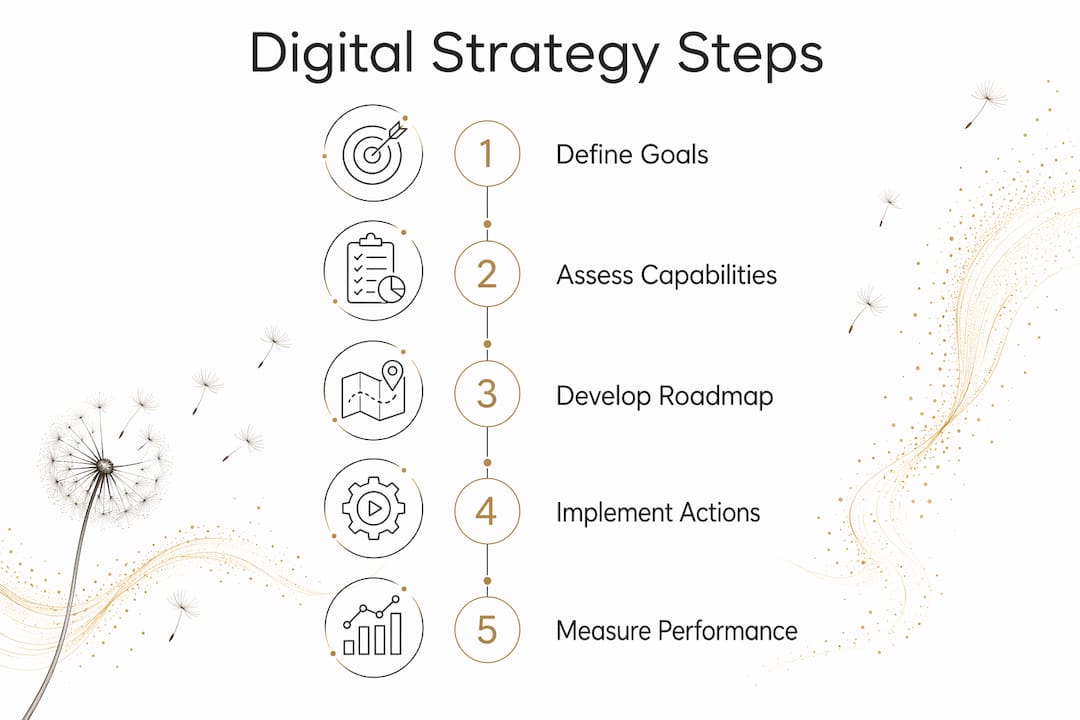
Zendesk advises starting with internal data to map your current activities, then building persona-specific action plans with clear measurement methods. That process breaks into five practical steps.
-
Research your current state. Gather data on your existing digital presence, customer behavior, and competitor positioning. Use tools like Google Analytics, Google Search Console, and any CRM data you have.
-
Set SMART goals. Define goals that are specific, measurable, achievable, relevant, and time-bound. “Grow website traffic” is not a goal. “Increase organic search traffic by 30% in six months” is.
-
Define your audience personas. Build profiles of your ideal customers based on real data. Include their preferred channels, buying triggers, and common objections.
-
Build your channel and campaign plan. Decide which digital channels (SEO, email, paid search, social media) align with your personas and goals. Assign budget and ownership to each.
-
Measure, review, and adjust. Set a reporting cadence, weekly or monthly, and review performance against your goals. Adjust tactics based on what the data shows.
This process is not linear in practice. You will revisit earlier steps as you learn more. That is expected and healthy.
Pro Tip: Assign a named owner to every initiative in your plan. Gartner’s governance research shows that responsibility scoping is one of the biggest predictors of whether a digital strategy actually gets executed.
Business owners building an online presence for the first time can find a faster path by reading how to build an online presence quickly without getting lost in complexity.
Why is a digital strategy important for business growth?
Digital channels accounted for 61.1% of total marketing spend in 2025, according to Gartner’s CMO Spend Survey of 402 marketing leaders across North America, the UK, and Europe. That figure tells you where your customers and competitors are already spending attention and money.
Without a clear plan, your digital spending becomes reactive. You chase trends, duplicate efforts, and struggle to measure what is actually working. A defined strategy fixes that by connecting every dollar to a specific goal.
The benefits of a clear digital plan include:
- Better resource allocation: You spend on channels that match your audience, not channels that are simply popular
- Improved customer experience: Consistent messaging across channels builds trust and reduces friction in the buying process
- New revenue streams: Digital channels open markets and customer segments that offline channels cannot reach
- Faster adaptation: A documented strategy makes it easier to pivot when market conditions or customer behavior shifts
“Digital strategy is about rethinking value creation and competition in a connected world, not just adopting the latest technology for its own sake.” — IMD
The consequence of skipping a strategy is not just wasted budget. It is lost ground to competitors who are operating with a plan while you are operating with instinct.
How can businesses sustain and evolve their digital strategy over time?
Gartner frames digital strategy as a dynamic system, not a one-time document. Customer behaviors shift. New platforms emerge. AI tools change what is possible in marketing and operations. A strategy that does not adapt becomes a liability.
Sustaining your digital strategy over time requires:
- Regular performance reviews: Monthly or quarterly reviews against your original goals, with documented decisions about what to change
- Ecosystem integration: Connecting your marketing technology, AI workflows, analytics tools, and creative processes so they share data and reinforce each other
- Leadership alignment: Keeping senior decision-makers informed and committed to the strategy, not just the team executing it
- Capability building: Investing in skills and tools as your strategy grows in complexity
Research on digital transformation highlights that capability challenges, including leadership alignment, culture, skills, and process redesign, are the most common reasons digital strategies stall. Technology is rarely the problem. People and processes are.
Marketing automation is one area where small businesses can build capability quickly. Automating repetitive tasks frees your team to focus on strategy and creative work instead of manual execution.
What I have learned from watching businesses build digital strategies
The most common mistake I see is treating a digital strategy like a launch event. Business owners put significant effort into creating the plan, present it to their team, and then move on. Six months later, nothing has changed, and the document is collecting dust.
The businesses that actually grow from their digital strategy treat it like a living system. They review it regularly, assign clear ownership to every initiative, and make small adjustments based on real data. They do not wait for a perfect plan before acting. They act, measure, and refine.
The second mistake is confusing activity with progress. Posting on social media every day is activity. Growing your qualified lead pipeline through social media is progress. The difference is a clear goal and a measurement system that connects the activity to the outcome.
If you are starting your digital strategy now, start smaller than you think you need to. Pick two or three channels that match your audience, build your measurement framework first, and execute consistently for 90 days before adding complexity. That approach produces more results than a sprawling plan that never gets fully executed.
— Christopher
How Moderatemurmurations helps you put your digital strategy into action
Building a digital strategy is one thing. Executing it with the right infrastructure is another.
Moderatemurmurations builds fast, clean websites, landing pages, brand copy, SEO content, and AI workflows for small businesses, creators, wellness brands, and service providers. If you have a strategy in mind but need the digital infrastructure to support it, the team at Moderatemurmurations can help you move from plan to published presence quickly. For businesses ready to build out their full digital system, the build services page covers website launches, AI workflow integration, and search-ready structure designed for growth.
Key takeaways
A digital strategy is the single most important plan a business can have for connecting digital activity to measurable growth outcomes.
| Point | Details |
|---|---|
| Definition matters | A digital strategy sets goals and competitive positioning, not just a list of tools or channels. |
| Core components | Every effective strategy includes vision, audience personas, channel plan, measurement, and a responsibility roadmap. |
| Know the distinctions | Digital strategy, digital transformation, and IT strategy are related but serve different purposes and scopes. |
| Build before you launch | Set your measurement framework before running campaigns, not after, to avoid wasted spend. |
| Treat it as a system | Review and adjust your strategy regularly. Static plans fail when markets and customer behavior shift. |
FAQ
What is the simplest definition of a digital strategy?
A digital strategy is a plan that defines how your business uses digital technologies and channels to reach specific goals. It connects every digital decision to a measurable business outcome.
How is a digital strategy different from a digital marketing strategy?
A digital marketing strategy focuses specifically on marketing channels and campaigns. A digital strategy is broader and covers all digital decisions across the business, including operations, customer experience, and technology.
How long does it take to create a digital strategy?
A focused digital strategy for a small business can be drafted in two to four weeks. The timeline depends on how much research and data gathering is needed before goal setting begins.
What is the biggest reason digital strategies fail?
Capability challenges, including unclear ownership, missing skills, and lack of leadership alignment, are the most common reasons digital strategies stall after launch.
Do small businesses need a formal digital strategy?
Yes. Even a one-page plan with clear goals, two or three channels, and a measurement method outperforms operating without direction. A formal plan reduces wasted spend and makes growth repeatable.