What Is a Business Growth Framework? A Clear Guide
What Is a Business Growth Framework? A Clear Guide

A business growth framework is defined as a systematic, structured plan that maps out the pathways, resource allocation, and operational steps a business uses to achieve measurable, sustainable growth. Unlike a vague ambition to “grow revenue,” a proper growth framework sets a defined planning horizon, typically 12–36 months, and specifies exactly how the business will expand its market presence and competitive position. The industry term for this discipline is strategic growth planning, and understanding what is a business growth framework is the first step toward building one that actually works. Without structure, growth targets replace growth strategy, and the result is reactive activity that never builds lasting capability.
What is a business growth framework made of?
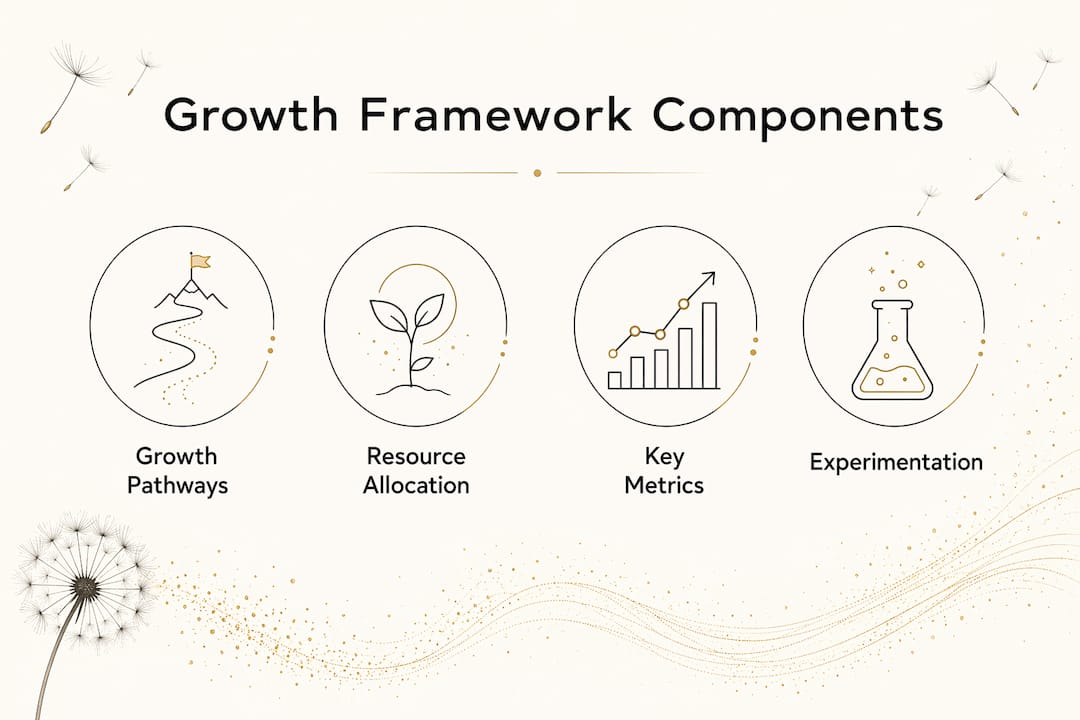
A growth framework is built from four core components: growth pathways, resource allocation, key metrics, and experimentation loops. Each component does a specific job. Together, they create a system that produces predictable results rather than lucky outcomes.

Growth pathways
The Ansoff matrix defines four growth pathways with ascending risk: market penetration, product development, market development, and diversification. Market penetration carries the lowest risk because you sell existing products to existing customers. Diversification carries the highest risk because you enter new markets with new products. Choosing the right pathway depends on your current capabilities, not just your ambition.
Resource allocation and metrics
Every growth framework requires a clear answer to where time, money, and people go. Without that answer, teams spread effort across too many initiatives and nothing gains traction. The most effective frameworks also identify a single North Star Metric to align the entire organization. That metric acts as a shared compass. It keeps teams focused on the one number that best reflects real business value.
Experimentation loops
Growth frameworks are not static documents. They include a feedback loop that runs continuously. The Growth Equation concept breaks abstract goals into measurable inputs: visitors, conversion rate, average order value, and purchase frequency. Each input becomes a lever you can test and adjust. This turns growth planning from a once-a-year exercise into a weekly discipline.
- Growth pathways: Choose from market penetration, product development, market development, or diversification based on your risk tolerance and resources.
- North Star Metric: Pick one metric that best represents the value you deliver to customers and align every team around it.
- Measurable inputs: Break your revenue goal into specific drivers you can track and test.
- Feedback loops: Build a weekly or biweekly cycle of ideate, test, and learn to keep the framework current.
- Operational steps: Define who owns each initiative, what the deadline is, and what success looks like.
Pro Tip: Write your North Star Metric on a whiteboard and leave it visible during every planning meeting. If a proposed initiative does not move that number, question whether it belongs in the current planning cycle.
How do established strategic models support effective growth frameworks?
Classic strategic models give your growth framework a proven structure to build on. They reduce the risk of reinventing the wheel and provide a shared language across your team.
The Ansoff matrix and the Three Horizons model
The Ansoff matrix is the most widely used tool for mapping growth pathways. It forces a clear conversation about risk before resources are committed. The Three Horizons model adds a time dimension that the Ansoff matrix lacks. Horizon 1 focuses on protecting and growing core revenue today. Horizon 2 develops emerging business lines that will drive revenue in the next two to three years. Horizon 3 places small bets on future ideas that may not pay off for five or more years.
The practical value of the Three Horizons model is that it prevents a common mistake: over-investing in short-term tasks at the expense of long-term competitiveness. Most businesses that plateau do so because they never allocate resources to Horizon 2 or 3. They optimize what exists instead of building what comes next.
Other models worth knowing
| Model | Primary use | Key strength |
|---|---|---|
| Ansoff matrix | Selecting growth pathways | Clarifies risk level before committing resources |
| Three Horizons | Balancing short and long-term investment | Prevents over-focus on immediate revenue |
| BCG matrix | Allocating capital across a portfolio | Identifies which products to fund, hold, or exit |
| Profit pool analysis | Finding value chain opportunities | Reveals where margin actually sits in your industry |
The BCG matrix helps businesses with multiple products decide where to invest and where to cut. Profit pool analysis goes one level deeper by showing where the real margin lives across an entire industry value chain. Both models support the capital allocation decisions that sit at the heart of any growth framework.
- Use the Ansoff matrix to agree on your growth pathway before setting budgets.
- Apply the Three Horizons model to split your planning into near-term, mid-term, and long-term buckets.
- Use the BCG matrix if you manage multiple products or business units.
- Run a profit pool analysis if you suspect your industry’s margin has shifted away from your current position.
What role do metrics and experimentation loops play in a growth framework?
Metrics and experimentation are what separate a growth framework from a strategy document that sits in a drawer. They create the feedback mechanism that keeps the framework alive and improving.
The AARRR funnel
The Pirate Metrics framework (AARRR) maps five customer journey stages: Acquisition, Activation, Retention, Referral, and Revenue. Each stage is a potential leak point. The AARRR framework does not just track performance. It identifies exactly where customers drop off so you can prioritize the fix with the highest bottom-line impact. A business losing customers at the Activation stage needs a different fix than one losing them at Retention.
The experimentation loop
The Growth Equation approach runs on a weekly cycle. Here is how it works in practice:
- Ideate. Generate ideas for improving one specific measurable input, such as conversion rate on a landing page.
- Prioritize. Score each idea using the ICE framework: Impact, Confidence, and Ease. Run the highest-scoring idea first.
- Test. Run the experiment for a defined period with a clear success metric.
- Learn. Document what worked, what did not, and why. Feed that learning into the next ideation round.
- Repeat. Run this cycle every week or every two weeks without exception.
This loop is what separates growth frameworks from growth hacks. A growth hack produces a one-time lift. A growth loop compounds over time because each cycle builds on the last. The compounding effect is the entire point.
Pro Tip: Score every experiment idea with ICE before committing resources. Impact times Confidence times Ease, each rated 1–10, gives you a number that removes gut-feel bias from your prioritization decisions.
You can learn more about tracking growth metrics to set up the measurement infrastructure your framework needs.
How do you create a growth framework for your specific business?
No single growth framework fits every business. Effectiveness depends on your target market, deal size, and go-to-market motion. Blind adoption of a framework built for a venture-backed SaaS company will fail a regional service business. The framework must fit the context.
Start with an honest assessment
Before selecting any model or metric, answer four questions about your business:
- Growth stage: Are you pre-revenue, early growth, or scaling an established model? Each stage calls for different priorities.
- Product complexity: A simple product with a short sales cycle suits high-velocity experimentation. A complex product with a long sales cycle needs a framework built around pipeline management and relationship development.
- Market position: Are you the market leader defending share, or a challenger trying to take it? The Ansoff pathway you choose should reflect this honestly.
- Organizational capacity: What can your team actually execute in the next 90 days? A framework that exceeds your capacity produces nothing.
Align the framework with your capabilities
Growth frameworks that work integrate lead management, pipeline operations, and deal closing into one system aligned with your specific business model. That integration is the hard part. Most businesses build the strategy layer but skip the operational layer. The result is a plan that looks good in a presentation but never changes daily behavior.
Leading organizations stress-test their frameworks regularly, using scenario planning and AI-powered tools to adapt as markets, budgets, and capacity shift. Build a quarterly review into your framework from day one. Treat it as a scheduled maintenance task, not an optional check-in.
Pro Tip: Build your digital growth roadmap before you finalize your framework. Knowing your digital infrastructure gaps will change which growth pathways are actually available to you right now.
Key Takeaways
A business growth framework produces predictable, compounding results only when it combines clear pathways, a single North Star Metric, and a disciplined weekly experimentation loop.
| Point | Details |
|---|---|
| Define your growth pathway first | Choose from the Ansoff matrix quadrants before allocating any budget or team resources. |
| Use one North Star Metric | A single shared metric aligns your team and prevents scattered effort across too many initiatives. |
| Run weekly experimentation cycles | The ICE-scored AARRR loop compounds growth over time; one-off tactics do not. |
| Match the framework to your context | Deal size, sales cycle, and growth stage determine which framework fits your business. |
| Stress-test quarterly | Review and realign your framework every 90 days to stay current with market and capacity changes. |
Growth frameworks are living documents, not launch plans
The most common mistake I see business owners make is treating a growth framework like a product launch. They build it once, present it to the team, and move on. Six months later, the market has shifted, two initiatives have stalled, and nobody has updated the plan. The framework becomes a historical artifact instead of a working tool.
The second mistake is confusing a growth target with a growth strategy. Writing “grow revenue by 20% this year” is not a strategy. It is a number. The strategy is the specific combination of pathways, metrics, and experiments that will produce that number. Skipping the strategy and jumping to the target is what leads to reactive, opportunistic activity that never builds real capability.
What I have found works is treating the North Star Metric as a non-negotiable anchor. Every quarter, the question is not “did we hit our revenue number?” The question is “did we move our North Star Metric, and do we understand why or why not?” That discipline keeps the framework honest. It also makes the quarterly stress-test feel natural rather than threatening, because the team is already in the habit of measuring what matters.
The businesses that grow consistently are not the ones with the most creative strategies. They are the ones that run their experimentation loops without skipping weeks, document what they learn, and adjust their frameworks based on evidence rather than opinion.
— Christopher
How Moderatemurmurations supports your growth framework
Building a growth framework is one thing. Having the digital infrastructure to execute it is another. Moderatemurmurations builds fast, clean websites, landing pages, and digital systems that give your framework the foundation it needs to produce results.
Whether you are setting up your first analytics layer, launching a new service line, or building out the digital presence that supports your market expansion pathway, Moderatemurmurations has the tools and experience to move quickly. Visit Moderatemurmurations to see how we help small businesses and service providers turn growth plans into live, working digital systems. If you are ready to build, the Moderatemurmurations build page outlines exactly what we offer and how we work.
FAQ
What is a business growth framework in simple terms?
A business growth framework is a structured plan that defines how a business will expand revenue, market share, or competitive position over a set period, typically 12–36 months. It includes specific pathways, metrics, and operational steps rather than vague goals.
How is a growth framework different from a growth strategy?
A growth strategy is the plan; a growth framework is the system that executes it. The framework includes the metrics, experimentation loops, and resource allocation decisions that turn a strategy into daily action.
What is the North Star Metric in a growth framework?
The North Star Metric is the single number that best represents the value a business delivers to its customers. Growth teams align every initiative around moving that one metric rather than tracking dozens of disconnected KPIs.
What are the main growth framework examples used by businesses?
The most widely used frameworks include the Ansoff matrix for selecting growth pathways, the Three Horizons model for balancing short and long-term investment, and the AARRR (Pirate Metrics) funnel for diagnosing customer journey performance.
How often should a business update its growth framework?
Leading organizations review and realign their growth frameworks at least quarterly, using scenario planning to adapt to market shifts, budget changes, and capacity constraints over the 12–36 month planning horizon.