$1,500–$25,000: Small Business Web Design Cost Estimates for 2026
$1,500–$25,000: Small Business Web Design Cost Estimates for 2026

A DIY website with a builder like Squarespace or Wix will cost under a few hundred dollars a year, while a professionally built small-business site typically starts in the low thousands and can climb significantly for custom development. Budget an extra portion of your build cost annually for hosting, plugins, and maintenance. Your next move: write a one-page brief and request three comparable quotes before you commit to anyone.
TL;DR:
- DIY website builders typically cost under a few hundred dollars annually, but professional sites start in the low thousands with costs increasing for custom features.
- Design accounts for 30 to 45 percent of total costs, ranging from $500 for templates to over $8,000 for fully custom work, and development can match or exceed those figures.
- Ongoing expenses such as hosting renewals, plugin licenses, security, and content updates generally total 10 to 15 percent of initial build costs yearly.
- Comparing quotes requires detailed scope descriptions including pages, user flows, integrations, and performance expectations; vague briefs lead to mismatched bids.
- Phased approaches prioritizing core pages and conversion paths enable faster launches, with prices starting at $1,500 for quick deployment and tailored plans for larger projects.
Table of Contents
- What Does Web Design Cost, Line by Line?
- DIY, Freelancer, or Agency: Who Should Build Your Site?
- How Much Should You Budget by Project Type?
- What Ongoing Costs Should You Plan For?
- How Do You Get Quotes You Can Actually Compare?
- What We Do Differently at Moderate Murmurations
- The Budgeting Mistake I See Most Often
- Get a Website Built Around Your Budget, Not a Generic Package
- Where These Numbers Come From
- Sources
- FAQ
What Does Web Design Cost, Line by Line?
Every website quote is really a bundle of separate costs, and vendors package them differently. Knowing what belongs in each bucket lets you compare quotes side by side instead of guessing why one bid is triple another.
Domain and registration. A domain name typically costs a small yearly fee through registrars like Namecheap or GoDaddy. Renewal pricing sometimes increases after the first year, so ask upfront rather than getting surprised at renewal time.
Hosting. Shared hosting typically starts at a low monthly rate. Managed WordPress hosting through providers like WP Engine or Kinsta costs more depending on traffic and support level. Platform-based hosting (Shopify, Squarespace, Wix) bundles hosting into a monthly plan with prices varying accordingly.
CMS, themes, and plugins. WordPress itself is free, but a quality premium theme costs $30 to $100 one time, and specialty plugins (booking systems, advanced SEO tools, membership gates) can add $50 to $300 a year combined. Site-builder platforms charge differently, folding most of this into the monthly subscription.
Design. This is the phase where a designer maps your brand, layout, and user flow before anyone writes code. Industry data shows design commonly represents 30 to 45% of a project’s total cost, which is a bigger share than most first-time buyers expect. A template-based design might run $500 to $2,000. Semi-custom design lands between $2,000 and $8,000. Fully custom design work starts around $8,000 and climbs from there.
Development. This is where the design becomes a working site: coding, CMS integration, forms, and testing across devices. Development costs vary by complexity and often match or exceed design costs on complex projects.
Content and imagery. Professional copywriting for a five- to seven-page site typically costs $500 to $2,500, depending on how much research and messaging strategy is involved. Stock photography is cheap ($10 to $80 per image), but original photography or video runs into the thousands.
Accessibility and SEO setup. Building to WCAG accessibility standards from the start, rather than retrofitting later, typically adds a modest percentage to development time. SEO setup, meaning proper page structure, metadata, and technical foundations, is often quoted separately from content writing. A service provider’s SEO foundations work best when built into the site from day one rather than bolted on after launch.
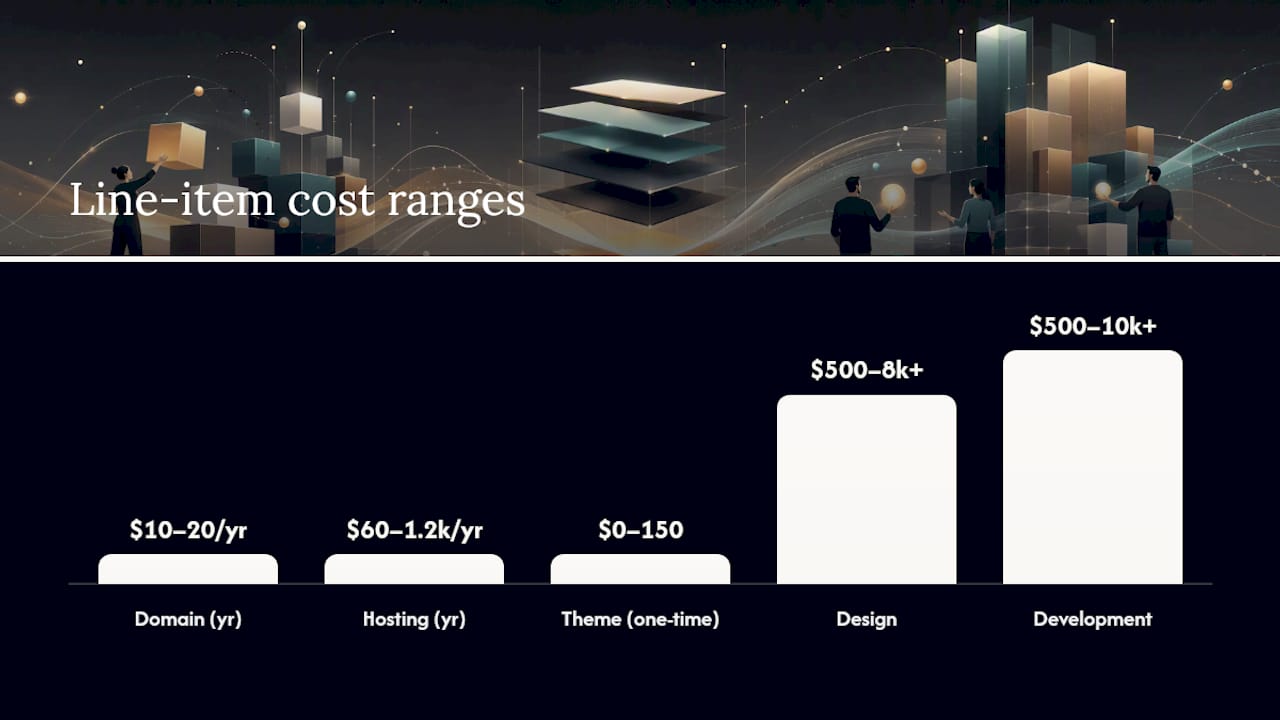
Here’s what a basic line-item list looks like for a small-business site:
- Domain: $10 to $20 per year
- Hosting: $60 to $1,200 per year, depending on type
- Theme or template: $0 to $150 one time
- Design: $500 to $8,000+ depending on customization
- Development: $500 to $10,000+ depending on complexity
- Content and copywriting: $500 to $2,500
- SEO setup: often $300 to $1,500 as a discrete line item
Pro Tip: Ask every vendor to itemize design and development separately, even if they quote a single bundled number. It’s the fastest way to spot who is overcharging for template work dressed up as custom design.
A recent industry dataset covering more than 600 project quotes puts total website costs anywhere from about $300 to $50,000 or more, with the widespread driven almost entirely by which delivery method you choose and how much customization you need.
DIY, Freelancer, or Agency: Who Should Build Your Site?
The same website brief can generate wildly different quotes depending on who builds it. Here’s how the four common delivery methods actually stack up.
DIY and site-builders. Platforms like Squarespace, Wix, and Shopify let you build and launch without writing code. Elementor’s own pricing research shows first-year DIY costs commonly landing between $60 and $300, covering a subscription plan, a domain, and maybe a premium theme. You do the design work yourself, which means the output only looks as polished as your own design instincts allow. This suits a solo service provider testing an idea or someone who genuinely enjoys tinkering with layout.
AI-assisted builders and services. A newer category sits between pure DIY and hiring a professional: AI-assisted tools and services that generate layout, copy drafts, and structure from a short brief, then let a human refine the result. Costs vary but often land closer to DIY pricing than to freelancer pricing, especially for AI landing pages built for a single campaign or offer. The trade-off is that you still need someone to check the output for brand accuracy and technical soundness.
Freelancers. Independent designers and developers typically quote project-based pricing rather than pure hourly rates, though hourly billing still shows up for smaller tweaks. A small-business site from a freelancer commonly starts in the low thousands and includes design, basic development, and sometimes a short training session on updating content yourself. Freelancer quality varies more than agency quality, so portfolio review matters more here than anywhere else.
Agencies. Agencies bring project management, multiple specialists (designer, developer, copywriter, SEO lead), and more structured processes. That structure costs money. Agency quotes typically run 2.4 to 2.7 times higher than freelancer quotes for the same scope of work. What you get for that premium is redundancy. If one person leaves the agency mid-project, someone else picks up the file. For a solo freelancer, that same disruption can stall your launch by weeks.
Regional pricing plays a real role too. US-based freelancers and agencies generally charge more than offshore teams doing comparable work, mostly reflecting labor costs and time-zone-aligned communication. That premium often buys faster response times and fewer misunderstandings over project scope, which matters more than it sounds like on a tight launch timeline.
- DIY/site-builder: $60 to $500 in year one
- AI-assisted builder or service: often $300 to $2,000 for a focused project
- Freelancer: $1,500 to $8,000 for a small-business site
- Agency: $5,000 to $25,000+ for the same scope, sometimes more
Match the model to your stage. A pre-revenue solopreneur validating an offer rarely needs agency-level infrastructure. A growing practice with multiple service lines and a real marketing budget usually outgrows DIY tools fast, because the time cost of managing your own site starts exceeding what a freelancer would charge.
How Much Should You Budget by Project Type?
Cost bands shift dramatically depending on what you’re actually building. A single landing page and a multi-vendor e-commerce store aren’t the same project wearing different clothes. Here’s roughly what each tier looks like in 2026.
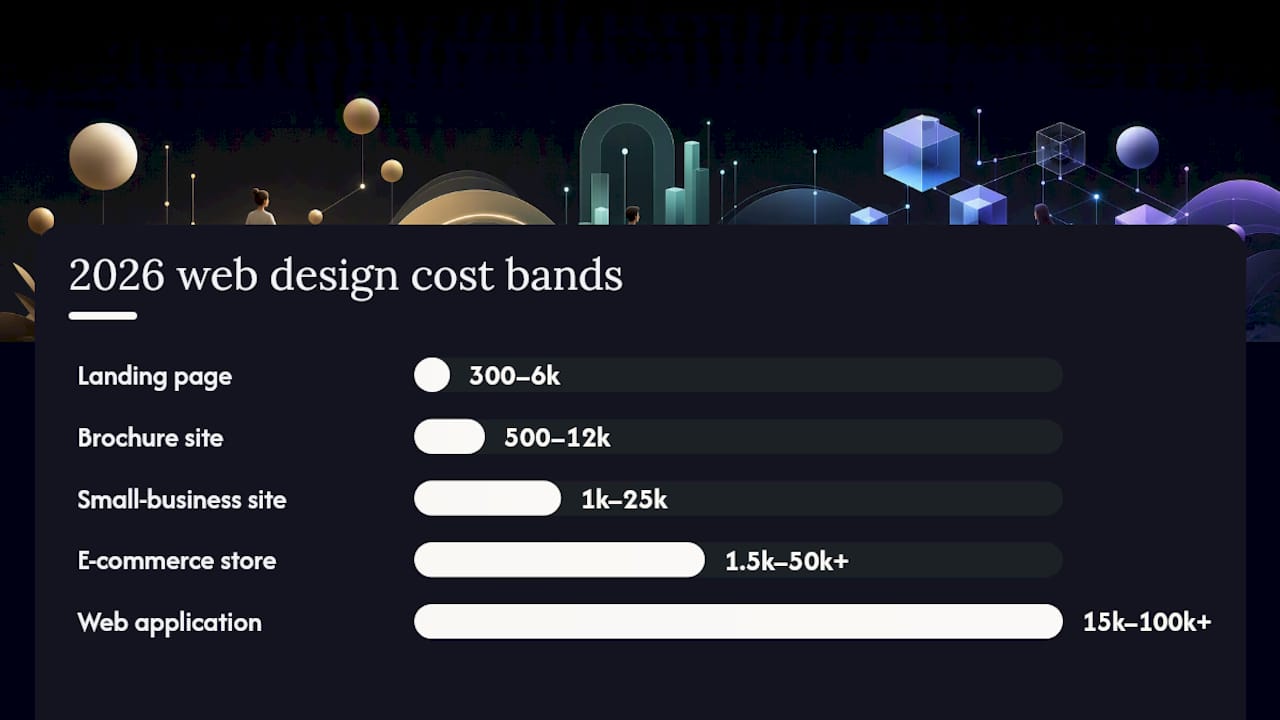
Landing page. Entry-level: $300 to $800, usually a single-page site built on a template with light copy editing. Mid-tier: $800 to $2,500, custom design with conversion-focused copywriting and basic analytics setup. Premium: $2,500 to $6,000, fully custom design, A/B testing infrastructure, and integration with email or CRM tools.
Brochure site (3 to 6 pages). Entry-level: $500 to $1,500 on a template platform. Mid-tier: $1,500 to $5,000 with semi-custom design and professional copy. Premium: $5,000 to $12,000 with fully custom design and a content strategy behind it.
Small business site (5 to 10 pages, possibly with booking or basic e-commerce). Entry-level: $1,000 to $3,000. Mid-tier: $3,000 to $10,000. Premium: $10,000 to $25,000, often including custom functionality like membership areas or advanced booking logic.
E-commerce store. Entry-level: $1,500 to $5,000 using Shopify or WooCommerce templates with a handful of products. Mid-tier: $5,000 to $20,000 for custom storefront design, product photography, and integrated payment and shipping logic. Premium: $20,000 to $50,000+ for custom-built platforms handling complex inventory, multiple currencies, or B2B pricing tiers.
Web application. These start around $15,000 for a simple tool and can exceed $100,000 for a full custom platform with user accounts, dashboards, and third-party integrations. This tier sits well outside typical small-business budgets and usually involves a dedicated development team rather than a single designer.
Platform choice changes your running costs as much as your build cost. A Shopify store carries transaction fees and a mandatory monthly subscription. A custom-coded platform avoids those fees but shifts more maintenance responsibility onto you or your developer. WordPress sits in between: relatively low platform cost, but plugin sprawl can quietly inflate your annual budget if nobody’s tracking licenses.
Forbes Advisor’s cost breakdown corroborates these bands, citing DIY builds from $0 to $450 and professional design starting around $1,500, alongside hosting and app costs of $15 to $150 a month, numbers that track closely with what small-business owners report paying across most of these project types.
What Ongoing Costs Should You Plan For?
The build cost is only the first bill. Most website budgets fail not because the initial quote was wrong, but because nobody accounted for what comes after launch.
Hosting renewals. Whatever you paid in year one, expect it again annually, and sometimes hosting providers raise renewal rates above the promotional first-year price. Managed hosting with a CDN for speed typically adds $10 to $40 a month over basic shared hosting.
Plugin and theme licenses. Premium plugins and themes usually renew annually, often $50 to $200 a year combined for a small business running five or six paid extensions. Security monitoring and automated backups, if not bundled into your hosting plan, add another $5 to $30 a month.
Content and tools. Ongoing content updates, whether you write them or pay someone, are an easy line item to forget. Analytics tools are often free at a basic tier, but CRM and email marketing platforms commonly run $20 to $100 a month once your list grows past a few hundred contacts. E-commerce stores also pay payment processor fees, typically 2.9% plus $0.30 per transaction through processors like Stripe.
- Hosting renewal: $60 to $1,200/year
- Plugin/theme licenses: $50 to $200/year
- Security and backups: $60 to $360/year
- Content updates: varies widely by volume
- CRM/email tools: $240 to $1,200/year
Forbes Advisor’s guidance on website costs specifically flags that initial setup prices rarely capture these long-term expenses, and recommends budgeting for them from the start rather than treating them as surprises.
A workable heuristic: budget 10 to 15% of your total build cost annually for maintenance and renewals. A $5,000 build should carry roughly $500 to $750 a year in ongoing costs. Anyone quoting you a build with no mention of what happens after launch hasn’t given you the full picture. A website maintenance plan that spells out exactly what’s covered removes most of that guesswork.
How Do You Get Quotes You Can Actually Compare?
Getting three quotes only helps if the quotes are answering the same question. Here’s how to write a brief that forces apples-to-apples comparisons.
- List every page and user journey. Specify not just “5 pages” but what happens on each: a booking form, a contact flow, a product filter. Vague briefs produce vague, mismatched quotes.
- Name your integrations. Email marketing tool, CRM, payment processor, booking software. Each integration adds development time that a generic quote won’t reflect.
- Define your CMS access level. Do you want to edit text yourself, or manage the whole site independently? This changes how much training or documentation should be built into the price.
- State performance expectations. Mobile load speed, accessibility compliance level, and browser support all affect scope. Clutch’s pricing guidance notes that hourly rates alone rarely reflect true project cost, since scope and integration complexity drive the final number far more than the rate card does.
- Ask about payment structure. Standard models include a deposit (often 30 to 50%) with milestone payments, a single fixed price, or a retainer for ongoing work. Ask what triggers each payment and what happens if a milestone slips.
- Ask what’s excluded. Photography, copywriting, and post-launch support are the three most commonly excluded items that show up as change orders later.
Pro Tip: Request an itemized contract that spells out design rounds, revision limits, and change-order pricing before you sign. That single document prevents more budget overruns than any negotiation tactic.
Once you have comparable quotes, negotiation gets easier. Phase the project to defer nonessential features, remove anything that doesn’t touch your core conversion path, or ask about bundling maintenance into a lower monthly retainer instead of a large upfront fee.
What We Do Differently at Moderate Murmurations
We phase most projects deliberately: core pages and conversion paths first, complex integrations and e-commerce features second. This keeps upfront cost lower and gets a working site in front of real customers faster, which validates demand before you spend more on features nobody’s asked for yet.
Our priority checklist mirrors that order: clear messaging first, then the handful of pages that actually drive inquiries, then the conversion paths (contact forms, booking, calls-to-action) that turn visitors into clients. Everything else waits for phase two. This approach shows up in how we discuss design’s role in conversions with clients from the first conversation.
The Budgeting Mistake I See Most Often
The biggest mismatch I see is scope creep dressed up as clarification. A client asks for “a few small changes,” and three rounds later the freelancer’s fixed quote has quietly become a much bigger project. The fix isn’t distrust, it’s structure: phase the build, lock a page count before design starts, and treat anything added mid-project as a separate line item with its own price. Clients who do this rarely feel blindsided by a final bill.
— Christopher
Get a Website Built Around Your Budget, Not a Generic Package
Some web design services build sites in days, not weeks, which matters when every week of delay is a week of lost inquiries for your business. If you’ve read through these price bands and landed somewhere in the freelancer or agency range, our phased approach gets your core pages and conversion paths live fast, then adds complexity only once you’ve validated it’s worth the spend.
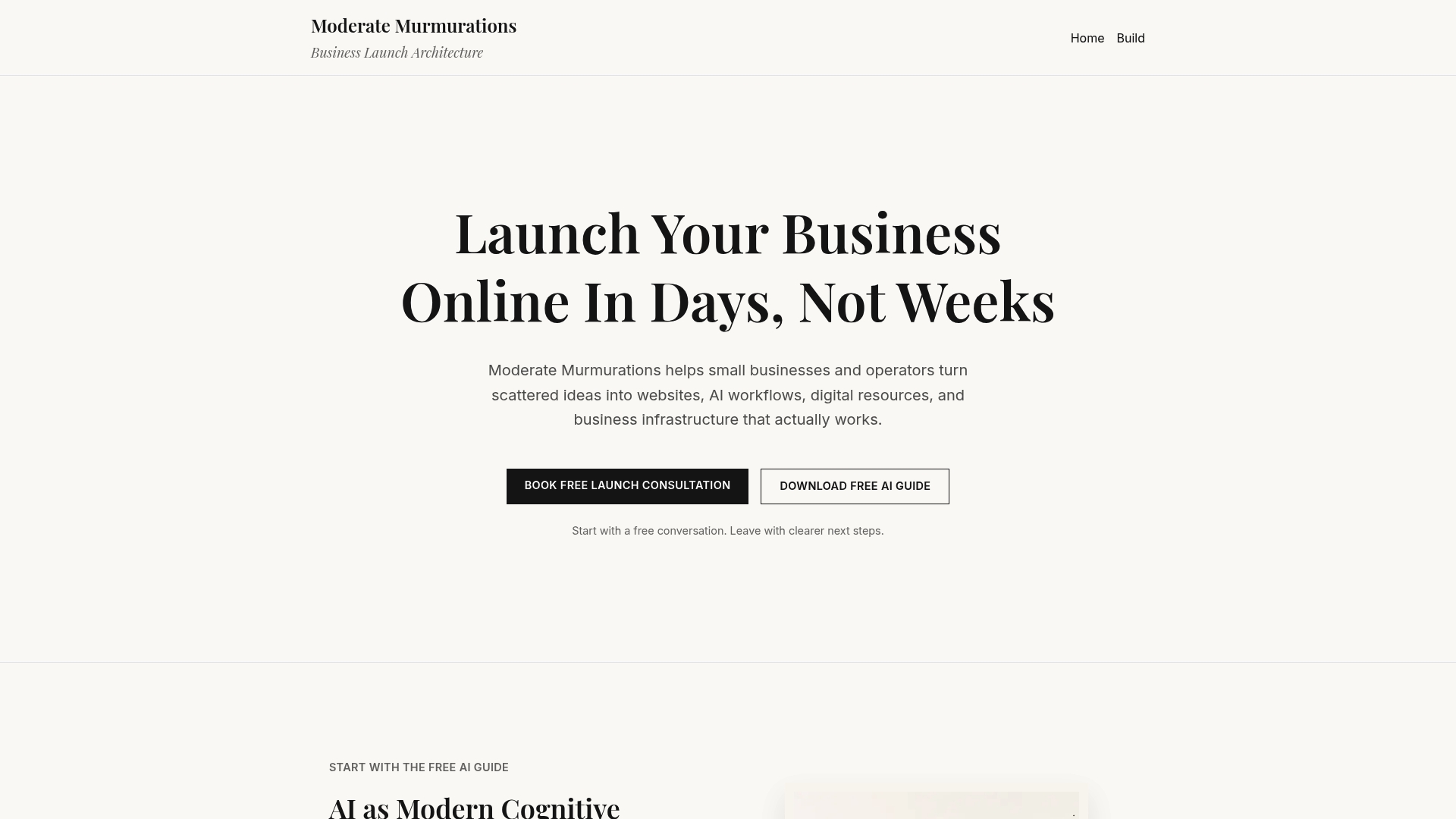
For a fast, focused launch, the Launch Sprint starts at $1,500 one time and covers the essentials most small businesses need first. If your project needs more infrastructure, from messaging to systems to a full launch plan, Business Launch Architecture starts at $2,500 one time. Not sure which scope fits? A Foundational Review, starting at $250 one time, audits what you already have and tells you exactly what’s missing before you spend more. Book a free consultation through our build page and walk away with a clear scope, not just another estimate.
Where These Numbers Come From
The price bands throughout this article draw on a 2026 dataset built from more than 600 project quotes, which anchors the DIY-through-agency ranges and the design-versus-development split. Forbes Advisor corroborates the DIY and professional-build ranges from a mainstream personal-finance lens. Elementor’s pricing guide supplied the DIY first-year figures, and Clutch’s pricing guidance informed the section on interpreting hourly rates versus fixed bids. Stanford’s research on web credibility backs the case for budgeting toward design and trust signals rather than treating them as optional.
Sources
- Website Design Pricing Real 2026 Rates, $500–$25K
- How Much Does A Website Cost? (Forbes Advisor)
- How much does it cost to build a website? (Elementor)
FAQ
How Much Does It Cost for a Web Designer?
Freelance web designers typically charge $1,500 to $8,000 for a small-business site, while agencies commonly quote 2.4 to 2.7 times that amount for the same scope. Rates depend heavily on region, experience, and whether design and development are billed separately.
How Much Should a Full Website Design Cost?
A full website design, meaning the visual and layout phase before development, typically runs 30 to 45% of your total project budget, according to industry pricing data. For a $5,000 project, that puts design alone in the $1,500 range.
Is Web Design Cost Still Worth It in 2026?
Yes, for most small businesses a professionally designed site remains worth the cost, since design and trust signals directly affect how visitors judge your credibility within seconds, a finding backed by Stanford’s research on web credibility. Whether it’s worth a full agency budget versus a phased freelancer or Moderate Murmurations build depends on your stage and how quickly you need to launch.
Is $1,000 a Good Price for a Website?
$1,000 covers a solid DIY or template-based site, or a very small entry-level freelancer project, but it sits below the typical low-thousands starting point for a fully custom small-business build. It’s a reasonable budget for a single landing page or a simple brochure site, not for a multi-page site with custom functionality.
What Does Moderate Murmurations Charge for a Website?
Moderate Murmurations’ Launch Sprint starts at $1,500 one time, and Business Launch Architecture starts at $2,500 one time, both listed on the build page. A Foundational Review, useful for scoping an existing site before committing to a bigger project, starts at $250 one time.