Types of Small Business Websites: A Practical Guide
Types of Small Business Websites: A Practical Guide

Types of small business websites are distinct models built around a single business goal, whether that goal is establishing credibility, generating leads, attracting local foot traffic, or selling products online. Choosing the right model before you build saves time, money, and a lot of rework. Most small business sites fall into four clear categories: credibility sites, lead generation sites, local discovery sites, and e-commerce sites. Each one serves a different customer interaction pattern. A focused five to seven page site is the standard for most service businesses, but the pages you include depend entirely on which type fits your business model.
1. What are the main types of small business websites?
The four primary website models for small businesses are credibility sites, lead generation sites, local discovery sites, and e-commerce sites. Each model shapes every design decision, from page structure to calls to action. Picking the wrong type means your site works against your business instead of for it. An effective small business website targets one primary goal, such as contact, booking, or purchase, and builds every page around that goal.
Understanding these categories also helps you budget accurately. A credibility site costs far less to build and maintain than a full e-commerce platform. Knowing which type you need before you hire anyone or pick a platform prevents expensive pivots later.

2. Credibility websites: build trust before the first call
A credibility website is the most common site type for service-based small businesses. Coaches, consultants, photographers, therapists, and tradespeople rely on these sites because their customers find them through referrals or search, visit the site to verify legitimacy, and then decide whether to reach out. The site’s job is not to close a sale. Its job is to remove doubt.
A well-built credibility site typically includes these pages:
- Home: Clear headline, one sentence on what you do, and a direct call to action
- About: Your background, credentials, and the story behind your work
- Services: A plain description of what you offer and who it is for
- Testimonials: Real client quotes or case study summaries
- Contact: A simple form, phone number, and response time expectation
The design should feel clean and professional without being flashy. Visitors spend seconds deciding whether to stay. A cluttered layout or vague headline sends them back to the search results.
Pro Tip: Add one specific result to your homepage headline. “I help HR consultants fill roles in under 30 days” outperforms “Welcome to my website” every single time.
If you are building a service site, the consultant website conversion guide from Moderatemurmurations covers exactly how to structure pages for maximum trust and contact rate.
3. Lead generation websites: convert visitors into prospects
A lead generation website is built for businesses with longer sales cycles. Financial advisors, marketing agencies, real estate agents, and B2B consultants use this model because their customers rarely buy on the first visit. The site focuses on converting visitors into leads rather than closing immediate sales.
Core features of a lead generation site include:
- Landing pages: Dedicated pages for each service or offer, each with one clear call to action
- Contact forms: Short forms that ask only for name, email, and one qualifying question
- Email list capture: A free resource, checklist, or guide offered in exchange for an email address
- Informational content: Blog posts or case studies that answer buyer questions and build authority
- Strong calls to action: Repeated throughout the page, not buried at the bottom
The content strategy matters as much as the design. Visitors who land on a lead generation site are often in research mode. They want answers before they want a sales conversation. Giving them useful content first builds the trust that eventually converts to a booked call or a proposal request.
Pro Tip: Place your primary call to action above the fold on every page. Visitors should never have to scroll to find out how to contact you.
For a deeper look at how websites drive client acquisition, the Moderatemurmurations article on website client acquisition breaks down the specific features that move visitors from curious to committed.
4. Local discovery websites: get found and get visited
A local discovery website serves businesses that depend on physical visits or local service areas. Cafés, salons, gyms, retail shops, and local service providers all need this type. Users search for these businesses either by name or by proximity, so the site must answer one question fast: “Are you near me and are you open?”
Key features for a local discovery site:
- Google Maps embed: Show your exact location without making visitors leave the page
- Hours of operation: Displayed prominently, updated for holidays and seasonal changes
- Click-to-call button: Mobile visitors should be able to call you in one tap
- Menu, service list, or offerings: Give visitors enough detail to decide before they arrive
- Online booking or reservation link: Reduce friction between interest and visit
- Photo gallery: Show the space, the products, or the team to set expectations
Local SEO is the backbone of this site type. Pages built around location-specific keywords, combined with a verified Google Business Profile, push your site into the local search results that drive foot traffic. One-page AI-generated sites that sync with Google Business Profiles update automatically and improve local SEO without manual effort. That kind of low-maintenance setup works well for owners who do not have time to manage a site regularly.
5. E-commerce websites: sell products around the clock
An e-commerce website is the right choice for any small business that sells physical or digital products. Retailers, artisans, food producers, and product-based startups all use this model. E-commerce sites include product catalogs, shopping carts, and payment systems that guide customers from browsing to checkout without friction.
The customer journey on an e-commerce site follows a predictable path: product discovery, product detail review, cart addition, checkout, and confirmation. Every page in that path needs to work correctly or you lose the sale. Usability and security are non-negotiable. Customers will abandon a checkout that feels slow, confusing, or untrustworthy.
Essential pages and features for an e-commerce site:
- Product catalog: Organized by category with clear filters and search
- Product detail pages: High-quality photos, clear descriptions, size or variant options, and price
- Shopping cart: Easy to edit, with a visible item count in the navigation
- Checkout: Minimal steps, guest checkout option, and multiple payment methods
- Order confirmation and email receipt: Automatic and immediate after purchase
- Returns and shipping policy: Clearly linked from the footer and the checkout page
Security matters more on e-commerce sites than on any other type. SSL certificates, trusted payment processors, and clear privacy policies are baseline requirements. Customers check for these signals before they enter a card number.
6. Comparing website types: which one fits your business?
Matching your business model to the right site type is the single most important decision you make before building. The table below maps each type to its best-fit business, core purpose, and primary design priority.
| Website type | Best for | Core purpose | Design priority |
|---|---|---|---|
| Credibility site | Coaches, consultants, tradespeople | Build trust and prompt contact | Clean layout, strong bio, testimonials |
| Lead generation site | Agencies, advisors, B2B firms | Capture contact details and nurture | Landing pages, forms, content |
| Local discovery site | Cafés, salons, gyms, retail | Drive visits and bookings | Location info, hours, booking link |
| E-commerce site | Retailers, artisans, product sellers | Sell products online | Product pages, cart, secure checkout |
Budget and timeline also differ significantly across these types. A credibility site can go live in days with the right support. An e-commerce site with a large product catalog takes weeks to build and test properly. Hybrid sites, which combine elements from two types, are possible but add complexity. A local café might combine a local discovery site with a small online shop for merchandise. That works, but only if both functions are built intentionally rather than bolted together as an afterthought.
Pro Tip: Start with the simplest site type that meets your current business goal. You can always add features later. A focused site that launches this month beats a complex site that launches next year.
AI website builders can reduce launch times significantly. Tools that rapidly produce tailored multi-page websites based on your business profile cut customization effort and get you online faster. For a full pre-launch checklist, the Moderatemurmurations website launch checklist covers every page and feature you need before you go live.
Key takeaways
The right type of small business website is determined by your business model and the single action you want visitors to take, whether that is calling you, booking an appointment, or buying a product.
| Point | Details |
|---|---|
| Four core website types | Credibility, lead generation, local discovery, and e-commerce each serve a distinct business goal. |
| One goal per site | Targeting one primary action improves clarity and increases the chance visitors follow through. |
| Site structure follows type | Page count and layout should match the site type, not personal preference or competitor imitation. |
| Budget scales with complexity | Credibility sites cost least; e-commerce sites require the most time and investment to build correctly. |
| Launch simple, then grow | A focused site live today outperforms a feature-heavy site still in planning six months from now. |
Why I think most small businesses pick the wrong site type first
The most common mistake I see is building an e-commerce site when a credibility site would have done the job. Owners assume more features signal more professionalism. They do not. A therapist with a five-page site that clearly explains their approach and makes booking easy will out-convert a therapist with a twelve-page site full of blog posts, a podcast feed, and a merch store.
The second mistake is copying a competitor’s site structure without understanding why that competitor built it that way. A large agency might have a resource library and a webinar archive because they have a team to maintain it. A solo consultant copying that structure ends up with a site full of outdated content that undermines trust instead of building it.
Clarity in purpose is what makes a site work. I have seen one-page sites outperform elaborate multi-section builds because the one-page site answered the visitor’s question immediately and made the next step obvious. The role of your website in client acquisition comes down to one thing: does the visitor know what to do next? If the answer is yes, the site is working. If the answer is no, the type is probably wrong or the structure is fighting the goal.
Pick the type that matches where your business is right now, not where you hope it will be in three years. You can rebuild. Starting with the right foundation makes every future change easier and cheaper.
— Christopher
How Moderatemurmurations helps you launch the right site fast
Choosing the right website type is only half the work. Building it cleanly, quickly, and with the right structure is where most small business owners get stuck.
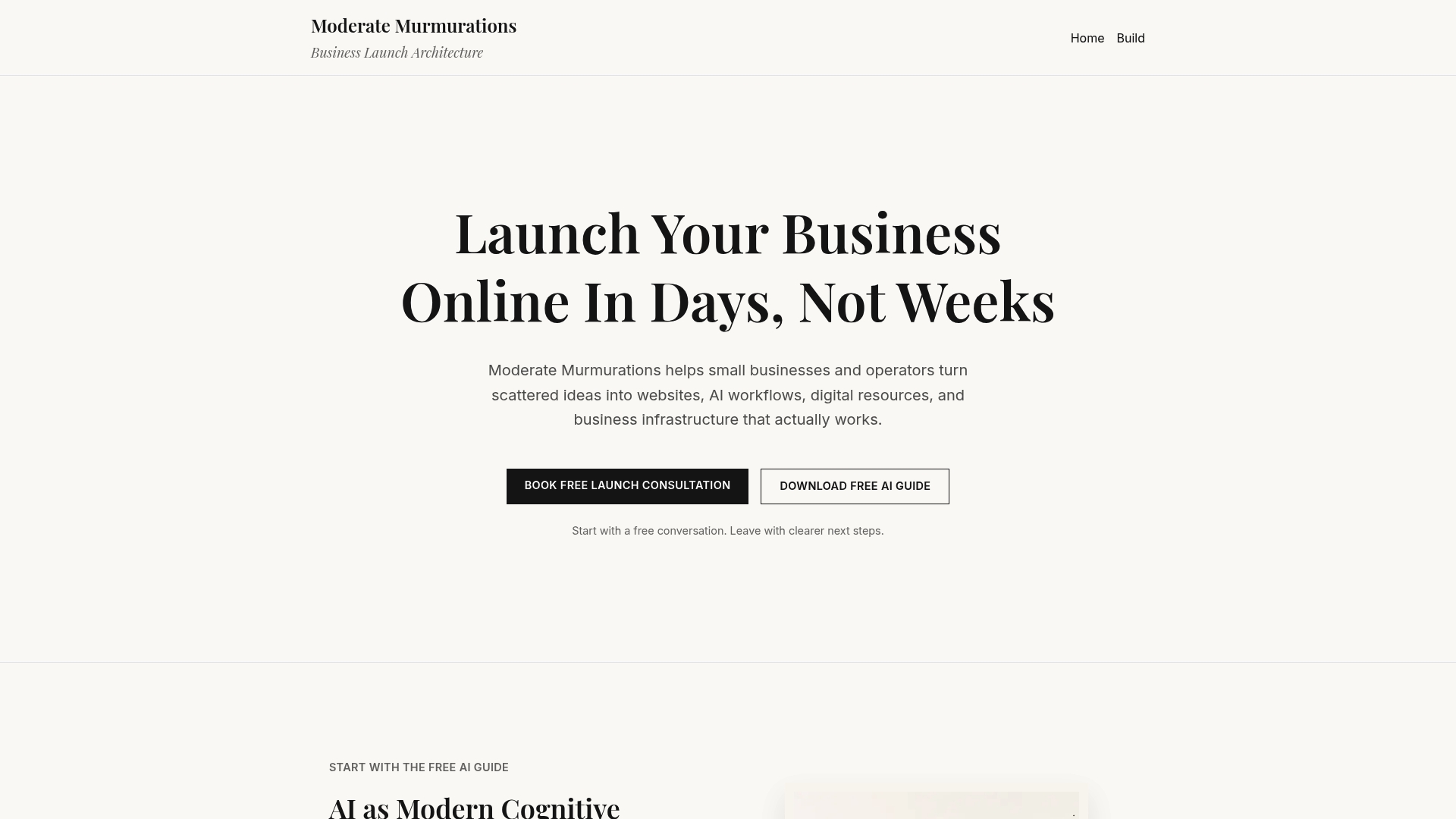
Moderatemurmurations builds fast, clean websites for small businesses, service providers, wellness brands, and creators. We match your site type to your business goal, write the copy, set up the SEO foundations, and get you live without the back-and-forth that slows most projects down. Whether you need a credibility site, a lead generation setup, or a local discovery page, we handle the structure and the messaging so you can focus on running your business. Visit Moderatemurmurations to see how quickly you can go from idea to live site, or check out our build services for a full look at what we offer.
FAQ
What are the main types of small business websites?
The four main types are credibility sites, lead generation sites, local discovery sites, and e-commerce sites. Each type is built around a different primary goal and customer interaction pattern.
How many pages does a small business website need?
Most small business websites need five to seven core pages, including Home, About, Services or Products, Testimonials, and Contact. The exact pages depend on the site type and business goal.
What type of website is best for a service-based business?
A credibility site is the best fit for most service-based businesses, including coaches, consultants, photographers, and tradespeople. It builds trust and prompts visitors to make contact.
Can a small business website serve more than one purpose?
Yes, but hybrid sites add complexity and should be built intentionally. Start with the type that matches your primary goal, then add features only when your business clearly needs them.
How fast can a small business website go live?
A credibility or local discovery site can go live in days with the right support and clear content. E-commerce sites with large product catalogs typically take several weeks to build and test properly.