The Role of Email Marketing Online for Business Growth
The Role of Email Marketing Online for Business Growth

Email marketing is the practice of sending targeted, permission-based emails to a subscriber list to build relationships, promote products, and drive measurable online sales. Unlike social media or paid ads, email is an owned channel where you control the list and the relationship. Algorithm changes on platforms like Instagram or Google do not affect your ability to reach subscribers. For marketing professionals and small business owners, understanding the role of email marketing online means recognizing it as one of the most reliable, cost-effective tools in your digital toolkit. Platforms like Klaviyo, Mailchimp, and Litmus have built entire ecosystems around this channel because the returns justify the investment.
What role does email marketing play in customer engagement and online sales?
Email marketing serves as the direct line between your business and your customers. It delivers the right message at the right moment, whether that is a welcome email, a product promotion, or an order confirmation. That precision is what separates email from broadcast channels like display advertising.
The channel performs several distinct functions at once:
- Relationship building: Regular newsletters and updates keep your brand present in the subscriber’s mind between purchases.
- Direct sales: Promotional campaigns and limited-time offers create urgency and drive immediate revenue.
- Retention: Post-purchase sequences and loyalty emails reduce churn and increase lifetime customer value.
- Education: Onboarding flows and product guides help customers get more value from what they have already bought.
- Transactional communication: Order confirmations, shipping updates, and receipts build trust and reduce support requests.
Segmentation and personalization improve campaign performance, with over 90% of marketing professionals reporting clear benefits in 2025 and 2026. That figure reflects a simple truth: customers respond better when the message matches their situation. A first-time buyer needs different content than a repeat customer who has not purchased in six months.
Pro Tip: Separate your list into at least three segments before your next campaign: new subscribers, active buyers, and lapsed customers. Each group needs a different message, and sending the same email to all three is the fastest way to increase unsubscribes.

Triggered behavioral emails, such as abandoned cart reminders and win-back sequences, are where email marketing for businesses earns its most concentrated revenue. These messages respond to what a customer actually does, not just who they are. That behavioral targeting is what makes email indispensable for ecommerce and service businesses alike.
How does email compare to social media, paid ads, and SMS?
Email marketing outperforms most digital channels on return on investment. Email averages $36 for every $1 spent, while paid search typically returns around $2 per dollar invested. That gap is not a rounding error. It reflects the structural advantage of owning your audience rather than renting access to someone else’s platform.
| Channel | Avg. ROI per $1 spent | Audience ownership | Algorithm dependency |
|---|---|---|---|
| Email marketing | ~$36 | Full ownership | None |
| Paid search | ~$2 | None | High |
| Social media ads | Variable | None | Very high |
| SMS marketing | High, lower volume | Full ownership | None |
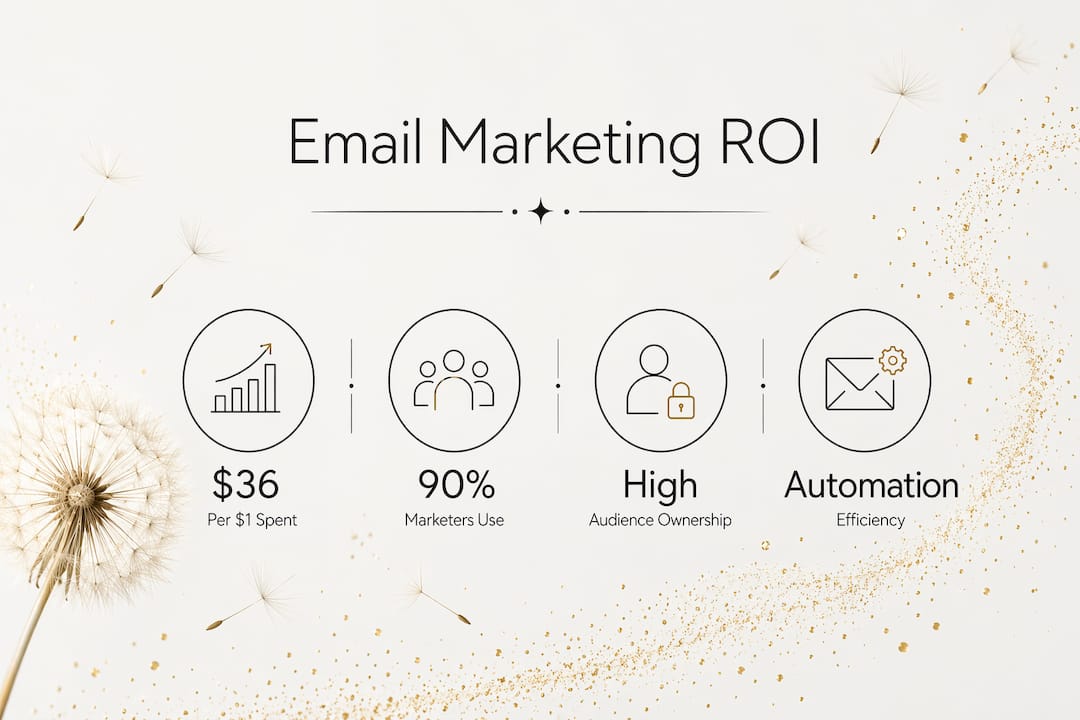
Social media platforms give you reach, but they also control who sees your content and when. A policy change or algorithm update can cut your organic reach overnight. Email does not work that way. Your list is yours. You built it, you maintain it, and no platform can take it from you.
SMS shares the ownership advantage with email, but it carries higher per-message costs and stricter frequency expectations. Subscribers tolerate far fewer texts per month than emails. Email gives you more room to communicate, test, and build context over time.
The impact of email marketing also compounds. Each subscriber you add, each automation you build, and each campaign you refine makes the channel more valuable. Paid ads stop the moment you stop spending. Email keeps working.
What makes an effective email marketing strategy?
A structured approach to email marketing produces sustained results. Simply sending broadcast emails to your full list is an outdated practice that delivers diminishing returns. A complete strategy covers six interconnected areas.
-
Goal setting: Define what success looks like before you send anything. Revenue per email, open rate, and click-to-purchase rate are measurable targets. Vague goals produce vague results.
-
List growth: Use opt-in forms, lead magnets, and checkout sign-ups to build a permission-based list. A content strategy that offers genuine value attracts subscribers who actually want to hear from you.
-
Deliverability management: Email deliverability depends on correct DNS authentication, specifically SPF, DKIM, and DMARC records, plus consistent list hygiene and low complaint rates. Even a technically perfect setup fails if your bounce rate is high or subscribers mark your emails as spam.
-
Content planning: Map your content to the customer lifecycle. New subscribers need orientation. Active buyers need product depth and social proof. Lapsed customers need a reason to return.
-
Automation workflows: Set up triggered flows for welcome sequences, abandoned carts, post-purchase follow-ups, and win-back campaigns. These run without manual effort and generate revenue around the clock.
-
Performance measurement: Track open rate, click rate, revenue per recipient, and unsubscribe rate. Review flow performance separately from broadcast campaigns, since the two serve different purposes and produce different results.
Pro Tip: Before scaling your send volume, audit your list for inactive subscribers. Sending to a stale list damages your sender reputation and reduces inbox placement for everyone on your list, including your most engaged customers.
79% of small businesses say email marketing is important, but only 60% believe it is effective. That gap exists because execution, not intent, determines results. A well-structured strategy closes that gap.
How does automation technology improve email marketing outcomes?
Automation is the mechanism that turns email marketing from a manual task into a revenue-generating system. Lifecycle automation flows generate nearly 41% of total email revenue while representing only 5.3% of total email volume. That ratio shows exactly where the highest-leverage work happens.
Modern platforms make this accessible for businesses of every size:
- Klaviyo specializes in ecommerce automation and integrates directly with Shopify. Its flow builder handles welcome series, abandoned cart, browse abandonment, and post-purchase sequences with precision.
- Mailchimp offers a broader set of tools suited to service businesses and content creators, including audience segmentation and basic behavioral triggers.
- Litmus focuses on email testing and analytics, helping teams verify rendering across devices and measure engagement quality.
AI-powered features within these platforms now handle product recommendations, send-time optimization, and predictive segmentation. These tools analyze subscriber behavior and surface the most relevant content for each individual. The result is higher engagement without proportionally higher effort.
Integration matters as much as the platform itself. Email works best when it connects to your CRM, ecommerce store, and website analytics. That connection lets you trigger emails based on real customer actions, not just calendar schedules. For small businesses exploring marketing automation, starting with two or three core flows and expanding from there is a practical approach that avoids complexity before you are ready for it.
Evaluating performance by revenue per recipient, rather than just open rate, gives you a clearer picture of what your automation is actually producing. Flow revenue and broadcast revenue behave differently, and treating them as the same metric leads to poor decisions.
Key Takeaways
Email marketing delivers the highest ROI among digital channels because it combines audience ownership, behavioral targeting, and automation into a single, compounding system.
| Point | Details |
|---|---|
| Owned audience advantage | Your email list cannot be taken away by algorithm changes or platform policy shifts. |
| ROI leadership | Email averages $36 per $1 spent, far ahead of paid search at roughly $2 per dollar. |
| Automation drives revenue | Lifecycle flows generate 41% of email revenue from just 5.3% of total send volume. |
| Segmentation is non-negotiable | Personalized, segmented campaigns consistently outperform broadcast sends across all metrics. |
| Deliverability is the foundation | SPF, DKIM, DMARC setup and list hygiene determine whether your emails reach the inbox at all. |
Why most small businesses underuse their most valuable channel
The honest observation I keep returning to is this: most small businesses treat email as an afterthought rather than infrastructure. They set up a list, send occasional newsletters, and wonder why the results are flat. The channel is not the problem. The approach is.
What I have seen work consistently is treating email the way you treat your website. You build it deliberately, you maintain it regularly, and you measure what matters. The businesses that get strong results from email are not necessarily sending more. They are sending smarter. They have a welcome flow that converts. They have a segmented list that receives relevant content. They clean their list before it becomes a liability.
The 79% of small businesses that say email is important but only 60% that find it effective tells you something specific. The gap is not about the channel. It is about execution. Businesses that invest in the infrastructure, the flows, the segmentation, and the deliverability practices close that gap quickly. Those that keep blasting the same message to everyone do not.
The future of email marketing is not about sending more volume. It is about precision. AI tools are making personalization accessible at a scale that was previously only available to large enterprise teams. Small businesses that build their email foundations now will have a compounding advantage as those tools mature. The list you build today is the audience you own tomorrow, regardless of what any platform decides to do.
— Christopher
How Moderatemurmurations helps you build your email marketing foundation
Building an email marketing system that actually performs requires more than a platform subscription. It requires a clear content strategy, a properly structured list, and automation flows that connect to your broader online presence.
Moderatemurmurations builds the digital infrastructure that makes all of this work together. From launching your business online with search-friendly structure and clear messaging, to setting up AI workflows that support your email and content systems, we help small businesses and creators move from scattered tools to a coherent, working setup. If you are ready to build an online presence where email marketing plays its proper role, the full service overview shows exactly how we approach that work.
FAQ
What is the role of email marketing online?
Email marketing serves as a permission-based, owned communication channel that drives customer engagement, retention, and direct sales through targeted messages and automated workflows. It gives businesses direct access to their audience without depending on third-party algorithms.
Why does email marketing have a higher ROI than paid ads?
Email averages $36 for every $1 spent because you own the audience, pay no per-click fees, and can automate high-converting flows that run continuously. Paid ads stop producing results the moment you stop funding them.
What email marketing strategies work best for small businesses?
Segmentation, lifecycle automation, and consistent list hygiene produce the strongest results for small businesses. Starting with a welcome flow, an abandoned cart sequence, and a post-purchase follow-up covers the highest-revenue triggers before adding broadcast campaigns.
How do I improve email deliverability?
Set up SPF, DKIM, and DMARC records on your sending domain, remove inactive subscribers regularly, and keep complaint rates low. Technical authentication combined with list hygiene practices is the foundation of reliable inbox placement.
What is the difference between a broadcast email and a lifecycle flow?
A broadcast email goes to a defined segment at a scheduled time, such as a weekly newsletter. A lifecycle flow triggers automatically based on subscriber behavior, such as joining a list or abandoning a cart. Flows generate disproportionate revenue relative to their volume.