The Role of Analytics in Growth for Entrepreneurs
The Role of Analytics in Growth for Entrepreneurs

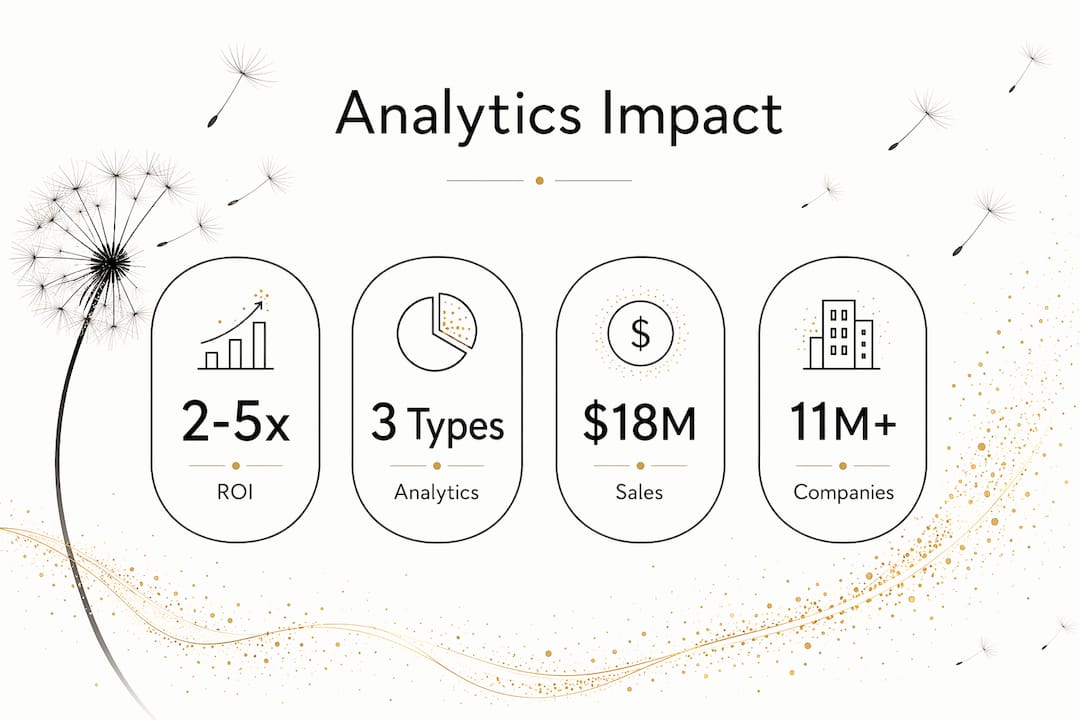
Analytics is defined as the systematic use of data to measure performance, identify patterns, and guide decisions that produce measurable business growth. The role of analytics in growth goes far beyond tracking website visits or monthly revenue. Firms with mature analytics programs achieve 2–5x ROI across revenue growth, operational efficiency, and risk reduction. That gap between data-aware businesses and data-driven ones is widening fast. Entrepreneurs who treat analytics as a core business function, not an afterthought, build a durable competitive edge.
How does the role of analytics in growth change by analytics type?
Not all analytics deliver the same results. The type of analytics your business uses determines how much growth you can actually capture from your data.
Analytics maturity follows a clear hierarchy: descriptive analytics yields modest efficiency gains, predictive analytics enhances revenue and decision accuracy, and prescriptive analytics delivers the greatest performance uplift. Each level builds on the last.
Here is how each type works in practice:
- Descriptive analytics answers “what happened.” It includes sales reports, traffic summaries, and customer counts. Most small businesses start here. The gains are real but limited to spotting past trends.
- Predictive analytics answers “what will happen.” It uses historical patterns to forecast demand, churn risk, or campaign performance. Businesses using predictive models make faster, more confident decisions because they act on probabilities, not guesses.
- Prescriptive analytics answers “what should we do.” It recommends specific actions based on predicted outcomes. This is where analytics shifts from reporting to driving strategy.
The jump from descriptive to predictive is where most entrepreneurs stall. They have dashboards full of historical data but no model telling them what to do next. Moving up the maturity ladder requires cleaner data, clearer goals, and a willingness to act on model outputs rather than gut instinct alone.
Pro Tip: Start with one predictive metric that directly connects to revenue, such as customer churn probability or lead conversion likelihood. Build the habit of acting on that single signal before adding more complexity.

What does research say about analytics and business growth?
The evidence for analytics as a growth driver is strong and consistent across industries. Three research findings stand out for entrepreneurs.
First, mature analytics programs produce 2–5x ROI across multiple business outcomes. That range reflects real variation in how well companies implement and act on their data. The ceiling is high for businesses that build analytics into their decision process.
Second, big data analytics improves customer satisfaction, which drives firm performance through retention and repeat purchases. Customer satisfaction acts as the mechanism that converts raw data into profitability. Businesses that use analytics to personalize interactions see measurable gains in lifetime customer value.
Third, agentic AI transforms growth analytics into an always-on capability. Autonomous systems now monitor market dynamics, flag anomalies, and surface strategic trends without waiting for a human to run a report. That speed advantage compounds over time.
“Analytics-driven organizations enjoy improved profitability and growth by building strong analytics culture and customer-centric orientation.” — Frontiers in Artificial Intelligence, 2026
The table below summarizes key research findings and what they mean for your business.
| Research finding | What it means for your business |
|---|---|
| 2–5x ROI from mature analytics programs | Investing in analytics infrastructure pays back in multiple areas, not just one |
| Customer satisfaction drives profitability | Personalized, data-informed interactions increase retention and repeat revenue |
| Agentic AI enables always-on monitoring | You get faster alerts on threats and opportunities without manual analysis |
| Prescriptive analytics delivers highest uplift | Moving beyond dashboards to recommended actions produces the biggest gains |
Predictive tools now analyze over 11 million companies and 1 billion data points simultaneously to spot market shifts early. That scale is not available to most small businesses directly, but the underlying models power many affordable analytics platforms entrepreneurs use today.
What are the most common mistakes in growth analytics?
The biggest barrier to effective growth analytics is not a lack of skill. Fragmented data architectures are the most common bottleneck, preventing cross-system visibility for growth decisions. When your marketing data lives in one tool, your sales data in another, and your customer service data in a third, you cannot see the full picture of how a customer moves through your business.
The second most common mistake is dashboard obsession without a decision system. Many entrepreneurs spend hours reviewing charts but never build a repeatable process for acting on what they see. Data without decisions is just noise.
Small business owners often drown in dashboards instead of establishing a repeatable weekly decision system. The framework that works is straightforward:
- Measure the metrics that connect directly to your growth goals, not every metric available.
- Learn what the data is telling you. Look for patterns, not just numbers.
- Decide on one specific action based on what you learned.
- Execute that action with a clear owner and deadline.
- Verify the result in the next measurement cycle.
This five-step rhythm turns analytics from a reporting exercise into a growth engine. The weekly cadence keeps decisions close to data and prevents the common trap of reviewing last quarter’s numbers to make next quarter’s plans.
Pro Tip: Pick three metrics that directly reflect your growth goals and review them every Monday morning. Resist the pull to add more until those three are driving consistent decisions.
A third common mistake is treating analytics as a technology problem rather than a culture problem. Analytics-driven organizations build strong analytics culture alongside their tools. The tool is only as useful as the habit of using it.
How can entrepreneurs use analytics to drive growth right now?
Practical analytics use for entrepreneurs falls into four clear areas. Each one connects data directly to a revenue outcome.
- Marketing optimization: Track acquisition cost, conversion rate, and channel performance together. When you see which channel brings customers who actually buy and stay, you reallocate budget toward it. This single shift often produces the fastest return on analytics investment.
- Customer retention: Use cohort analysis to track how long customers stay and when they leave. Identifying the point where churn spikes tells you exactly where your product or service experience breaks down. Fix that point and retention improves without acquiring a single new customer.
- Operational efficiency: Connect financial data with operational metrics like fulfillment time, support volume, or project completion rate. Patterns in that combined data reveal where your business loses money quietly, without anyone noticing until margins shrink.
- Growth milestone forecasting: Modern predictive tools use live data streams to produce dynamic scoring models forecasting critical milestones such as M&A or IPO readiness. For most entrepreneurs, this means using predictive scoring to time hiring decisions, product launches, or market expansion.
The role of automation in scaling businesses connects directly to analytics here. Automated data collection removes the manual work of pulling reports, so your team spends time on decisions rather than data entry.
One underused application is integrating human capital data with financial analytics. Tracking which team configurations produce the best revenue outcomes, or which hiring decisions correlate with growth periods, gives entrepreneurs a clearer picture of where to invest in people. Most small businesses track financial performance and marketing performance separately from team performance. Combining them reveals patterns that neither dataset shows alone.
Data-driven intelligence fuels sustained incremental sales increases averaging $18 million annually for mid-sized companies. For smaller businesses, the proportional gains are equally significant. The mechanism is the same: better information produces better decisions, and better decisions compound over time.
Key Takeaways
Analytics drives measurable business growth when it moves beyond reporting into a repeatable decision system built on predictive and prescriptive insights.
| Point | Details |
|---|---|
| Analytics maturity drives ROI | Moving from descriptive to prescriptive analytics produces the highest business performance gains. |
| Customer satisfaction is the growth mechanism | Analytics improves profitability primarily by enhancing customer satisfaction and retention. |
| Fragmented data is the real bottleneck | Siloed systems across marketing, sales, and operations block the cross-system visibility growth requires. |
| Weekly decision rhythms make analytics work | A consistent measure, learn, decide, execute, verify cycle turns data into growth outcomes. |
| Predictive tools now forecast key milestones | Live data streams power scoring models that help entrepreneurs time major business decisions accurately. |
Analytics culture matters more than analytics tools
I have worked with enough business owners to say this clearly: the tool is rarely the problem. Entrepreneurs buy analytics platforms, set up dashboards, and then check them the same way they check social media. They look, feel informed, and move on without changing a single decision.
The businesses I have seen grow consistently from analytics share one trait. They treat their weekly data review as a decision meeting, not a reporting session. Someone owns each metric. Someone is accountable for the decision that follows. The data does not just get reviewed. It gets used.
The other shift I keep coming back to is simplicity. Most entrepreneurs track too many metrics too early. They add a new dashboard every time they read an article about growth. The result is a collection of numbers with no clear hierarchy and no obvious next step. The online visibility checklist for entrepreneurs we put together at Moderatemurmurations reflects this same principle: start with the metrics that connect directly to revenue, and build from there.
Speed is the other factor that separates analytics leaders from the rest. Agentic AI now gives businesses an always-on monitoring capability that used to require a full data team. Entrepreneurs who adopt these tools early gain a compounding advantage. They catch problems faster, spot opportunities sooner, and make decisions with more current information than competitors relying on monthly reports.
The mindset shift is simple but not easy. Stop treating analytics as something you check. Start treating it as something you act on.
— Christopher
How Moderatemurmurations helps you build an analytics-ready business
Moderatemurmurations builds fast, clean digital systems for small businesses and entrepreneurs who want their online presence to work as hard as they do.
Every website and digital system we build includes search-friendly structure, clear messaging, and the technical foundations that make analytics integration straightforward from day one. Whether you are launching your business online in days or building out a full digital infrastructure with AI workflows, we make sure your setup supports the data-driven decisions your growth depends on. If you are ready to build with clarity and speed, see what we build and find the right starting point for your business.
FAQ
What is the role of analytics in business growth?
Analytics drives growth by converting raw business data into decisions that improve revenue, retention, and efficiency. Firms with mature analytics programs achieve 2–5x ROI across multiple business outcomes.
What are the three types of analytics that affect growth?
Descriptive analytics reports what happened, predictive analytics forecasts what will happen, and prescriptive analytics recommends what to do. Prescriptive analytics delivers the highest business performance uplift of the three.
Why do small businesses struggle with growth analytics?
The most common cause is fragmented data across disconnected tools, which prevents a clear view of the full customer journey. The second cause is reviewing dashboards without a repeatable system for making and tracking decisions.
How does predictive analytics help entrepreneurs plan ahead?
Predictive tools use live data streams to build dynamic scoring models that forecast critical milestones such as hiring readiness, market expansion timing, or revenue targets. This shifts planning from reactive to forward-looking.
How does analytics improve customer retention?
Big data analytics improves customer satisfaction through personalized interactions, which drives repeat purchases and long-term retention. Customer satisfaction is the primary mechanism through which analytics converts data into profitability.