How to Choose a Texas AI Consultant for Your Business
How to Choose a Texas AI Consultant for Your Business

Hire a local, vendor-neutral Texas AI consultant who combines business-first use-case discovery with a clear path to production delivery. The three reasons this matters: a Texas-based advisor understands your industry’s regional dynamics (oil and gas procurement cycles, Texas healthcare data rules, local finance compliance), has relationships with the implementation talent you’ll need, and can sit across the table from your team when a project hits friction. If you’re ready to move, book a 30-minute scoping call before you write a single RFP. It will save you weeks.
Key Takeaways
Hiring the right Texas AI consultant comes down to three things: verified delivery experience, a clear data plan, and an engagement model that matches your timeline and risk tolerance.
| Point | Details |
|---|---|
| Hire for delivery, not credentials | Ask for a proof-to-production example; a consultant who can’t name one is a strategy-only vendor. |
| Data readiness determines timeline | Audit your data before scoping any model work; missing this step reliably doubles project cost. |
| Match the engagement model to your risk | Use a fixed-fee sprint or PoC to validate before committing to a full build-to-production budget. |
| Texas context shapes compliance | Healthcare, energy, and finance projects carry sector-specific data rules that must be built into the project plan from day one. |
| Moderatemurmurations for small businesses | Moderatemurmurations offers AI-assisted websites, workflows, and digital systems built fast, without long-term contracts. |
Table of Contents
- How do you choose the right Texas AI consultant?
- What services do Texas AI consultants typically provide?
- What do engagement models, timelines, and costs look like in Texas?
- What are the first steps to hire and run a successful AI engagement in Texas?
- Why Moderate Murmurations: process, proof, and how we work
- What are the legal and regulatory considerations for Texas AI projects?
- What Texas decision-makers often get wrong about AI consulting
- Moderatemurmurations helps small Texas businesses get AI systems running fast
- Sources
How do you choose the right Texas AI consultant?
The selection process has one job: separate consultants who can deliver working systems from those who can only talk about them. Use this checklist to shortlist candidates quickly.
Prioritized selection checklist
- Business fit first. Can they describe your industry’s core workflow without you explaining it? A Dallas AI consultant who has never touched a field-services company will spend your first month learning your business.
- Delivery track record. Ask for a proof-to-production example, not a slide deck. Did they take a model from pilot to live system? Who maintained it afterward?
- Engagement model match. Do they offer the format you need: a fixed-fee strategy sprint, a time-and-materials build, or fractional AI leadership? Mismatched models create scope disputes.
- Data readiness assessment. A credible AI consulting Texas firm will audit your data before scoping a model. If they skip this step, walk away.
- Security and compliance posture. Do they have a documented approach to access controls, data handling, and human-in-the-loop review? Practitioners who design scalable, human-in-the-loop AI systems treat this as a baseline, not an add-on.
- Total cost of ownership. The build fee is only part of the cost. Ask about hosting, retraining, monitoring, and handoff support.
12 questions to ask on a screening call
- Walk me through a project where you moved a model from proof of concept to production. What broke, and how did you fix it?
- How do you assess data readiness before scoping a project?
- What does your discovery process look like in week one?
- How do you handle a situation where the data turns out to be insufficient mid-project?
- Who owns the model weights, training data, and code at the end of the engagement?
- How do you price scope changes?
- What does your handoff or maintenance plan look like after go-live?
- Do you have experience with Texas-specific compliance requirements (HIPAA for healthcare, TXRULES for financial data, CCPA-adjacent privacy practices)?
- How do you measure success, and what KPIs do you recommend for a project like mine?
- Can you describe your vendor selection process? Are you certified or incentivized by any platform vendor?
- What is your approach to change management and team training?
- Have you worked with companies at my revenue scale? What was the outcome?
Red flags to watch for
- Promises a specific accuracy rate or ROI figure before seeing your data.
- No data engineering plan in the proposal (just “model development”).
- Vague IP and ownership language in the contract.
- No mention of security, access controls, or compliance steps.
- Refuses to provide a reference from a completed production project.
- Proposal has no defined acceptance criteria or milestone sign-offs.
Comparing proposals side by side
When you receive proposals, evaluate them on five dimensions: scope clarity (are deliverables named, not described?), milestone structure (are payments tied to outcomes?), acceptance criteria (how do you know when a deliverable is done?), handoff and maintenance terms, and pricing shape (fixed-fee vs. time-and-materials vs. milestone). A proposal that scores well on all five is worth a higher headline number than one that is cheap but vague.
Pro Tip: Ask every finalist to describe how they would handle a situation where the data you provide turns out to be unusable. The answer tells you more about their real delivery experience than any case study they choose to share.
The AI adoption guide for small business owners from Moderatemurmurations includes additional checklist language and onboarding advice you can adapt for your own vetting process.
What services do Texas AI consultants typically provide?
Most AI consulting Texas engagements cover a predictable set of service categories, though the depth and sequencing vary by firm size and industry. Knowing what each category produces helps you read a proposal critically.
Common service categories and their deliverables
- Discovery and use-case framing. Deliverable: a prioritized use-case backlog with effort and value scores. This is where good consultants earn their fee before writing a line of code.
- Data engineering. Deliverable: a cleaned, documented dataset or data pipeline. No model works without this, and many Texas projects stall here.
- Model selection and engineering. Deliverable: a trained, evaluated model or a fine-tuned foundation model with documented performance benchmarks.
- Integration and MLOps. Deliverable: a production API, monitoring dashboard, and retraining schedule. This is what separates a demo from a live system.
- UX and agent design. Deliverable: a working conversational interface or custom GPT workflow embedded in your existing tools.
- Training and change management. Deliverable: internal training materials, recorded walkthroughs, and a team enablement plan. Boutique Texas firms like those offering AI training and workflow discovery often bundle this with agent pilots to reduce adoption risk.
- Governance and monitoring. Deliverable: a model card, bias audit checklist, and alert thresholds for model drift.
How these services appear in Texas industries
Oil and gas. Discovery and data engineering dominate. The data is often siloed across legacy SCADA systems, and the first deliverable is usually a unified data layer before any model work begins.
Healthcare. Governance and compliance steps run in parallel with every other phase. HIPAA constraints shape data access from day one, and human-in-the-loop controls are non-negotiable for clinical decision support.
Finance and professional services. Model explainability and audit trails matter as much as accuracy. Clients in this sector typically require documented model cards and regular bias reviews.
Small and mid-market service businesses. Discovery and UX/agent design are the highest-value services. A well-designed AI workflow that automates intake, follow-up, or reporting can deliver measurable time savings within 60 days.
For a practical framework on scoping these services for your own business, the AI strategy guide from Moderatemurmurations covers the planning steps in plain language.
What do engagement models, timelines, and costs look like in Texas?
The right engagement model depends on your risk tolerance, data readiness, and how much internal capacity you have to support the work. Here are the five formats you will encounter most often when working with a Texas artificial intelligence expert.
Common engagement models
Strategy sprint. A one-week to three-week fixed-fee engagement that produces a prioritized roadmap and use-case backlog. Low risk, fast output, no implementation included. Best when you need executive alignment before committing budget.
Proof of concept (PoC). A four-to-eight-week timebox that tests one use case against real data. The goal is a working prototype with documented performance metrics, not a production system. Risk is contained because scope is narrow.
Pilot. An eight-to-sixteen-week engagement that takes the PoC output and runs it in a limited production environment with real users. This is where you measure business impact before a full build commitment. Tools like Qualtrics are commonly used at this stage to capture user experience metrics and validate outcomes.
Build to production. A three-to-nine-month engagement covering full engineering, integration, and go-live. Typically priced on a milestone or time-and-materials basis. Requires the most internal coordination and data readiness.
Fractional AI leadership. A part-time engagement (typically 10–20 hours per week) where a senior AI advisor acts as your interim head of AI. Useful for companies that need strategic direction and vendor oversight without a full-time hire. Independent consultants often offer this format alongside one-week strategy sprints and multi-month production builds.
Training-only engagement. A one-to-three-day workshop or a structured multi-week program that builds internal AI literacy without any model development. Good as a first step when your team needs a shared vocabulary before scoping a project. The AI literacy guide from Moderatemurmurations is a useful primer to share with your team before this kind of engagement.
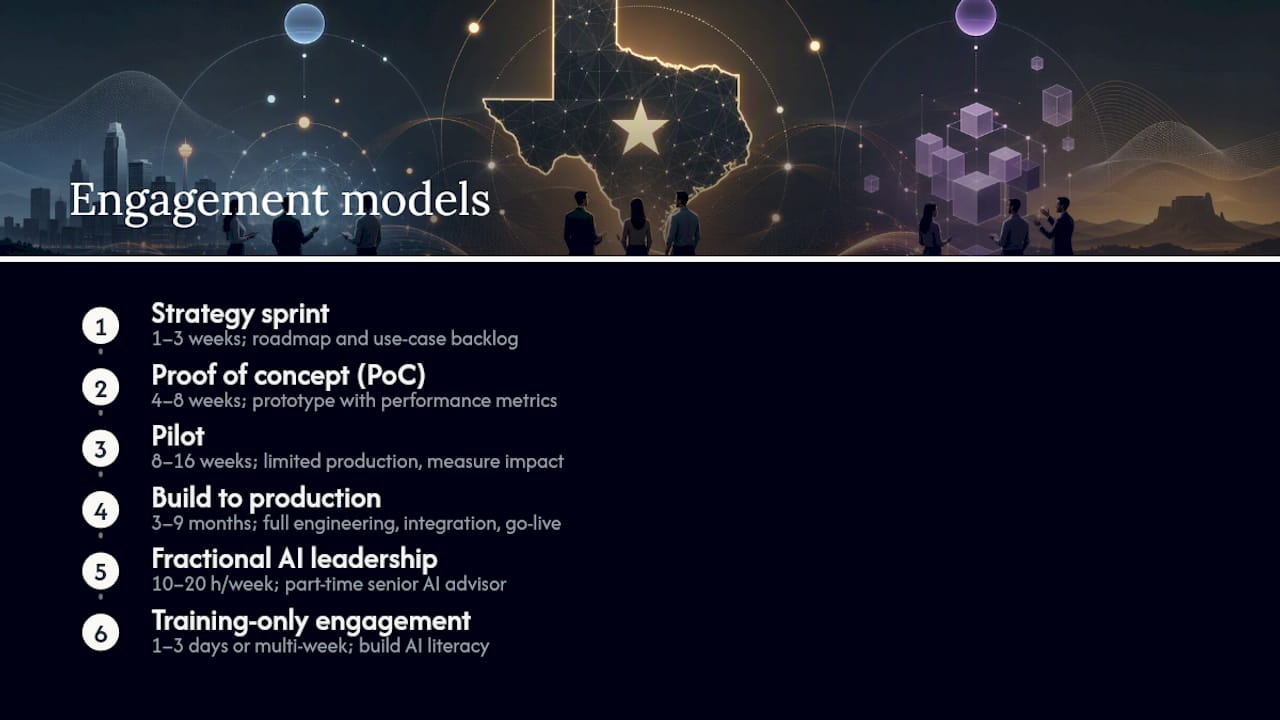
Engagement model comparison
| Model | Typical timeline | Primary outcome | Risk profile | Pricing shape |
|---|---|---|---|---|
| Strategy sprint | 1–3 weeks | Roadmap and use-case backlog | Low | Fixed fee |
| Proof of concept | 4–8 weeks | Working prototype with benchmarks | Low to medium | Fixed fee or milestone |
| Pilot | 8 weeks | Validated business impact data | Medium | Milestone or T&M |
| Build to production | 3–9 months | Live system with monitoring | Medium to high | Milestone or T&M |
| Fractional AI leadership | Ongoing (monthly) | Strategic direction and vendor oversight | Low | Monthly retainer |
| Training only | 1–3 days to 6 weeks | Team AI literacy and workflow readiness | Very low | Fixed fee |
Ballpark cost ranges
Cost varies significantly by data readiness, integration complexity, and consultant seniority. As general orientation:
- A strategy sprint typically runs in the low thousands to mid-five figures depending on scope and firm size.
- A PoC from a boutique Texas firm tends to fall in the mid-five-figure range for a well-scoped single use case.
- A full build-to-production engagement for a mid-market company can reach six figures, particularly when integration with legacy systems is involved.
- Fractional AI leadership from an experienced independent consultant is usually priced as a monthly retainer.
When a proposal comes in significantly below these bands, ask specifically what is excluded. Missing data engineering, monitoring, or handoff support are the most common omissions that inflate total cost later.
Pro Tip: If your data is not yet organized, budget for a data readiness sprint before any model work. Skipping it is the single most reliable way to double your project cost.
What are the first steps to hire and run a successful AI engagement in Texas?
Once you have selected a consultant, the first 30 days determine whether the project builds momentum or stalls. Here is a practical starting plan.
First 30 days: discovery and onboarding
- Confirm data access. Identify every data source the project will touch. Assign an internal data owner for each source and document access permissions before the consultant’s first day.
- Build a stakeholder map. List every person whose workflow will change and every executive whose sign-off you will need. Share this with your consultant in week one.
- Define success metrics upfront. Agree on three to five KPIs before discovery begins. Examples: reduction in manual processing time, improvement in lead qualification accuracy, reduction in customer service ticket volume, model response latency under a defined threshold.
- Identify compliance contacts. If your project touches health data, financial records, or personal information, name the internal compliance or legal contact who will review data handling plans.
- Prepare your materials. Gather sample data files, existing process documentation, org charts for affected teams, and any prior vendor evaluations. A consultant who receives these on day one moves faster and bills less.
- Schedule a kickoff workshop. A half-day session with your consultant and key stakeholders aligns everyone on scope, constraints, and decision rights before any technical work begins.
- Agree on communication cadence. Weekly status updates, a shared project tracker, and a defined escalation path prevent the most common mid-project surprises.
Onboarding checklist for your vendor
- Signed NDA and data processing agreement in place before data sharing begins.
- Access credentials provisioned for relevant systems (read-only where possible).
- Compliance and security review completed for any cloud environments the consultant will use.
- Project charter signed, with scope, milestones, acceptance criteria, and IP ownership terms clearly stated.
- Internal project sponsor named with authority to make decisions.
Local Texas context at kickoff
Texas-based consultants often offer hybrid delivery: remote engineering work combined with on-site workshops for stakeholder alignment. Many Texas consultants combine in-person workshops with remote delivery to balance cost with hands-on team enablement. If your team is distributed across Houston, Dallas, and Austin, clarify travel expectations and on-site frequency in the contract. Regional data center preferences (particularly for healthcare and financial data) are also worth discussing early, since some Texas clients have specific requirements about where data is stored and processed.

Why Moderate Murmurations: process, proof, and how we work
Moderatemurmurations works with small businesses, service providers, and creators who need AI-assisted systems built and deployed without a six-month enterprise engagement. The process is direct: discovery, build, deploy, measure.
How we run a project
- Discovery (week 1–2). We map your current workflow, identify the highest-value AI use case, and define success metrics before any build work begins.
- Build (weeks 3–6). We design and build the system: AI-assisted website, landing page, brand copy, SEO content structure, or AI workflow setup, depending on your goal.
- Deploy. We launch the system, configure integrations, and confirm everything works in your real environment.
- Measure. We review performance against the KPIs we set in discovery and identify the next improvement cycle.
Moderatemurmurations provides AI-assisted websites, brand copy, SEO content, and digital systems built specifically for small businesses and service providers. The work is practical, fast, and designed to produce a working online presence or AI workflow within days, not months.
Author background
Moderatemurmurations serves small businesses, creators, wellness brands, and service providers across the United States. Our work focuses on reducing friction between your idea and a polished, functional online presence. You can learn more about how consultant websites convert clients and what a well-structured digital system looks like in practice.
Ready to talk through your project? Book a free scoping call through the contact page at Moderatemurmurations. The call takes 30 minutes and ends with a clear next step, whether that is a proposal, a referral, or a resource that helps you move forward on your own.
What are the legal and regulatory considerations for Texas AI projects?
Texas does not yet have a single comprehensive AI-specific privacy law equivalent to California’s CCPA, but that does not mean your project operates in a compliance-free environment. Several overlapping frameworks apply depending on your industry and data type.
Key regulatory frameworks affecting Texas AI projects
Federal sector regulations. Healthcare projects must comply with HIPAA, which governs how protected health information is collected, stored, processed, and shared. Any AI model trained on patient data requires a documented data use agreement and, in most cases, a de-identification process before training begins. Financial services projects fall under GLBA and, depending on the institution, SEC and FINRA rules that govern data handling and model explainability.
Texas-specific rules. The Texas Privacy Protection Act (TPPA) and related state-level consumer protection statutes create obligations around data collection disclosure and opt-out rights for Texas residents. While enforcement has been limited compared to California, the regulatory direction is clearly toward stricter requirements. Energy sector projects in Texas often intersect with NERC CIP standards for critical infrastructure data.
Contractual and IP considerations. Your consulting contract should specify who owns the trained model, the training data, and any derivative works. This is particularly important when a consultant uses a proprietary framework or pre-trained foundation model. Ambiguous IP terms are one of the most common sources of post-project disputes.
Website-based AI projects. If your AI project includes a web interface that collects user data, you need a privacy policy, a cookie consent mechanism, and a data retention policy. A GDPR cookie compliance plugin is a practical starting point for WordPress-based web properties, even for US-focused projects where GDPR does not strictly apply, because it establishes a documented consent workflow that satisfies most state-level disclosure requirements.
Practical compliance steps to build into your project.
- Conduct a data inventory before discovery begins. Know what personal data you hold, where it lives, and who can access it.
- Include a compliance review milestone in your project plan, not just at the end.
- Document your model’s decision logic, especially for any system that affects hiring, lending, or healthcare decisions.
- Assign a named compliance contact who reviews data handling plans before any data is shared with a consultant.
This is general information, not legal advice. Confirm current requirements with a qualified attorney or your organization’s compliance team before sharing sensitive data with any third party.
What Texas decision-makers often get wrong about AI consulting
The most common mistake Texas business leaders make is treating AI consulting as a technology purchase rather than an organizational change. A model is not a product you install. It is a system that requires clean data, trained users, and ongoing maintenance. When a project fails, the cause is almost never the algorithm. It is usually a data problem that was visible in week one but not addressed, or a team that was never shown how to use the output.
The second mistake is optimizing for the lowest proposal price. A PoC that costs less but excludes data engineering, compliance review, and handoff documentation will cost more to fix than it saved. The cheapest proposal is often the one that defers the hard work to a future engagement you will pay for separately.
One non-obvious pro tip for Texas leaders specifically: negotiate for a knowledge transfer session at the end of every engagement phase, not just at project close. This keeps your internal team informed throughout the build, reduces dependency on the consultant for basic questions, and gives you a natural checkpoint to reassess scope before the next phase begins. It also protects you if the consultant relationship ends unexpectedly, because your team has been learning alongside the build rather than receiving a handoff document they have never seen before.
Moderatemurmurations helps small Texas businesses get AI systems running fast
Moderatemurmurations is the practical alternative to a long enterprise engagement for small and mid-size Texas businesses that need AI-assisted systems built and working this quarter. Where a traditional consulting firm might spend the first two months on discovery documentation, we move from scoping call to working system in days to weeks, with clear deliverables and no open-ended retainer required.
Our services map directly to the categories covered in this guide: AI workflow setup, AI-assisted website design and development, brand copywriting, SEO content, and digital systems organization. If you need a working online presence, a cleaner intake process, or an AI workflow that saves your team hours each week, we can scope and build it without the overhead of a large firm engagement.
Book a free 30-minute consultation at Moderatemurmurations. Come with a description of your current workflow and the problem you want to solve. We will leave the call with a clear scope and a realistic next step.
Sources
- Qualtrics