10 Step Service Package Structure for Consultants and Creators
10 Step Service Package Structure for Consultants and Creators

The best service package structure builds top-down: a big promise, a named mechanism, a defined scope, three pricing tiers with a highlighted recommended option, risk reversal, and finally a name. Skip that order and you end up selling hours instead of outcomes. The rest of this article walks through a reproducible 10-step workflow, pricing math, and the guardrails that keep scope from eating your margin.
TL;DR:
- Using a big promise with a clear outcome and timeframe enhances client trust and sets precise expectations from the start.
- Tiers should reflect the value of results delivered, with pricing ratios designed to increase perceived value across premium levels.
- Scope boundaries must be explicitly defined with milestones, deliverables, and exclusions to prevent scope creep and protect margins.
- Fixed or value-based pricing is best for repeated services, while hourly billing should be reserved for unpredictable, one-off projects.
- Building packages around standardized deliverables and automation allows scalable, repeatable service delivery and shortens sales cycles.
Table of Contents
- What Are the Six Layers of a Packaged Offer?
- Which Pricing Model Fits Your Service?
- How Do You Prevent Scope Creep in a Package?
- Custom, Productized, or DIY: Which Delivery Model Scales?
- A 10-Step Workflow to Build Your Package
- How Do You Calculate Prices Across Tiers?
- How Should You Structure Guarantees and Payment Terms?
- Why Packaging Changes How You Sell, Not Just What You Charge
- Get Your Package Pages Live Without the DIY Guesswork
- Sources
What Are the Six Layers of a Packaged Offer?
Most service providers start by listing what they do, then try to price it. That’s backward. Build from the client’s outcome down to the paperwork, and each layer answers a question the last one raised.
The promise comes first. A weak promise says “website design.” A strong one says “a live, search-ready website in 14 days.” Outcome plus timeframe. That’s what buyers actually evaluate.
The mechanism gives the promise credibility. Name your process. “The 5-Day Sprint Method” sounds specific and repeatable, even if the underlying work resembles what competitors do.
Scope defines what’s included and excluded, with counts (three page templates, two revision rounds) and client responsibilities spelled out before money changes hands.
Pricing and tiers should reflect the value of the outcome, not the hours behind it. Risk reversal removes the buyer’s last objection. The name comes last because it should summarize a package you’ve already built, not shape it.
- Promise: outcome + timeframe
- Mechanism: your named process
- Scope: deliverables, counts, exclusions
- Pricing: tiers tied to value, not hours
- Risk reversal: guarantee or milestone structure
- Name: memorable label applied last
The Catalyst Outsourcing framework for packaging service offers follows this exact stack, and it’s worth using as a checklist every time you build a new package.
Which Pricing Model Fits Your Service?
Hourly billing punishes speed. The faster you work, the less you earn, which is exactly backward from what a growing practice needs. Fixed pricing rewards efficiency but only works once scope is locked down. Value-based pricing ties the fee to the client’s outcome, and retainers work well for ongoing relationships where the deliverable is attention and availability rather than a single project. Performance pricing (a cut of results) fits a narrow set of situations, mostly marketing and sales roles, where outcomes are cleanly measurable.
- Default to fixed or value-based pricing for anything you’ve delivered more than a few times.
- Reserve hourly billing for genuinely unpredictable, one-off scope.
- Use retainers when the client needs ongoing access more than a finished deliverable.
- Build three tiers, not two or five. Three lets buyers self-select without decision fatigue.
Pricing ratios that work: A commonly used ratio sets Basic at 1x, Standard at 1.5 to 2x, and Premium at 2.5 to 3x, according to WhatShouldICharge’s pricing guide. Present the premium tier first to anchor perceived value, then let the middle tier catch most buyers under a “Recommended” label.
How Do You Prevent Scope Creep in a Package?
Scope creep kills margin faster than underpricing does. The fix is a deliverables checklist tied to acceptance criteria, not a vague description of “ongoing support.”
Map every deliverable to a module or milestone: homepage copy, three interior pages, one round of SEO metadata, delivered and approved by a specific date. Each item needs a clear definition of “done.”
Exclusions matter as much as inclusions. If stock photography, copywriting beyond page one, or third-party plugin licensing isn’t included, say so in writing before the project starts. List client inputs too: brand assets, login credentials, and approval turnaround times all belong in the contract.
- List deliverables by milestone with a sign-off date attached
- State exclusions explicitly (what’s not included, and why)
- Require client-provided assets and approvals before work begins
- Cap revisions (two rounds is standard) and set response-time expectations
A simple statement of work should cover scope, timeline, payment schedule, and revision limits. Tools like Formable’s SOW creator turn that into an enforceable document instead of an email thread, which matters more than most new providers expect.
Custom, Productized, or DIY: Which Delivery Model Scales?
Delivery models sit on a spectrum, and where your package lands determines how much of your time it consumes forever.

At one end sits fully customized, done-with-you work. Every project starts from scratch, which limits how many clients you can serve at once. At the other end sits DIY: templates or self-serve tools the client uses without you. In between are productized done-for-you offers, where you deliver a standardized result using repeatable processes, and hybrid models that combine a templated core with light customization.
MIT Sloan’s research on productizing professional services makes the case plainly: standardizing and documenting delivery lets you delegate parts of the work, which improves both margin and repeatability. Faster delivery becomes a selling point, not a discount justification.
- Build templates for your three most common deliverables first
- Turn recurring client questions into a checklist or intake form
- Automate scheduling, onboarding, and status updates wherever possible
A 10-Step Workflow to Build Your Package
- Identify your ideal client and the single outcome they want most.
- Draft your big promise: outcome plus timeframe, one sentence.
- Name your mechanism so the promise feels specific and ownable.
- Inventory every deliverable required to fulfill the promise.
- Choose your delivery model: custom, productized, hybrid, or DIY.
- Set scope boundaries and list what’s explicitly excluded.
- Price three tiers using a 1x / 1.5 to 2x / 2.5 to 3x ratio.
- Build your payment schedule and pick a risk-reversal offer.
- Pilot the package with one or two real clients before publishing.
- Publish the package to your sales page and adjust based on feedback.
Pro Tip: Run your first version as a paid pilot at a discount, not a free trial. Paying clients give honest feedback; free ones rarely do.
Steps 5 through 7 line up directly with guidance from Robin Waite’s consulting pricing framework: productize your most repeated engagement first, then price it on value rather than hours.
How Do You Calculate Prices Across Tiers?
Start with hours, then work toward value. Say a basic website build takes 20 hours at a $75 target hourly rate. That’s a $1,500 floor price for your Basic tier.
Here’s what most providers miss: your effective hourly rate should rise across tiers, not stay flat. If Premium adds five extra hours of work for $3,000 more revenue, your effective rate jumps well past $75. That’s the entire point of tiering: the additional value you package in costs the client more than it costs you to deliver.
- Who benefits most from this outcome, and how much is that worth to them?
- Can you name a measurable result (traffic, bookings, revenue) tied to the deliverable?
- Would the client pay more to get it faster?
The 1x / 1.5 to 2x / 2.5 to 3x ratio gives you a starting formula, but adjust it once you know how much extra value each tier’s inclusions actually create.
How Should You Structure Guarantees and Payment Terms?
Risk reversal removes hesitation. A satisfaction guarantee suits low-risk, high-trust services. A milestone-based refund (money back if a specific deliverable misses its deadline) fits larger projects. A paid pilot at reduced scope works well for retainers and ongoing engagements where the client wants proof before committing long-term.
Payment schedules should protect your cash flow without scaring off the buyer: a deposit (usually 30 to 50 percent) to start, a milestone payment at the halfway mark, and a final payment on delivery.
- Display guarantees near the price, not buried in fine print
- State payment terms on the pricing page itself, not just in the contract
- Use milestone payments for projects longer than two weeks
Why Packaging Changes How You Sell, Not Just What You Charge
Packaging isn’t a pricing trick. It’s a decision about what kind of business you’re running. Every hour you spend re-explaining scope on a new call is an hour you’re not spending on delivery or growth, and most service providers underestimate how much of that time packaging eliminates.
What surprises people most is that clear packages don’t just protect your margin. They change how buyers perceive your expertise. A provider with three named tiers and a visible guarantee looks more established than one still quoting by the hour, even when the underlying work is identical.
Service providers often see that moving from custom quoting to published packages shortens sales conversations and increases close rates. If you haven’t tested a packaged offer yet, give yourself 30 days with one tier, one guarantee, and one clear price. You’ll learn more from that than from another month of custom proposals.
— Christopher
Get Your Package Pages Live Without the DIY Guesswork
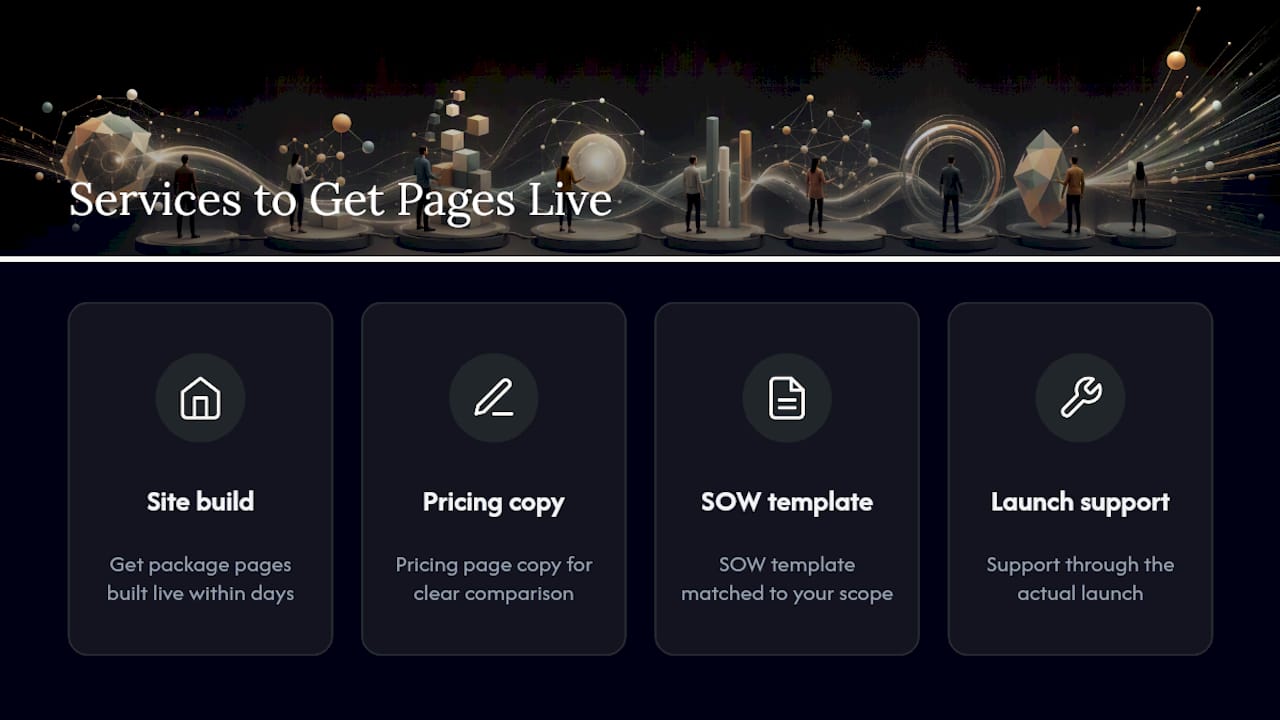
Once your package structure is set, the harder problem is often the page it lives on: pricing tiers that actually compare cleanly, a scope section that reads as reassuring rather than legalistic, and a statement of work that matches what your site promises. Specialized services exist that cover the site itself, pricing page copy, an SOW template matched to your scope, and support through the actual launch.
This fits consultants, coaches, and service providers who’ve already worked out their tiers (using the framework above) and now need it live and converting instead of sitting in a document. For a look at how pricing pages should be laid out for clarity, Let’s Build My App’s pricing page is a useful reference point. If you want packaging tips that actually reach buyers through search, SEO for service providers explains how to make those pages discoverable, not just published.
Visit Moderatemurmurations to book a free consultation and get your package pages built and live within days, not months.
Sources
For deeper reading, MIT Sloan’s analysis of productizing professional services explains the scale and margin case in full. For a ready-made SOW, Formable’s contract creator turns your scope into a signable document in minutes. For automating the proposal side of your workflow, see Moderatemurmurations’ notes on proposal automation.
- How to turn professional services into products
- How to Package a Service Offer (2026 Guide)
- Freelance Pricing Packages — How to Create 3-Tier Pricing | WhatShouldICharge
- How to Price Consulting Services Without Underselling