SEO for Service Providers Explained, One Page at a Time
SEO for Service Providers Explained, One Page at a Time

SEO for service providers is the practice of making an invisible service tangible to searchers by using focused service pages, E-E-A-T proof, local signals when relevant, and conversion-focused design. There’s no product photo to sell the value of a consulting engagement or a plumbing repair, so your service page has to do that work through words, structure, and proof.
Here’s the one thing to do today:
- Pick your single most requested service and rebuild that page with a hero statement, a clear call-to-action, at least one proof point, and a short FAQ.
Get that one page right, and you have a template for every other service page on your site.
Key Takeaways
Service page SEO succeeds when each page functions as a standalone sales conversation, backed by proof, structured for both search engines and skeptical buyers.
| Point | Details |
|---|---|
| One page per service | Split combined service pages so each one targets a single, specific offering. |
| Structure every page the same way | Use hero, audience fit, process, proof, and FAQ in that order every time. |
| Location pages need real local content | Only build them for three or more genuinely distinct service areas. |
| Format FAQs for AI and snippets | Answer directly first, then add schema markup to target featured snippets. |
| Track calls, not just rankings | Use call tracking and UTM parameters to attribute leads to specific pages. |
Table of Contents
- What Is SEO For Service Providers, Really?
- The Four Pillars Of Service SEO That Actually Move Rankings
- Build A Service Page That Actually Converts
- Should You Build Location Pages Or Niche Pages?
- Win The Questions Buyers Are Already Asking
- Technical Fixes That Protect Your Rankings
- Track The Metrics That Actually Predict Revenue
- Proof That Builds Trust Without Breaking Confidentiality
- The Mistakes Quietly Killing Your Service Pages
- Bring In Extra Help Without Losing Your Voice
- What Most Service Providers Get Backward About SEO
- Sources
What Is SEO For Service Providers, Really?
Product SEO answers “which one should I buy?” Service SEO answers “can I trust this person to solve my problem?” That’s a different question, and it changes everything about how you write and structure a page.
Three structural differences matter most:
- Services are question-driven. Buyers search “how much does a divorce lawyer cost” or “what happens during a deep tissue massage,” which makes your content naturally suited to featured snippets and AI answer boxes.
- One page per core service beats one page covering everything. A page trying to rank for bookkeeping, tax prep, and payroll dilutes relevance for all three.
- Location pages only earn their keep when you genuinely serve distinct areas. A single-city consultant doesn’t need five city pages that just swap a place name.
The Four Pillars Of Service SEO That Actually Move Rankings
Every service page succeeds or fails on four things: content depth, local signals, technical performance, and E-E-A-T. Skip one, and the others can’t fully compensate.
- Content: explain the service, who it’s for, the process, and a pricing range or approach, not just a vague “contact us for a quote.”
- Local signals: an optimized Google Business Profile, correct service-area settings, and local links where your business is genuinely tied to a place.
- Technical performance: fast mobile load times, clean indexability, and schema markup that tells search engines exactly what you offer.
- E-E-A-T: a real author bio, anonymized case studies, and visible reviews.
A typical service page needs a clear CTA, 500+ words of unique content, pricing information, three to five FAQs, and Service or LocalBusiness schema to compete. Google Business Profile carries substantial weight for Map Pack visibility, and reviews plus consistent local signals materially affect how often you show up in that pack.
Pro Tip: Before writing a single word of new content, audit your existing service pages against these four pillars. Most service businesses are missing at least two.
Build A Service Page That Actually Converts
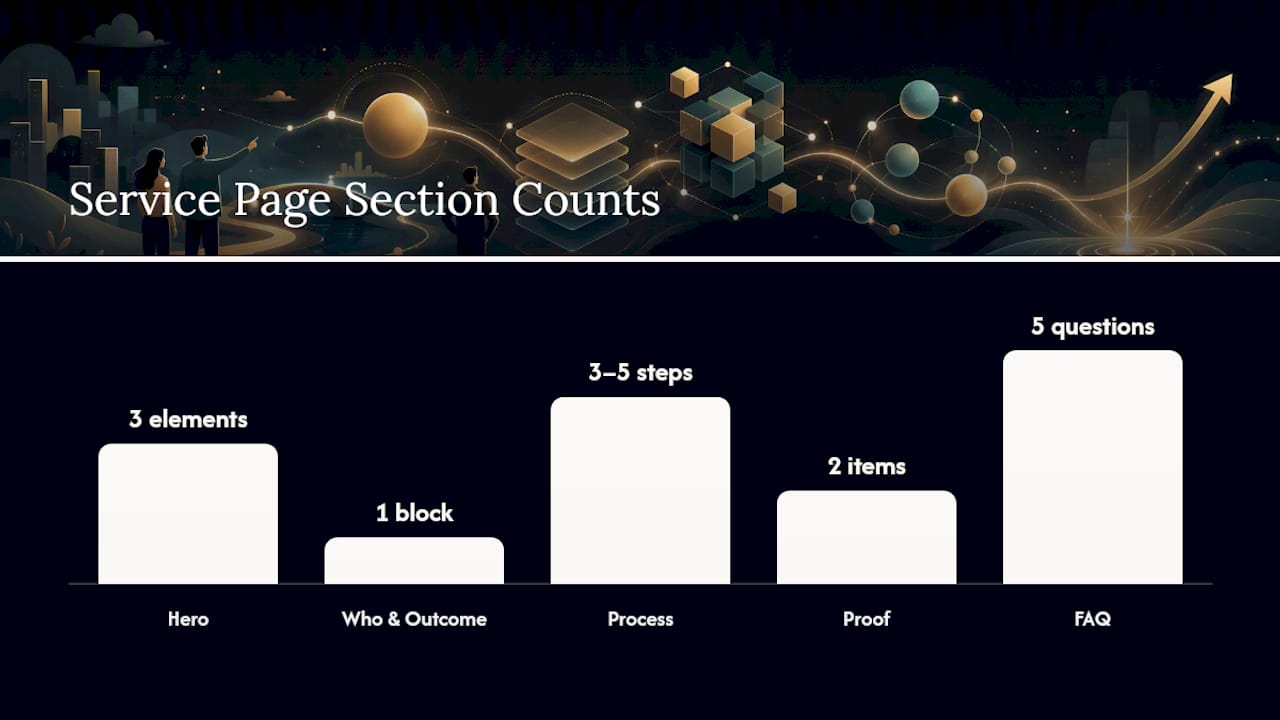
Think of your service page as a sales conversation you never have to repeat. It should answer the questions a hesitant buyer asks in order, without making them dig.
Here’s the sequence that works:
- Hero: one sentence promising the outcome, a short subhead, and a CTA above the fold.
- Who it’s for and the outcome: 40 to 80 words describing the client type and what changes for them.
- Process: three to five steps that make the invisible work visible, so the buyer knows what happens after they click “contact.”
- Proof: an anonymized case study and a review excerpt placed where skeptics look for reassurance, right before the next CTA.
- FAQ: direct answers to the five questions you hear most in sales calls, marked up with schema.
Supporting elements that round out the page:
- A secondary CTA repeated near the bottom, not just at the top.
- Internal links to related service and blog content.
- A pricing range or a clear explanation of how pricing works, even if you can’t quote an exact number.
Service pages should make invisible work tangible by covering what the service is, who it serves, the process, outcomes, timelines, and cost. If you want examples of hero statements that do this well, our local business homepage copy examples are worth a look before you draft your own.
Should You Build Location Pages Or Niche Pages?
Site architecture decisions get expensive fast when they’re wrong. Build the wrong set of pages, and you’re maintaining thin, duplicate content that Google quietly ignores.
Use these decision rules:
- One or two service areas: skip location pages entirely. Fold local mentions into your homepage and main service pages instead.
- Three or more genuinely distinct service areas: build location pages, but only if each one has real local content (permit rules, neighborhood specifics, local project examples), not a copy-pasted template with the city name swapped.
- Online-only or expertise-based services: target niche client-type pages instead (“SEO for wellness brands” instead of “SEO in Denver”), since geography isn’t the buyer’s real filter.
Our guide to local business SEO walks through GBP setup and service-area configuration in more depth.
Win The Questions Buyers Are Already Asking
Every FAQ section on your site is a chance to show up in a featured snippet, a “people also ask” box, or an AI answer summary. The format matters more than most service providers realize.
- Answer the question directly in the first sentence, no throat-clearing.
- Follow with two or three sentences of context, caveats, or specifics.
- Mark up the whole section with FAQPage schema so search engines can parse it cleanly.
This pattern works because buyer queries in service industries are naturally question-driven, and direct-answer FAQ formatting with schema markup targets snippets and PAA results directly.
Pro Tip: Mine your email inbox and past sales calls for the exact questions prospects ask. Those are your FAQ headlines, word for word.
Technical Fixes That Protect Your Rankings
Great content on a broken site still loses. Before investing more time in writing, confirm the technical basics are solid.
- Submit your sitemap in Google Search Console and check for pages stuck in “discovered, not indexed.”
- Hit mobile performance targets for Core Web Vitals, since slow load times quietly bleed both rankings and conversions.
- Add Service and LocalBusiness schema to every service page, not just your homepage.
- Check for duplicate or near-duplicate service pages competing against each other for the same query.
Our online visibility checklist covers these technical priorities in more detail if you want a fuller audit.
Track The Metrics That Actually Predict Revenue
Rankings feel good, but they don’t pay your bills. Calls and form submissions do, so measurement has to trace back to those.
- Set up call tracking so you can attribute phone calls to specific service pages, not just your homepage.
- Add UTM parameters to any link you promote off-site, so form submissions show their true source.
- Track three primary KPIs: call volume, qualified leads, and conversion rate per individual service page.
For many service businesses, phone calls remain the single most important conversion metric, which makes call-tracking tools like CallRail worth the modest monthly cost. Review this data monthly for quick wins and quarterly for structural decisions, like whether a service page needs a rebuild. Our guide on how consultant websites convert clients digs deeper into conversion-focused design choices.
Proof That Builds Trust Without Breaking Confidentiality
You don’t need to name a client to prove you’ve done the work. Anonymized detail is often more credible than a logo wall anyway, because it shows you understand the specifics of a real situation.
- Structure each case study around context, the challenge, your approach, and the outcome, with metrics where you can share them.
- Place your author bio near the top of blog content and link it to related service pages, listing real credentials and relevant experience.
- Add a short “results we’ve delivered” section to service pages using two or three of these anonymized summaries.
Anonymized case studies are both safe and high impact: they signal genuine experience without violating a client’s confidentiality.
A wellness coach doesn’t need to name a client to say: “Worked with a client managing chronic fatigue who wanted a sustainable routine, not another crash plan. Within 90 days, energy tracking scores improved and the client kept the habits after coaching ended.”
If you work in the wellness space specifically, our post on why wellness brands need SEO has more sector-specific proof formatting ideas.
The Mistakes Quietly Killing Your Service Pages
Most underperforming service pages share the same handful of problems. Here’s how to fix each one.
- Thin, combined service pages. Split any page covering three or more services into separate pages, each with its own depth and keyword focus.
- Duplicate location pages. Either add genuine local specifics to each one or consolidate similar regions into a single regional page.
- Weak or missing CTAs. Shorten contact forms to the essentials and put your phone number where it’s impossible to miss, especially on mobile.
- No FAQ, no schema. Add three to five direct-answer FAQs and mark them up with FAQPage and Service schema before you do anything else on the page.
Most underperforming service pages fail for the same reasons: they’re thin, combined, or missing the proof elements that build trust.
Bring In Extra Help Without Losing Your Voice
Some of these fixes take an afternoon. Others, like a full site restructure or a proper schema implementation, take longer than most service providers have to spare between client work.

If your service pages need a rebuild rather than a patch, Moderatemurmurations builds AI-assisted websites, service page copy, and SEO content specifically for small businesses, consultants, coaches, and wellness brands who need this done right the first time. We also work with partners like Spin Creative Group when a service page calls for video proof instead of just text and photos.
Book a free consultation with Moderatemurmurations and we’ll walk through your current service pages together, no pressure, just a clear read on what’s costing you leads.
What Most Service Providers Get Backward About SEO
Most service providers treat their website like a digital brochure and their SEO strategy like an afterthought, something to hire out once the “real” marketing budget exists. That order is backward. A service page that’s built to answer the exact questions a hesitant buyer is asking, with proof placed where skepticism peaks, does more selling than a paid ad campaign, and it keeps working long after the campaign budget runs out.
The conventional advice oversells keyword research and undersells structure. You can target the perfect keyword and still lose the click if your page doesn’t explain the process, show proof, or make the CTA obvious. Structure is what converts a visitor into a call, not keyword density.
If you’re a service provider with limited time, prioritize one thing first: rebuild your highest-value service page using the hero, process, proof, FAQ template. Everything else, local pages, schema, link building, matters less if your core page can’t convert the traffic it already gets.
— Christopher
Sources
The research behind this playbook draws from four sources worth bookmarking: GrowWithSakib’s service business SEO guide, Rank Math’s service page checklist, Tygart Media’s SEO, AEO, and GEO playbook, and TheStacc’s guide on ranking service businesses.
For deeper reading on related topics, see our posts on local business SEO and consultant website conversion.
- SEO, AEO, and GEO for Service Businesses: The Playbook for Companies That Sell Expertise, Not Products - Tygart Media
- Service Page SEO: Transform Any Service Page Into a Lead Magnet » Rank Math
- SEO for Service Websites: Site Structure, Intent & Rankings