How to Write a Value Proposition for Entrepreneurs
How to Write a Value Proposition for Entrepreneurs

A value proposition is a concise statement that explains who your business serves, what problem it solves, the measurable outcome it delivers, and why your solution beats the current alternative. For entrepreneurs, this statement is not a tagline or a mission statement. It is the clearest test of whether your business idea holds up under pressure. Learning to write value proposition entrepreneurs actually use requires four specific elements: a named target buyer, a defined current alternative, a measurable outcome, and a unique differentiator. Unclear value propositions contribute to 23% of startup failures due to misaligned priorities and costly sales cycles. That number signals one thing: getting this right early saves you from expensive mistakes later.
What key elements make an effective value proposition for entrepreneurs?
An effective value proposition contains four structural components: a specific target buyer, a clearly named problem, a measurable outcome, and a unique alternative. Each element does a different job. Together, they give your buyer a reason to choose you over what they are already doing.
Here is what each element requires:
- Target buyer: Name the specific person or business, not a broad category. “Small business owners” is too wide. “Independent yoga instructors with fewer than 50 students” is specific enough to write to.
- Problem clarity: State the exact pain or friction. Vague problems produce vague propositions. “Struggles to fill class spots without spending hours on social media” is a real problem.
- Measurable outcome: Give a concrete result. “Save 5 hours per week” beats “save time.” Buyers need to picture the win.
- Unique differentiator: Name what makes your solution different from the current alternative. If you do not name an alternative, the buyer has no reason to switch.
- Plain language: Write at the level your buyer speaks. Jargon signals that you are more focused on sounding credible than on solving their problem.
Listing features instead of outcomes weakens the message and confuses buyers. A feature tells buyers what your product does. An outcome tells them what their life looks like after they use it.
Pro Tip: Read your draft out loud to someone outside your industry. If they cannot repeat the core benefit back to you in one sentence, the proposition needs more work.

Common pitfalls to avoid include writing for everyone, using buzzwords like “world-class” or “next-generation,” and burying the benefit in the third sentence. The headline of your proposition carries the most weight. Put the outcome there, not the feature.
How to craft your first draft using proven frameworks
Three frameworks give entrepreneurs a fast, structured way to write their first draft: Jobs-to-be-Done, Classic Positioning, and Before/After. Each produces a different style of statement. Writing all three side by side reveals which angle resonates most clearly.
-
Jobs-to-be-Done: Focus on the progress your buyer is trying to make, not the product itself. Template: “When [situation], I want to [motivation], so I can [outcome].” Example: “When I launch a new service, I want to communicate my value clearly, so I can close clients without lengthy back-and-forth.”
-
Classic Positioning: This is the most structured format. Template: “For [target buyer] who [problem], [product name] is a [category] that [measurable benefit]. Unlike [current alternative], we [unique differentiator].” This format forces you to name the alternative, which most entrepreneurs skip.
-
Before/After: Describe the buyer’s world before your solution, then after. This format is especially useful for landing pages and email subject lines because it creates contrast quickly.
| Framework | Best used for | Key strength |
|---|---|---|
| Jobs-to-be-Done | Early-stage discovery | Captures real buyer motivation |
| Classic Positioning | Website copy and pitches | Forces naming of alternatives |
| Before/After | Landing pages and ads | Creates immediate contrast |
Framework templates speed up drafting and produce clearer messaging because they impose structure before you start wordsmithing. Without a framework, most entrepreneurs write a description of their product rather than a statement of buyer value.
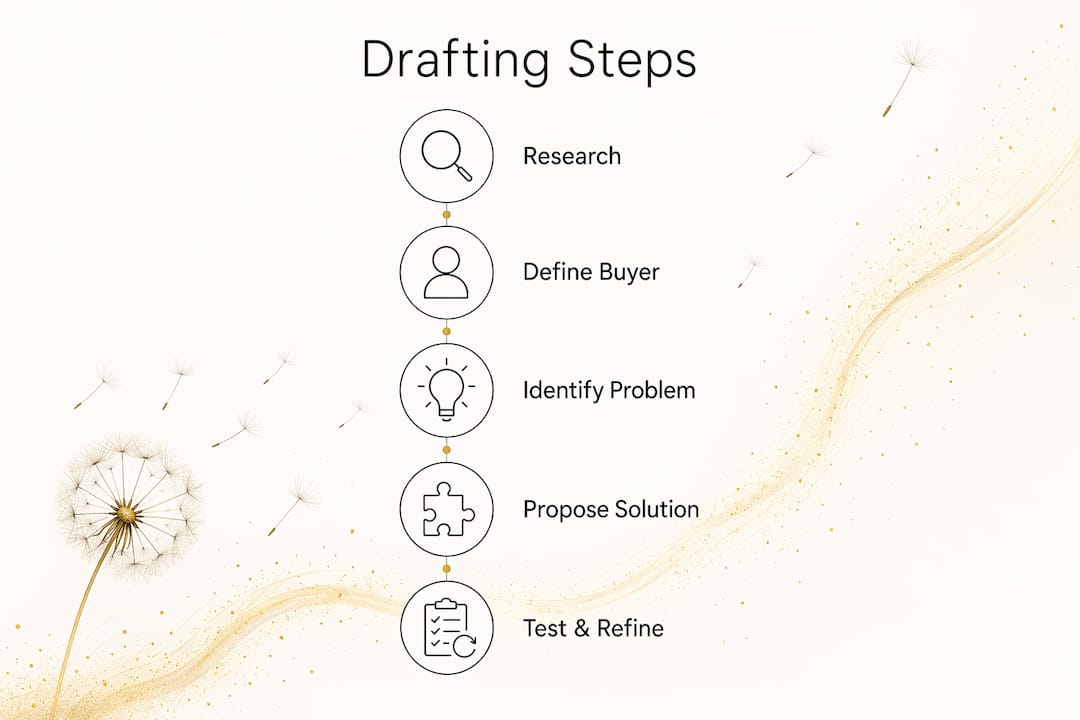
Pro Tip: Write at least two versions using different frameworks before you test anything. The version that feels most natural to write is rarely the one that performs best with buyers.
The best first drafts come from customer interviews that capture specific challenges and outcomes in the buyer’s own words. Do not invent the language internally. Pull phrases directly from what your customers say when they describe their problem.
How to validate and refine your value proposition with real feedback
A draft proposition is a hypothesis. Validation turns it into a tested message. The goal is to find out which version of your statement makes buyers feel the most urgency.
The most reliable validation protocol works like this:
- Present 5–10 target buyers with your draft propositions, without showing them your product or website.
- Ask them which problem, as described, would be most costly to leave unsolved.
- The proposition tied to the problem they rate as most urgent is your strongest candidate.
- Run a live market test using a landing page or email subject line with that proposition.
- Measure click-through rate or sign-up rate, not just verbal feedback.
Presenting propositions to real users without product context removes the bias that comes from people trying to be polite about your idea. Buyers respond to the problem statement, not to your enthusiasm about the solution.
Verbal feedback alone is not enough. People say they like things they would never pay for. A landing page test with a real call to action gives you behavioral data, which is far more reliable than survey responses.
Statistic callout: Poor clarity in a value proposition contributes to 23% of startup failures due to misaligned priorities and costly sales cycles. Validating early prevents you from building a sales process around a message that does not land.
Refine based on what buyers say in their own words during interviews. If three people describe your benefit the same way and you are not using that language, change your draft. Their phrasing will outperform yours almost every time.
How to integrate your value proposition into internal business strategy
A value proposition is not just marketing copy. It is a strategic filter for decisions across product development, hiring, sales, and customer selection. Entrepreneurs who treat it as only a website headline miss most of its value.
“Company values and value propositions must be integrated into the DNA of a business, guiding internal decisions, or they fail to sustain scaling challenges.” — Purpose-Driven Leadership in Practice
Practical ways to embed your proposition as a decision filter:
- Budgeting: Ask whether each spend directly supports the measurable outcome in your proposition. If it does not, deprioritize it.
- Hiring: Write job descriptions that reflect the specific problem your business solves. Candidates who understand that problem will outperform generalists.
- Partnerships: Evaluate potential partners by asking whether they serve the same target buyer with a complementary, not competing, solution.
- Product decisions: When a new feature is proposed, test it against your proposition. Does it make the core outcome more measurable or more accessible?
The risk of keeping your proposition only in your marketing materials is real. Teams make decisions every day that either reinforce or erode your positioning. Without a shared internal understanding of who you serve and what outcome you deliver, those decisions drift. A content strategy built around your proposition keeps every channel aligned with the same core message.
Audit your alignment every quarter. Read your current proposition, then look at your last five hiring decisions, your last five budget approvals, and your last five product changes. If they do not connect back to the proposition, the statement needs updating or the decisions need redirecting.
Common mistakes entrepreneurs make when writing their value proposition
Most early-stage entrepreneurs make the same five mistakes. Recognizing them is faster than learning from them the hard way.
- Treating it as a tagline. A tagline is a brand memory device. A value proposition is a strategic statement. “We make business simple” is a tagline. It tells no one anything specific.
- Using vague buzzwords. Words like “world-class,” “innovative,” and “best-in-class” signal that you have not done the work of identifying a real, specific outcome.
- Skipping the alternative. A credible alternative must be named, or the buyer has no reason to switch. Name what they are currently using, whether that is a spreadsheet, a freelancer, or doing nothing.
- Focusing on features, not outcomes. Buyers do not care what your product does. They care what changes in their business after they use it.
- Ignoring customer language. The words your buyers use to describe their problem are almost always more persuasive than the words you invent internally.
Many entrepreneurs also make the mistake of finalizing their proposition before they have spoken to enough buyers. An online visibility checklist can help you confirm that your messaging is reaching the right audience before you lock in a final version.
Pro Tip: If your value proposition could apply to three different businesses in three different industries, it is not specific enough. Specificity is what makes a proposition credible.
Key takeaways
A clear, validated value proposition is the single most important statement an entrepreneur can write, because it aligns every business decision from hiring to product to sales around one measurable outcome for one specific buyer.
| Point | Details |
|---|---|
| Four required elements | Every proposition needs a target buyer, named alternative, measurable outcome, and unique differentiator. |
| Use proven frameworks | Jobs-to-be-Done, Classic Positioning, and Before/After each produce testable drafts quickly. |
| Validate with real buyers | Test 5–10 target buyers without product context to find the message tied to the most urgent problem. |
| Embed it internally | Use your proposition as a filter for budgeting, hiring, and product decisions, not just marketing. |
| Avoid vague language | Taglines, buzzwords, and feature lists all weaken the proposition. Outcomes and specificity win. |
Why your value proposition is the clearest thinking you will do as a founder
I have worked with dozens of entrepreneurs at different stages, and the ones who struggle most are rarely struggling with their product. They are struggling with their explanation of it. The value proposition is where that confusion shows up first.
What I have seen consistently is this: founders who write a strong proposition early make faster decisions. They know which customers to say no to. They know which features to skip. They know which partnerships are worth pursuing. The proposition becomes a compass, not just a sentence on a website.
The uncomfortable truth is that most entrepreneurs avoid writing a tight proposition because it forces them to make choices. Naming a specific buyer means excluding others. Naming an alternative means admitting the competition exists. Committing to a measurable outcome means being accountable to it. Those are uncomfortable commitments, and that discomfort is exactly why the exercise is worth doing.
I also want to push back on the idea that a value proposition is ever finished. The best ones evolve. As you learn more about your buyers, as the market shifts, as your product matures, the statement should sharpen. Treat it as a living document you revisit every six months, not a plaque you hang on the wall.
If you are a personal brand or service provider, your proposition is often the first thing a potential client reads. Make it count. Write it, test it, refine it, and then build everything else around it.
— Christopher
How Moderatemurmurations helps entrepreneurs build clear messaging fast
Crafting a strong entrepreneur value statement is only the first step. Putting it in front of the right audience, on a site that loads fast and reads clearly, is what turns a good message into real business results.
Moderatemurmurations builds fast, clean websites, landing pages, and brand copy for small businesses and service providers. Every project starts with your core message and builds outward from there, so your value proposition is not buried in a footer. It leads every page. Whether you need a full site or a single landing page to test your proposition in the market, Moderatemurmurations can launch your business online in days, not months. For a closer look at what a full build includes, the services overview covers website launch, AI workflows, and digital infrastructure built for growth.
FAQ
What is a value proposition?
A value proposition is a concise statement that identifies a specific buyer, names the problem they face, describes a measurable outcome, and explains why your solution beats their current alternative. It is a strategic statement, not a tagline.
How long should a value proposition be?
An effective value proposition is one headline sentence supported by two to three sentences that cover the target buyer, the problem, the measurable benefit, and the unique alternative. Longer is not stronger.
What is the difference between a value proposition and a unique selling proposition?
A value proposition defines the full context of buyer, problem, outcome, and alternative. A unique selling proposition (USP) focuses specifically on the single feature or benefit that sets you apart. The value proposition is broader and more strategic.
How do I know if my value proposition is working?
Test it on 5–10 target buyers without showing them your product. If they identify the problem in your statement as the most costly one they face, the message is landing. Follow up with a live landing page or email test to confirm with behavioral data.
How often should I update my value proposition?
Revisit your proposition every six months or whenever your target buyer, core product, or competitive environment changes significantly. A value proposition that no longer reflects your actual buyer is more harmful than having none at all.