Founder Coaching for Small Business Owners: 2026 Guide
Founder Coaching for Small Business Owners: 2026 Guide

Founder coaching is structured, one-on-one support that helps you shift from running every detail yourself to building a company that runs without you at the center. If your business is growing but still completely dependent on you, a founder coach is worth serious consideration. If your primary constraint is that no one can find you online, a fast website launch may be the better first move.
Three signals that you need a coach now:
- Every major decision waits for you, and your team can’t move without your input
- You’re preparing for a fundraise, a board conversation, or a key hire and feel underprepared for the leadership demands
- You keep hitting the same operational bottlenecks month after month with no clear fix
Table of Contents
- What founder coaching actually delivers
- How mentoring, coaching, advising, and therapy differ
- Which founders benefit most from coaching?
- How to choose a founder coach
- Where to find founder coaching and low-cost U.S. alternatives
- Your 30/60/90 plan to get value from coaching fast
- When a polished online presence is the faster fix
- Key Takeaways
- What I’ve seen working with founders and creators
- Useful sources to read next
What founder coaching actually delivers
The three outcomes founders report most often are: a cleaner operating model that reduces founder dependency, faster and more confident decision-making, and a clearer sense of what the CEO role actually requires at their stage. These aren’t soft wins. They show up in how your team functions week to week.
A founder who used to approve every vendor contract might, after coaching, have a documented approval framework their ops lead runs independently. A solo creator scaling a service business might move from reactive client management to a repeatable intake system, driven by behavioral and structural changes. The shift is behavioral and structural, not just motivational.
Pro Tip: Track key indicators of delegation and priority alignment in your first coaching period: decisions delegated, team waiting times, and calendar reflection of priorities. If none of those numbers move, the engagement needs a reset.
How mentoring, coaching, advising, and therapy differ
These supports are not interchangeable. Each one fits a different problem at a different stage.
| Support type | Best for | Cost shape | Accessibility | Format | Specialization |
|---|---|---|---|---|---|
| Mentoring (e.g., SCORE) | Early validation, operational basics | Free | Nationwide, email/phone/video | Ongoing, volunteer-led | Broad small business |
| Founder coaching | Operator→CEO transition, scaling | Per-session or monthly | Varies by coach | 1:1, structured | Stage and industry specific |
| Advising | Specific domain gaps (legal, finance) | Equity or project fee | On-demand | Ad hoc | Narrow functional area |
| Therapy | Mental health, burnout, personal patterns | Insurance or out-of-pocket | Licensed providers | Weekly sessions | Clinical |
| Peer coaching | Accountability, shared experience | Low or free | Cohort-based | Group or paired | Founder community |
SCORE mentoring is free and available for the life of your business through the SBA, making it the right starting point for most small-business owners who need operational guidance before they can justify a coaching retainer. Founder coaching, by contrast, starts somewhere more awkward: the founder built the constraints the company is now stuck inside, and a good coach helps you see and redesign them. Advising fills specific knowledge gaps. Therapy addresses the personal patterns underneath the professional ones. Peer coaching provides accountability and shared context, but without the structured frameworks a paid coach brings.
Which founders benefit most from coaching?
The core signal is straightforward: growth is happening, but the company still can’t function without you making the calls. That gap between traction and independence is where coaching moves the needle most.

| Stage | Coaching fit | Primary signal |
|---|---|---|
| Solo creator / service provider | Moderate | Capacity ceiling, no repeatable systems |
| Early small business (customers, founder-heavy ops) | High | Every decision routes through you |
| Seed→Series A startup | Very high | Role demands exceed prior experience |
| Pre-revenue / idea stage | Low | Mentoring or peer groups are a better fit first |
The seed-to-Series A window is particularly disorienting because the founder role changes faster than most people expect. What worked at ten customers doesn’t work at a hundred. Coaching is also valuable when board pressure or a fundraise forces you to show up differently as a leader. Where coaching is not the right first step: if you haven’t validated your offer yet, or if your primary problem is that potential customers can’t find you, those are different problems with faster solutions.
How to choose a founder coach
Prioritize founder experience, stage fit, clear engagement terms, measurable goals, and a discovery or trial session before committing to a longer engagement.
Selection criteria:
- Operated a company at a comparable stage, not just coached others through it
- Can provide references from founders at your stage or in your industry
- Uses structured frameworks and tools, not just open-ended conversation
- Sets agreed behavior changes or KPIs at the start of the engagement
- Offers a low-cost intro call or short trial period before a full retainer
Questions to ask on a discovery call:
- What does your onboarding process look like, and how do you surface blind spots early?
- What specific frameworks or tools do you use, and can you show me an example?
- How do we define success for this engagement, and how will we measure it?
- Can you share a reference from a founder at a similar stage?
- What happens if the engagement isn’t working after 30 days?
On pricing: Boutique founder coaches range from modest per-session fees for early-stage advice to multi-thousand-dollar monthly retainers for ongoing work with venture-backed CEOs. A good low-cost alternative is a single strategy session or a short first month before committing to a longer arrangement.
Red flags: No references, vague outcome language, no structured onboarding or audit, and no trial option are all reasons to keep looking. A quality coach will also expect you to do work between sessions, not just show up and talk.
Where to find founder coaching and low-cost U.S. alternatives
- SCORE: Free mentoring from experienced volunteers, available nationwide by email, phone, and video. Apply directly through the SCORE website and get matched with a mentor in your area. Best for early-stage and small-business owners who need operational guidance without a budget for coaching.
- GrowthMentor: On-demand access to vetted advisors and mentors for per-session fees. Good for founders who need specific expertise quickly without a long-term commitment.
- Y Combinator resources: YC publishes startup advice, runs office hours for portfolio founders, and offers the Startup School program free to any founder. Best for tech-enabled startups seeking investor-ready frameworks.
- Dave Bailey: Publishes practical frameworks for scaling founders and offers coaching for venture-backed CEOs. His writing alone is a useful free resource.
- Amy Buechler: Specializes in the seed-to-Series A transition, with a focus on founder mental models and leadership development.
- Adam Dexter (The Startup Founder Coach): Positions the coach role as a connected thinking partner who spots patterns rather than prescribes answers. Good fit for founders who want a sounding board with real operator experience.
- Paid coaches: When free mentoring or peer groups aren’t enough, a paid coach with a structured onboarding audit and agreed KPIs is worth the investment. Look for coaches who interview your stakeholders and observe your leadership meetings early in the engagement.
Your 30/60/90 plan to get value from coaching fast
The first 30 days are about diagnosis. Days 60 and 90 are about building and handing off.
- Days 1–30 (onboarding and audit): Complete a stakeholder interview process with your coach. Map every decision that currently routes through you. Identify your top three operational bottlenecks and write a one-page constraint summary. Prepare your key metrics and a clear value proposition before your first session.
- Days 31–60 (decision levers): Move at least one recurring decision to a team member with a documented framework. Set a weekly operating rhythm your team can run without you in the room. Track how often you intervene on routine issues.
- Days 61–90 (delegation and systems): Hand off a second decision category. Review your calendar against your actual CEO priorities. Evaluate whether the engagement KPIs are moving, and have an honest conversation with your coach about scope if they aren’t.
Before your discovery call, prepare: a list of your top five decisions from last month, your current team structure, and one sentence describing the constraint that’s costing you the most time or growth.
When a polished online presence is the faster fix
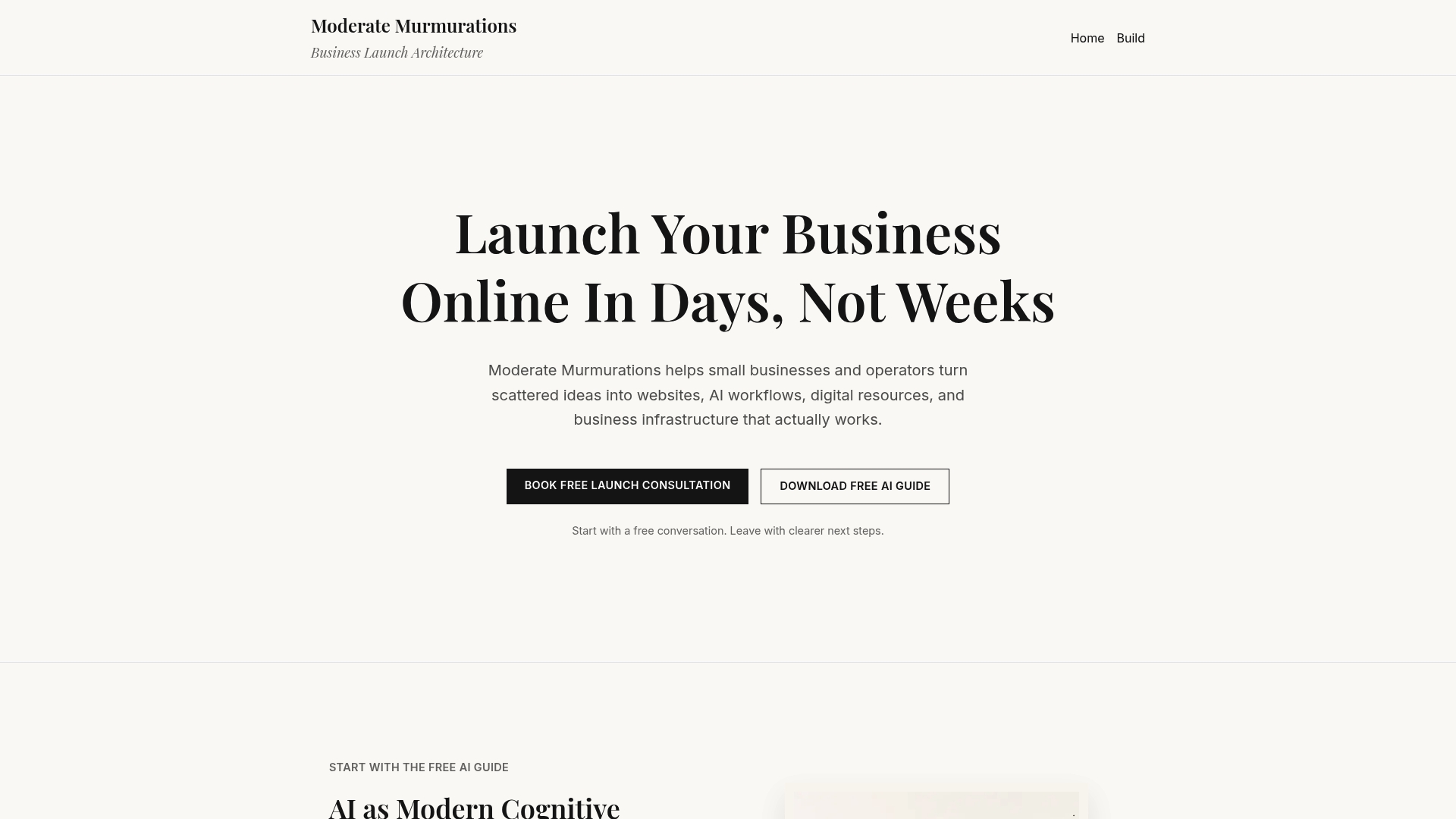
If your primary constraint is that potential clients can’t find you, don’t understand your offer, or land on a website that doesn’t convert, months of leadership coaching won’t solve that. Moderatemurmurations builds fast, clean, AI-assisted websites, landing pages, brand copy, and digital systems for small businesses, creators, and service providers. When your buyer journey is the bottleneck, a focused website project delivers a measurable result in days, not months.
Choose coaching when founder dependency or leadership gaps are the core constraint. Choose Moderatemurmurations when your online presence is what’s holding back growth. Launch your online presence and see what a clear, conversion-ready site can do for your business right now.
Key Takeaways
The most effective founder coaching engagements start with a clear onboarding audit, agreed KPIs, and a trial period before any long-term commitment.
| Point | Details |
|---|---|
| Start with free options | SCORE offers free, ongoing business mentoring for the life of your business nationwide through the SBA — a practical first step before a paid coach. |
| Match coaching to your stage | Coaching delivers most at the early small business and seed→Series A stages, when growth outpaces the founder’s current operating model. |
| Vet coaches rigorously | Require references, a structured onboarding process, measurable KPIs, and a trial session before committing. |
| Use the 30/60/90 plan | Map decisions in month one, move one decision category to your team in month two, and evaluate KPIs by month three. |
| Moderatemurmurations as an alternative | If your constraint is online visibility rather than leadership gaps, Moderatemurmurations delivers a fast, polished digital presence without a long engagement. |
What I’ve seen working with founders and creators
Most founders I work with don’t have a leadership problem. They have a visibility problem dressed up as a leadership problem. They’re capable operators who haven’t built the digital infrastructure that lets their business speak for itself. A coach can help you delegate decisions, but if your website is unclear and your offer is buried, you’ll still be the one explaining your business to every new prospect.
The practical sequence matters: get your online presence working first, so your business can generate interest while you focus on building the internal systems that reduce your dependency. Coaching is most powerful when the external signals are already working and the internal structure is the remaining constraint. Moderatemurmurations exists for exactly that first step, helping founders and creators build a clear, fast, conversion-ready online presence so the coaching work can focus on what it’s actually for.
Useful sources to read next
- SCORE: Apply for free mentoring matched to your location and business stage.
- SBA SCORE mentoring page: Official SBA resource for understanding SCORE’s free mentoring program.
- Founder Coach: Take the CEO Focus Finder™ and explore 500+ visual frameworks for scaling founders.
- Amy Buechler: Book a discovery call if you’re navigating the seed-to-Series A transition.
- Adam Dexter / The Startup Founder Coach: Explore the thinking-partner model and book an intro session.
- FounderFriend: Review pricing structures and engagement formats for boutique founder coaching.
- Coaching Founder: Start with a low-cost trial session to test fit before committing to a retainer.