Audit FAQ schema: server side JSON-LD and remove templated blocks
Audit FAQ schema: server side JSON-LD and remove templated blocks

FAQPage markup is still valid, but Google removed the FAQ rich result from search on May 7, 2026. Keep the schema only where the FAQs are genuine, visible, and written for a specific page rather than pasted into a sitewide template. If your FAQ block existed mainly to win that extra blue link real estate, pull the JSON-LD and put the effort into the visible content instead.
TL;DR:
- FAQ schema remains supported technically, but Google’s visual FAQ rich results were removed from search in May 2026, reducing its direct visibility benefit.
- Only keep FAQ markup on pages where the questions are genuinely visible, answer real visitor inquiries, and are not templated across multiple pages.
- Remove FAQ schema from hidden, duplicate, or purely template-based blocks that do not provide unique or valuable visitor content.
- Ensure JSON-LD markup is server-rendered, matches visible content exactly, and includes unique questions to avoid manual flagging.
- Focus on writing standalone, clear, and concise answers that search engines and AI systems can easily cite, rather than relying solely on schema for visibility.
Table of Contents
- What Is FAQ Schema, and What Changed in 2026?
- Should You Keep, Audit, or Remove Your FAQ Schema?
- How to Implement FAQPage JSON-LD Correctly
- Which Tools Still Validate FAQ Schema?
- How Do You Write FAQ Answers AI Can Actually Cite?
- Structural Housekeeping Beats Chasing the Next SERP Feature
- Get a Structured-Data Audit Instead of Guessing
- Where to Verify This Yourself
- Sources
- FAQ
What Is FAQ Schema, and What Changed in 2026?
FAQ schema is a structured-data pattern built from three pieces: FAQPage, the wrapper type that tells crawlers “this content is a set of questions and answers”; Question, one entry in that set; and acceptedAnswer, the response tied to it, usually written as an Answer object. Most sites implement this using JSON-LD, a lightweight script block that sits in the page’s HTML and describes the content without changing how it looks.
Schema.org still defines FAQPage exactly as it always has, and the type sees enormous adoption. Google’s own index aggregation puts FAQPage usage in the 1 million to 10 million domain range, which tells you this was never a niche tactic.
What changed is not the schema. It’s the payoff. Google pulled the visual FAQ rich result out of search results on May 7, 2026, and followed up in June by dropping related Search Console reporting and Rich Results Test support. That distinction matters for how you plan your next move:
- Structured data (FAQPage schema): unchanged. Schema.org still supports it, and crawlers still parse it.
- The rich result (expandable Q&A snippet in Google search): gone as of May 7, 2026.
- Search Console’s FAQ performance reports: deprecated, so you cannot pull fresh data on FAQ impressions going forward.
The markup didn’t die. The reward for using it just moved.
Should You Keep, Audit, or Remove Your FAQ Schema?
Run every page carrying FAQPage markup through a three-question test before deciding anything:
- Is the Q&A actually visible on the page, in real HTML a person can read without expanding a hidden accordion built purely for schema purposes?
- Does the content answer something a visitor genuinely asks, or was it written to hit a keyword and check a structured-data box?
- Is the same block templated across dozens of pages, with only the product name swapped out?
A page that fails any one of those questions is a candidate for change. A page that fails two is a page you should fix today.
From there, sort your inventory. If your site runs on a CMS, you can usually find every instance of FAQPage markup with a site crawl tool or by searching your templates and tag manager for “FAQPage” in the JSON-LD output, since centralized components often emit the same block on far more pages than anyone intended.
Once you have that list, the actions split three ways:
- Keep: the FAQ is unique to the page, visible without extra clicks, and answers something a real visitor would search for. Leave the markup in place.
- Audit and rewrite: the topic is relevant but the answers are generic, thin, or copied from a competitor’s structure. Rewrite the answers as standalone facts, then keep the schema.
- Remove: the FAQ exists only in a hidden accordion, repeats across every product page with minor swaps, or was built purely to chase the old rich result. Delete the JSON-LD and either improve the section or drop it.
Pro Tip: Don’t treat “remove” as a loss. A templated FAQ block that never matched the page content was hurting your credibility with readers even while it was pulling impressions in the old rich result.
How to Implement FAQPage JSON-LD Correctly
Once you decide a page earns the “keep” or “audit and rewrite” label, the implementation itself is short. Here is a minimal, valid pattern for one question:
{
  "@context": "https://schema.org",
  "@type": "FAQPage",
  "mainEntity": [{
    "@type": "Question",
    "name": "How long does a website launch take?",
    "acceptedAnswer": {
      "@type": "Answer",
      "text": "Most launches take one to three weeks depending on scope, from initial content to a live, working site."
    }
  }]
}
Four fields do the real work here. @type: FAQPage declares the page type. Question wraps each individual query, with name holding the exact question text. acceptedAnswer nests an Answer object, and its text field carries the response verbatim, matching what a visitor actually sees on the page. JSON-LD’s own specification recommends exactly this pattern: clear, one-to-one Question and acceptedAnswer pairs rather than nested or conditional logic.
The part developers get wrong most often isn’t the syntax. It’s rendering. If your JSON-LD only appears after JavaScript hydration, some crawlers and extraction pipelines never see it at all, since server-side preservation is a practical requirement for the markup to count for anything. Render the script tag server-side, in the raw HTML response, before any client-side framework touches the page.
A short developer checklist before you ship:
- Confirm the JSON-LD survives a “view source” check, not just a rendered DOM inspection.
- Set the
inLanguageor equivalent language tag correctly if the page isn’t in English. - Write unique questions per page. Never copy the same five FAQs across fifty product pages.
- Match the visible Q&A text to the schema text exactly. A mismatch between what’s on the page and what’s in the markup is one of the fastest ways to trigger a manual quality flag.
- Avoid injecting the block through a centralized template that fires on every page regardless of whether the content fits.
That habit is exactly what turned a useful structured-data type into a liability once Google started paying closer attention to how honestly it was used.
Which Tools Still Validate FAQ Schema?
Two tools matter now, and they do different jobs. Validator remains the correct place to check JSON-LD syntax against the Schema.org vocabulary. It doesn’t tell you whether Google will show a rich result, because there is no rich result left to show. It tells you whether the code is valid.
The Rich Results Test, by contrast, no longer supports FAQ rich-result eligibility checks at all. If you’re still relying on it as your FAQ validation step, you’re testing for a feature that doesn’t exist anymore.
Beyond syntax checking, run these steps:
- Manually load the page and view source to confirm the JSON-LD is present in server-rendered HTML, not injected later.
- Export your historical Search Console FAQ performance data now, before you start removing markup, so you have a before-and-after baseline for any CTR shift.
- Watch click-through rate on affected URLs over four to six weeks post-change. A dip tied to lost rich-result real estate looks different from a ranking-position problem, and conflating the two leads to the wrong fix.
- Set up light monitoring for how Bing and AI answer engines like Perplexity treat your FAQ content, but stay cautious about attribution. There’s no confirmed evidence that FAQPage markup alone drives AI citation, so don’t credit the schema for a citation bump that might be coming from your content quality instead.
How Do You Write FAQ Answers AI Can Actually Cite?
The schema was always a wrapper. The answer text inside it is what search engines, readers, and AI retrieval systems are actually evaluating, and most FAQ sections fail on the writing, not the markup.
- Make every answer stand alone. Write it as a complete assertion that makes sense with zero prior context, since an LLM quoting your answer won’t carry the rest of your page along with it. Skip pronouns like “this” or “it” that only make sense next to the question.
- Cut the marketing language. “Our industry-leading platform delivers unmatched results” answers nothing. State the fact plainly, then stop.
- Use real question-style headings. An H2 or H3 phrased as an actual question, paired with visible answer text right below it, satisfies both a human skimming the page and a crawler parsing the DOM.
- Build in accessibility from the start. Semantic HTML tags for each question, keyboard-navigable expand and collapse controls if you use an accordion, and appropriate ARIA attributes matter here, since accessible markup and extractable markup tend to be the same markup.
- Never hide the text a crawler needs to see. No
display: nonetricks, no text stuffed into an attribute instead of the page body.
Pro Tip: Read each FAQ answer out loud with no context. If it doesn’t make sense as a standalone sentence, an AI summarizer will struggle with it too.
Structural Housekeeping Beats Chasing the Next SERP Feature
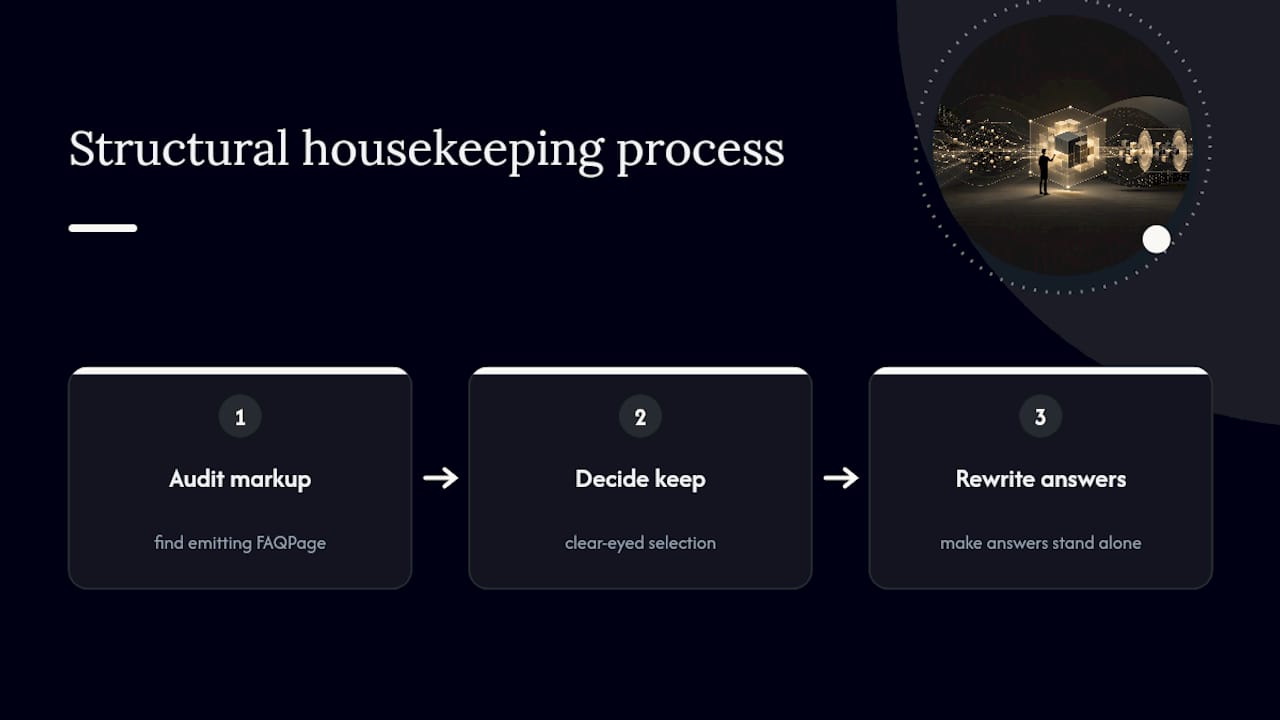
Schema is a descriptive layer sitting on top of your content. It never made a weak answer good, and removing it never made a strong one weak. What actually holds up over time is content written to stand on its own, whether a human reads it or a machine parses it.
Our approach is unglamorous by design: a fast audit of what’s emitting FAQPage markup, a clear-eyed call on what to keep, and rewrites that make each answer worth keeping in the first place. Chasing the next rich result is a treadmill. Writing answers that hold up regardless of what Google displays this quarter is not.
— Christopher
Get a Structured-Data Audit Instead of Guessing
There are faster paths to a clean FAQ setup than piecing it together from blog posts and forum threads. Instead of manually crawling templates, cross-checking JSON-LD, and rewriting answers one page at a time, a service can handle the inventory crawl, sort every page into Keep, Audit, or Remove, deploy the server-side JSON-LD correctly, and rewrite the answers themselves so they’re worth keeping.

The path is simple: start with a free consultation, and depending on scope, that turns into a Foundational Review if you just need the audit and a plan, or a full Launch Sprint if your FAQ rewrite is part of a broader content and structure cleanup. Unlike hiring an agency for an open-ended retainer, this is a scoped project with a fixed starting price, from $250 for the review. If your FAQ pages have been running on autopilot since before the May 2026 change, book a consultation and get an actual plan instead of another guide to read.
Where to Verify This Yourself
Check the official FAQPage type definition on Schema.org, run your markup through validator.schema.org, and read the breakdown of what changed on May 7, 2026 for the full deprecation timeline. For broader context on which structured-data types still produce visible enhancements, this rich-results overview is worth a read, and our own notes on site architecture and crawlability cover how to inventory pages at scale.
Sources
FAQ
What Is FAQ Schema?
FAQ schema is structured data built from the FAQPage type, with individual Question entries and their acceptedAnswer responses marked up in JSON-LD. It tells crawlers exactly which text on a page is a question and which text answers it, and Schema.org still fully supports the type.
Is FAQ Schema Still Relevant in 2026?
Yes, but not for the reason most sites originally added it. Google removed the visual FAQ rich result on May 7, 2026, so the markup no longer earns extra space in search results. It remains relevant as a structural signal that can help non-Google parsers and AI retrieval tools identify clean question-answer pairs.
Is FAQ Schema Worth Implementing Now?
It’s worth implementing only on pages where the FAQ is genuine, visible, and written specifically for that page. On templated or decorative FAQ blocks, the effort is better spent rewriting the content itself, since the schema no longer produces a visible search benefit on its own.
What Does the FAQ Schema Code Look Like?
A minimal example wraps a FAQPage object around one or more Question entries, each carrying an acceptedAnswer with an Answer object holding the response text. The full working snippet appears earlier in this article under the implementation section, and it should always be rendered server-side so crawlers see it in the raw HTML.
Can Moderatemurmurations Help Audit My Existing FAQ Schema?
Yes. Moderatemurmurations offers a Foundational Review that inventories every page emitting FAQPage markup, sorts them into Keep, Audit, or Remove, and outlines the fixes, starting from $250 for the review itself.