8 Homepage Copy Examples for Local Businesses That Convert
8 Homepage Copy Examples for Local Businesses That Convert

This article gives you eight real-style homepage copy examples for local businesses, plus three fill-in headline and CTA templates you can paste straight into your site. Each example below shows the hero headline, the subhead that backs it up, why the pairing works, and one line on adapting it to your town, service radius, or offer.
Here’s what’s included:
- Restaurant/food hero copy
- Trades and contractor homepage messaging
- Salon and beauty homepage copy
- Accountant/consultant hero statement
- Solo creative/photographer homepage
- Retail/ecommerce local shop copy
- Fitness studio homepage example
- Local service provider (cleaning/landscaping) copy
Scroll to the headline and CTA templates section to grab three fill-in-the-blank formulas you can adapt in minutes.
Key Takeaways
Local business homepages convert best when the headline states a specific benefit, location, or offer, and the CTA sits within view of it.
| Point | Details |
|---|---|
| Lead with benefit, not history | Your hero headline should name the outcome and location, saving your story for the About page. |
| Pair every headline with a CTA | Keep the primary action visible near the hero text, with a lower-commitment option nearby. |
| Localize with specifics | Swap in your actual town, service radius, or turnaround time rather than generic claims. |
| Test one variable at a time | Change only the headline or only the CTA wording, then track clicks before adjusting further. |
| Get expert help when needed | Moderatemurmurations offers a done-for-you homepage rewrite with CTA testing and a strategy call. |
Table of Contents
- What every local business homepage must include
- Eight homepage copy examples worth stealing
- Headline formulas and CTA templates you can copy
- What most homepage advice gets backward
- Why “just add more information” is the wrong instinct
- Get a homepage rewrite without the agency retainer
- Sources
What every local business homepage must include
Before you borrow any of the copy below, know where each line belongs. Most local homepages that convert well share the same skeleton, just with different words filling it in.
- Hero headline: states the main benefit or service, with a local cue (town name, neighborhood, or “near you”) when it fits naturally.
- Supporting subhead: one short sentence clarifying who you help and how.
- Primary CTA: a clear action plus a modifier (“Book a Free Quote Today”), with a lower-commitment secondary link nearby for visitors who aren’t ready yet.
- Service snapshot: three core offers written as benefits, not job titles.
- Trust signals: a customer quote, a review count, a local badge, or a quick stat.
- Contact and booking access: phone number, booking button, or short form visible in the header or footer.
LocaliQ’s research on local homepages points to the same pattern: a plain statement of what you do, visible proof, and a CTA that matches local intent. Weave in local keywords by naming your city or service area inside the headline or subhead, not by stacking keywords into a sentence that no human would say out loud.
Pro Tip: Read your headline out loud to someone outside your industry. If they can’t repeat back what you do and where, rewrite it before you touch anything else on the page.
Eight homepage copy examples worth stealing
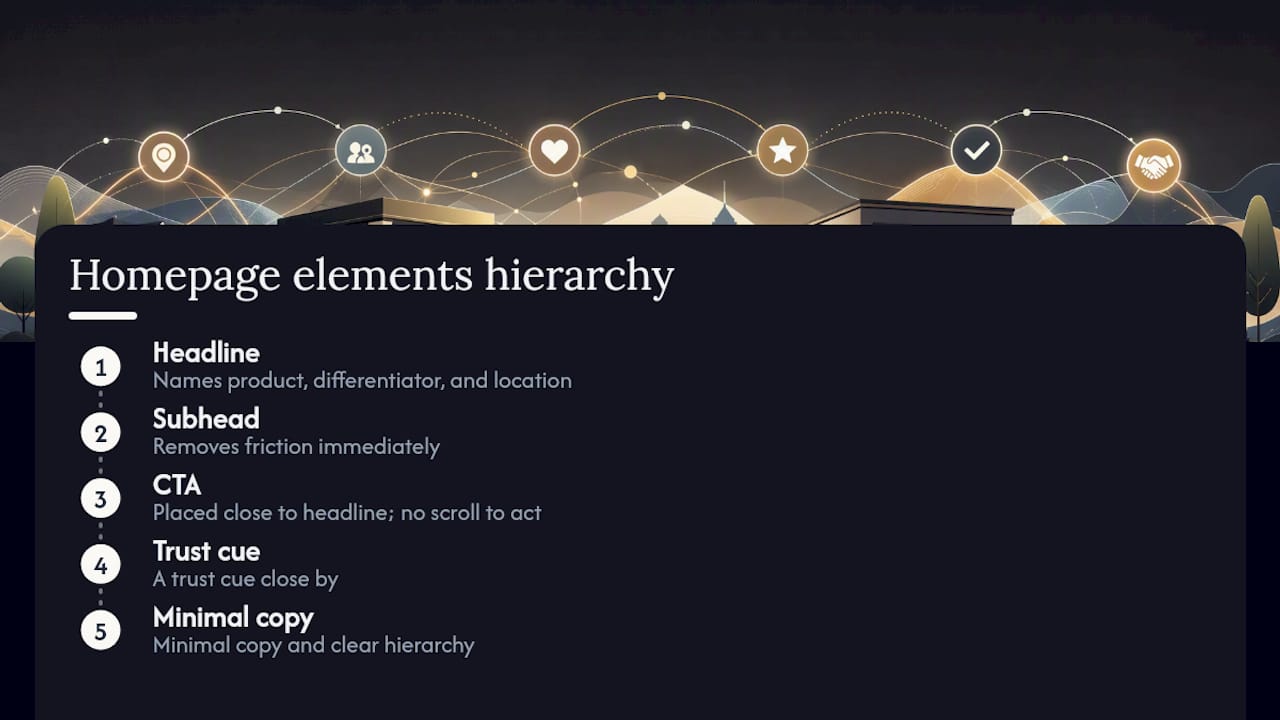
These examples of local business homepage copy come from patterns seen across dozens of small business website examples, adapted here into ready-to-use snippets. Each one models the checklist above: headline, subhead, CTA, and a trust cue close by.
1. Restaurant/food
This works because it names the product, the differentiator (wood-fired), and the location in one breath, then removes friction with two ordering options. Adaptation tip: swap “Riverside” for your neighborhood and add your busiest hour as a subtle urgency cue.

2. Trades/contractor
Speed and credibility sit side by side, which matters most when someone is searching mid-crisis. Adaptation tip: replace the response time with your actual average and name your service radius (e.g., “serving Dayton and 15 surrounding towns”).
3. Salon/beauty
The headline sells the outcome, not the service list, and the subhead removes booking friction immediately. Adaptation tip: add your stylist count or years in business as a one-line trust cue below the CTA.
4. Accountant/consultant
It names the emotional pain point (panic) and the audience (small business owners) in the same breath. Adaptation tip: swap “Denver” for your metro area and mention one specific service, like quarterly filings, to sharpen relevance.
5. Solo creative/photographer
Specificity beats generic “photography services” language every time, and the seasonal cue creates natural urgency. Adaptation tip: rotate the season and location phrase quarterly so the homepage always feels current. A personal brand site built around this kind of specificity tends to hold attention longer.
6. Retail/ecommerce (local shop)
Naming the actual street signals a real, physical place, and the delivery offer gives online shoppers a reason to act now. Adaptation tip: replace the threshold with your own delivery minimum and mention pickup hours if you offer them.
7. Fitness/studio
It disqualifies the wrong audience (gym lovers) while speaking directly to the reluctant beginner, then removes commitment anxiety. Adaptation tip: swap “no contract” for whatever your actual low-risk entry point is, like a punch card or trial week.

8. Local service provider (cleaning/landscaping)
Reliability and speed are the two things homeowners actually worry about with service providers, and both show up before the fold ends. Adaptation tip: state your actual quote turnaround time. If it’s faster than 24 hours, say so; that number alone can lift conversions.
Framer’s gallery of small business sites shows a common thread across strong homepages: minimal copy, clear hierarchy, and CTAs placed close enough to the headline that visitors never have to scroll to act.
Headline formulas and CTA templates you can copy
Most homepage headlines that convert follow one of two structures: benefit + audience + location, or offer + service + trust cue. Once you know which one fits your business, filling in the blanks takes minutes.
- [Benefit] for [Audience] in [Location]. Example: “Stress-Free Moves for Busy Families in Tampa.”
- [Service] Without the [Pain Point]. Example: “Roof Repairs Without the Runaround.”
- [Offer], [Service], [Trust Cue]. Example: “Free Estimates, Same-Week Installs, Rated 4.9 Stars Locally.”
For CTAs, stack three types on your homepage: a primary action (“Book Your Appointment”), an urgency modifier (“Get a Same-Day Quote”), and a lower-commitment option (“See Our Work First”). If your tone needs to shift, swap “book now” for “schedule a visit” when you want to sound friendlier, or “request a consultation” when you want more authority.
Pro Tip: Test one headline change at a time. Swap only the location phrase or only the CTA wording, then track time-on-page or CTA clicks for two weeks before changing anything else. Your local SEO setup should stay consistent while you run these tests, so you’re only measuring one variable.
How these examples were chosen
Selection favored clarity of headline, a visible CTA, easy local adaptation, and at least one trust signal, drawn from patterns across curated small business galleries and design platform roundups. The goal was variety across industries, not any single vendor’s template.
What most homepage advice gets backward
Every one of the small business owners and local service providers Moderatemurmurations has worked with makes the same early mistake: leading with company history instead of visitor benefit.
Two habits separate homepages that convert from ones that don’t. Do lead your hero headline with the outcome the visitor wants, and do test CTA wording every few weeks instead of setting it once. Don’t hide your phone number below three scrolls, and don’t reach for vague industry jargon when a plain sentence would land harder.
Pro Tip: On past projects, pairing a rewritten headline with one simple photo change, like swapping a stock image for a real storefront shot, moved the needle faster than a full redesign.
Why “just add more information” is the wrong instinct
Most homepage advice tells small business owners to add more: more services, more credentials, more copy explaining what makes them different. The research on effective small business sites points the opposite direction. Squarespace’s own analysis of strong small business homepages found the best ones use minimal copy and let a clear CTA do the work a paragraph never could.
The conventional advice to “tell your story on the homepage” is where most local businesses lose visitors. Your story belongs on an About page. The homepage’s only job is answering three questions in under five seconds: what do you do, where, and what happens when I click.
If you take one thing from this list, prioritize the headline and CTA pairing over everything else. A local service provider with a mediocre design but a headline that names the exact benefit and location will outconvert a beautifully designed site with a vague one.
Get a homepage rewrite without the agency retainer
If rewriting your own homepage from these examples feels like more time than you have this month, Moderatemurmurations offers a faster path: a done-for-you homepage rewrite built around local SEO friendly copy and CTA testing, without the multi-month agency timeline or ongoing contract.
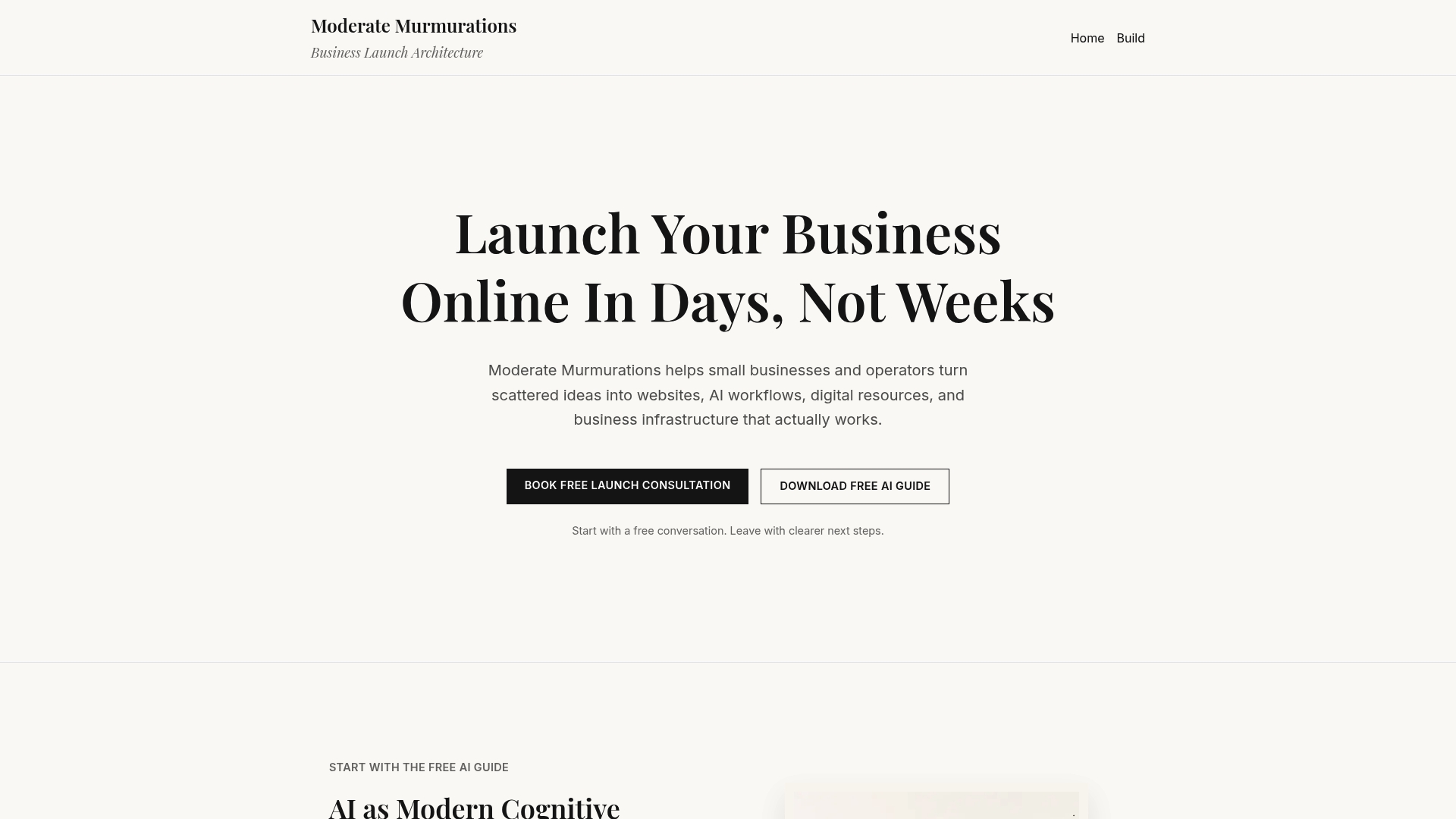
The service includes a headline and subhead rewrite tailored to your services and town, a CTA testing plan so you know what to try next, and a 30-minute strategy call to walk through it together, with optional full implementation if you want it handled end to end. It pairs well with a broader online visibility checklist if your homepage is just one piece of a larger refresh. Book a free consultation with Moderatemurmurations to see what a rewritten homepage could look like for your business before you commit to anything.
Sources
- Small Business Websites: 50+ Inspiring Examples
- Small business website examples
- 9 Small Business Website Examples to Inspire You — Squarespace