Digital Transformation: A Strategic Guide for Leaders
Digital Transformation: A Strategic Guide for Leaders

Digital transformation is the strategic integration of digital technology across every part of an organization to fundamentally change how it operates and delivers value. It is not a single project or a software upgrade. It is a continuous process of rewiring how your business thinks, works, and grows.
What digital transformation actually means for your organization
Most definitions focus on technology. The more useful frame is this: digital transformation reshapes business models, processes, culture, and customer relationships simultaneously. McKinsey describes it as continuous organizational rewiring focused on deploying technology at scale, requiring CEO leadership and cross-functional alignment. IBM and SAP align on the same core idea: technology is the enabler, not the destination.
The five domains where transformation actually happens are:
- Business model: How you create and capture value, including new revenue streams and market approaches
- Processes: How work gets done, from supply chain to customer service to internal operations
- Culture: How people think about change, experimentation, and data-driven decisions
- Technology: The platforms, tools, and infrastructure that make everything else possible
- Customer experience: How customers discover, buy, and stay loyal to your brand
Understanding these domains together is what separates a genuine transformation from a technology refresh. You can buy the best software on the market and still fail if culture and process stay the same.
Why the importance of digital transformation keeps growing

The competitive gap between digital leaders and laggards is measurable and widening. Digital leaders achieved about 65% greater annual total shareholder returns than digital laggards between 2018 and 2022, according to McKinsey research. That figure alone reframes the conversation from “should we transform?” to “how fast can we move?”
The benefits extend beyond shareholder returns:
- Customer loyalty: Digital tools let you personalize at scale, respond faster, and reduce friction in every interaction
- Operational agility: Automated workflows and real-time data reduce the lag between a market shift and your response
- Cost reduction: Cloud infrastructure, remote collaboration tools, and process automation cut overhead that used to be fixed
- New revenue streams: Data collected through digital channels reveals demand patterns that open entirely new markets
The pandemic accelerated all of this. Organizations that had invested in cloud infrastructure and digital customer channels adapted within weeks. Those that had not spent months catching up, often at a steep cost. The lesson was not subtle: waiting for the “right time” to transform is itself a risk.
Stat to know: Deloitte research found that investing in technology without building organizational change capability risks a 9% erosion in enterprise value, equivalent to $1.5 trillion across Fortune 500 companies.
That figure reframes the risk calculus entirely. The danger is not moving too fast. It is spending on technology while neglecting the human and organizational side.
Why culture and change management determine whether transformation succeeds
Technology failures in digital transformation are rare. Cultural failures are common. SAP’s research consistently shows that poor planning, misaligned goals, and lack of leadership alignment, not technology issues, are the primary reasons transformation efforts stall.
The cultural barriers that derail most initiatives include:
- Resistance from employees who feel threatened by new tools or processes
- Siloed departments that protect their workflows instead of collaborating
- Leadership that sponsors transformation in name but does not model the behavior
- A culture that punishes failure rather than treating it as a learning signal
Change management in a transformation context means more than communication plans and training sessions. It means building psychological safety so teams will experiment, report problems early, and adapt without waiting for permission. IBM’s guidance on this is direct: empowering employees with a “fail fast” mindset is not a cultural nicety. It is a structural requirement for transformation to work.
Pro Tip: Balance centralized governance with decentralized innovation. Set clear standards for data, security, and architecture at the center, then give individual teams the freedom to experiment within those guardrails. This prevents chaos without killing the agility that transformation requires.
Deloitte’s research reinforces this tension. Organizations that over-centralize lose the speed and creativity that digital markets demand. Those that over-decentralize end up with fragmented systems and duplicated effort. The right balance is a deliberate design choice, not a default.
How frameworks from BCG and McKinsey structure your transformation strategy
A framework does not replace judgment, but it does prevent you from skipping steps that matter. Two of the most widely used approaches come from BCG and McKinsey, and they complement each other well.
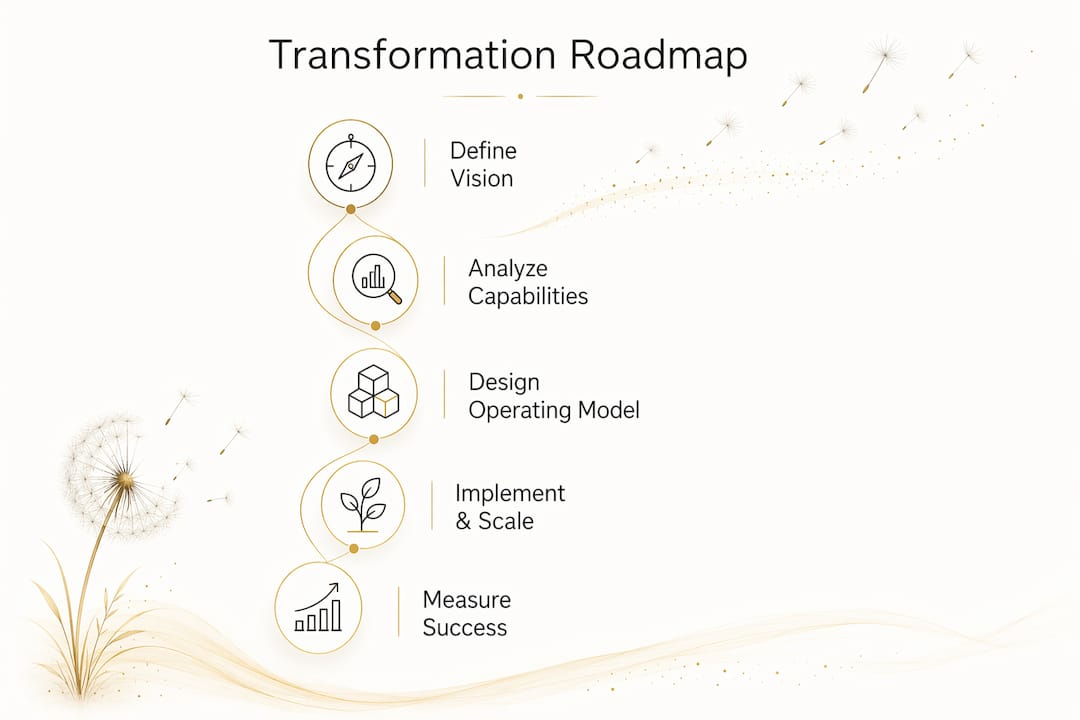
BCG’s digital strategy roadmap spans 8–12 weeks and moves through four phases: defining a clear vision, analyzing capability gaps, prioritizing the highest-value digital bets, and building an execution plan. The time-bound structure forces decisions that open-ended planning processes tend to defer indefinitely.
McKinsey outlines six essential capabilities for successful transformation: strategy clarity, scalable operating models, distributed technology, accessible data, strong adoption practices, and leadership alignment. These are not sequential steps. They are parallel requirements that need to be in place simultaneously.
| Strategic domain | Primary focus | Key activities | Expected outcome |
|---|---|---|---|
| Customer journeys | Experience redesign | Journey mapping, personalization, digital channels | Higher retention and satisfaction |
| Business model | Value creation | New revenue streams, platform thinking, ecosystem plays | Competitive differentiation |
| Processes | Operational efficiency | Automation, workflow redesign, data integration | Lower costs, faster execution |
| Employee experience | Workforce enablement | Digital tools, training, collaboration platforms | Higher engagement and productivity |
The table above reflects how McKinsey and BCG both treat transformation as multi-domain work. Focusing on one domain while neglecting others produces partial results at best. A company that automates its operations but ignores customer experience will cut costs and lose customers at the same time.
What leadership roles actually look like in a transformation
The CEO’s role is not to understand every technology decision. It is to set the direction, hold the organization accountable, and sustain commitment when the initiative gets hard. McKinsey is explicit that transformation requires CEO-level ownership, not delegation to a Chief Digital Officer who lacks the authority to drive cross-functional change.
Leadership responsibilities across the C-suite break down this way:
- CEO: Sets vision, owns accountability, models the cultural behaviors transformation requires
- CIO/CTO: Translates business goals into technology architecture and manages vendor relationships
- CFO: Aligns investment decisions with transformation priorities and tracks value creation
- CHRO: Leads workforce planning, skill development, and the cultural change program
- Business unit leaders: Own transformation within their domains and champion adoption on their teams
Cross-functional governance matters as much as individual roles. Transformation initiatives that live inside a single department tend to optimize for that department’s needs rather than the organization’s. A steering committee with representation across functions, meeting regularly with real decision-making authority, prevents the initiative from becoming a technology project that nobody else owns.
IBM’s perspective on this is worth noting: leadership clarity reduces the ambiguity that causes middle management to stall. When people know who decides what, they spend less time navigating politics and more time executing.
How AI and emerging technologies accelerate transformation
AI is the most consequential technology in the current transformation cycle, but it works best when it is embedded in a clear business process rather than deployed as a standalone experiment. The practical applications that deliver the most consistent value are decision support, process automation, and personalization at scale.
Key technology enablers in 2026 include:
- AI and machine learning: Predictive analytics, natural language processing, and automated decision-making across customer service, operations, and product development
- Cloud and hybrid infrastructure: Cloud computing provides the agility and scalability that on-premise systems cannot match, and hybrid models let organizations move at their own pace
- IoT and connected systems: Real-time data from physical assets, enabling predictive maintenance and supply chain visibility
- Automation workflows: End-to-end process automation that reduces manual work and error rates across finance, HR, and operations
The role of automation in scaling businesses is particularly relevant here. Automation does not replace transformation strategy. It executes it faster and at lower cost once the strategy is clear.
Pro Tip: Start AI adoption with a process you already understand well. Applying AI to a broken or poorly defined process produces faster bad outcomes. Fix the process first, then automate and augment it.
Technology is the accelerant, not the foundation. Organizations that treat AI as a strategy rather than a tool tend to invest heavily in platforms while underinvesting in the data quality, process clarity, and change management that make those platforms useful.
How to measure ROI and track transformation success
Measurement is where many transformation programs lose credibility. Executives approve budgets based on projected returns, then struggle to connect technology spending to business outcomes eighteen months later. The problem is usually that the metrics were defined too late, too broadly, or not connected to the domains where investment was made.
McKinsey organizes transformation KPIs into three categories: value creation, team health, and change management progress. Each category needs its own set of metrics tracked on a regular cadence.
| Metric category | Example KPIs | Business impact |
|---|---|---|
| Value creation | Revenue from new digital channels, cost per transaction, customer lifetime value | Directly links technology investment to financial outcomes |
| Team health | Employee engagement scores, adoption rates, skill assessment results | Indicates whether the organization can sustain transformation |
| Change management | Training completion, process compliance, leadership behavior assessments | Measures whether cultural change is actually happening |
Deloitte’s research shows that properly linking digital strategy, technology investments, and change capability can yield a 5% lift in competitive market capitalization. That lift depends on measurement being built into the program from day one, not retrofitted after the fact.
The risk of misaligned metrics is real. A team measured on technology deployment speed will ship fast and skip adoption. A team measured on cost reduction will cut the training budget that makes adoption possible. Metrics shape behavior, so they need to reflect the full picture of what transformation requires.
Practical steps to start or improve your digital transformation strategy
The most common mistake leaders make is treating transformation as a planning problem. They spend months on strategy documents and never get to execution. The more effective approach is iterative: start with a clear vision, move quickly to a pilot, learn from it, and scale what works.
Here is a practical sequence that works across industries and organization sizes:
- Define your transformation vision tied to specific business outcomes, not technology adoption. “We will reduce customer onboarding time by 40%” is a vision. “We will implement a CRM” is a project.
- Assess your current capabilities across the five domains: business model, process, culture, technology, and customer experience. Identify the gaps that matter most.
- Prioritize your highest-value bets using a framework like BCG’s roadmap. Not every gap needs to be closed at once. Focus on the two or three initiatives that will create the most value in the next 12 months.
- Engage stakeholders early. Transformation fails when people feel it is being done to them. Involve frontline employees, customers, and partners in design from the start.
- Build change management into the plan, not as a separate workstream but as a core element of every initiative. Every technology rollout needs a parallel adoption and training plan.
- Prototype and iterate. Run small pilots before committing to full-scale deployment. Use the feedback to refine the approach before scaling.
- Track metrics from day one. Define your value creation, team health, and change management KPIs before you launch, not after.
A digital business growth roadmap helps translate this sequence into a plan your team can actually execute against. The goal is not a perfect plan. It is a clear enough direction to start moving and a feedback loop that lets you adjust as you go.
Pro Tip: Set 90-day milestones rather than annual targets. Transformation programs that measure progress only at year-end lose momentum and miss early warning signs. Short cycles keep teams focused and give leadership the data to make course corrections before small problems become expensive ones.
Expert insights shaping the future of digital transformation
The most important shift in how leading organizations think about transformation is the move from “project” to “permanent state.” McKinsey and Deloitte both describe this as a continuous rewiring mindset: the organization never finishes transforming, it just gets better at it.
This framing has practical implications. It means transformation capability, the ability to change quickly and deliberately, becomes a core organizational asset. Companies that build this capability outperform those that treat each transformation as a fresh start.
Emerging research from Springer’s work on identity in digital transformation adds a dimension that most frameworks miss: brand identity and ecosystem participation. Future-ready organizations do not just transform internally. They define how they participate in broader digital ecosystems, platforms, marketplaces, and partner networks, and they build a clear identity within those ecosystems that customers and partners can recognize and trust.
Key insights from leading practitioners in 2026:
- Transformation programs that neglect organizational change capability risk the 9% enterprise value erosion Deloitte quantified across Fortune 500 companies
- The organizations with the highest transformation ROI treat culture change and technology deployment as equally weighted investments
- Ecosystem thinking, how your organization connects to partners, platforms, and customers digitally, is becoming as important as internal process improvement
- Continuous learning at the leadership level, not just the workforce level, is what separates organizations that sustain transformation from those that stall after the first wave
At Moderatemurmurations, we work with businesses at exactly this intersection: clear digital strategy grounded in practical execution, not theoretical frameworks that never reach the team.
How to build the skills your workforce needs for transformation
Workforce capability is the most frequently underestimated constraint in transformation programs. Organizations invest in platforms and processes, then discover that their teams lack the skills to use them effectively. The result is expensive technology that sits underused while the transformation stalls.
The skill gaps that matter most in 2026 fall into three categories. Data literacy, the ability to read, interpret, and act on data, is now a baseline requirement across most roles, not just analytics teams. Digital tool proficiency covers the specific platforms your organization is deploying, from cloud collaboration tools to AI-assisted workflows. Adaptive thinking, the ability to work in ambiguous, fast-changing conditions, is harder to train but critical for sustaining transformation momentum.
Effective skill development programs share a few characteristics. They are role-specific rather than generic, connecting training directly to the tools and processes each team uses. They include practice, not just instruction, so employees build confidence through doing rather than watching. And they are ongoing, with regular refreshes as tools and processes evolve, rather than one-time events tied to a system launch.
IBM’s research on employee engagement shows that digital transformation, when implemented well, improves engagement and drives higher performance in sales productivity and lower absenteeism. The connection is direct: when employees feel equipped and supported, they perform better and stay longer.
Data management and cybersecurity during digital transformation
Every transformation initiative generates more data and more exposure. New systems, new integrations, and new digital channels all expand the attack surface that security teams need to protect. Organizations that treat cybersecurity as a post-launch concern consistently face breaches and compliance failures that erode the value their transformation was meant to create.
Data governance needs to be designed into transformation programs from the start. This means defining who owns each data set, how it is stored and accessed, what retention policies apply, and how it connects to other systems. Without this foundation, organizations end up with data silos that prevent the analytics and AI applications their transformation depends on.
The cybersecurity considerations specific to transformation include:
- Identity and access management: As more systems connect and more employees work remotely, controlling who can access what becomes more complex and more critical
- Third-party risk: Digital transformation often involves new vendors, platforms, and integrations, each of which introduces potential vulnerabilities
- Data privacy compliance: Regulations like GDPR and CCPA apply to the data your new digital systems collect, and non-compliance carries financial and reputational costs
- Security training: Employees are the most common entry point for breaches, so security awareness needs to be part of every transformation training program
The practical guidance here is straightforward. Build a data governance framework before you launch new systems, not after. Conduct security assessments at each phase of the transformation, not just at the end. And treat cybersecurity investment as a fixed cost of transformation, not an optional add-on.
Real-world examples of digital transformation done right
The most instructive case studies are not the ones where everything went smoothly. They are the ones where organizations made deliberate choices about where to start, how to measure progress, and how to handle the cultural resistance that every transformation encounters.
Starbucks is a frequently cited example of customer experience transformation done well. The company’s mobile app, which integrates ordering, payment, and loyalty rewards, was not just a technology project. It required redesigning the customer journey, retraining baristas, and building the data infrastructure to personalize offers at scale. The result was a loyalty program that became one of the most successful in retail.
Amazon demonstrates operational transformation at scale. The company’s investment in warehouse automation, including robotics and AI-driven inventory management, reduced fulfillment costs and increased speed. Critically, Amazon did not automate existing broken processes. It redesigned the processes first, then automated them.
Uber illustrates how digital transformation enables entirely new business models. The original ride-sharing platform generated data and customer relationships that made Uber Eats a natural extension, not a separate startup. The transformation capability Uber built for one market became the foundation for entering another.
These examples share a common pattern. Each company started with a clear customer or operational problem, built the technology solution around that problem, invested in the cultural and process changes needed to make the technology work, and measured outcomes against specific business goals rather than technology deployment milestones.
The lesson for your organization is not to copy what Starbucks or Amazon did. It is to apply the same discipline: define the problem, design the solution around it, and build the change management program that makes adoption real.
Key Takeaways
Digital transformation succeeds when leadership commitment, cultural change, and technology investment advance together, not when any one of them runs ahead of the others.
| Point | Details |
|---|---|
| Culture drives outcomes | Technology failures are rare; cultural and leadership failures cause most transformation programs to stall. |
| Financial stakes are high | Neglecting organizational change capability risks a 9% erosion in enterprise value, per Deloitte research. |
| Measure from day one | Track value creation, team health, and change management progress using KPIs defined before launch. |
| Frameworks reduce guesswork | BCG’s 8–12 week roadmap and McKinsey’s six capability model give transformation programs a structured starting point. |
| Transformation never ends | Organizations that treat digital change as a permanent operating state consistently outperform those that run it as a one-time project. |
Ready to move from strategy to execution? Moderatemurmurations builds the digital infrastructure that makes transformation practical for small businesses, service providers, and growing teams. From AI-assisted workflows to search-ready content systems, we help you build what your business actually needs, without the complexity.

Start with a clear foundation at moderatemurmurations.com.