Digital Systems for Entrepreneurs Explained
Digital Systems for Entrepreneurs Explained

Digital systems for entrepreneurs are interconnected technologies and processes designed to automate, organize, and run business operations without constant manual effort. Every growing business runs on systems, whether those systems are intentional or not. The difference between a founder who works 60-hour weeks and one who works 30 is rarely talent. It is infrastructure. This article breaks down what digital systems actually are, which categories matter most, how to build them in the right order, and how to choose tools that match where your business is right now.
What are digital systems for entrepreneurs?
A digital system is a set of connected tools and defined processes that handle a repeatable business function. The industry term for this is business infrastructure, and it covers everything from how you capture leads to how you send invoices. Digital systems for entrepreneurs explained simply: they are the operating layer beneath your daily work.
Entrepreneurs often confuse digital systems with software. Software is just one component. The system includes the workflow, the rules, the data flow, and the people or automations that execute each step. A CRM tool sitting unused is not a system. A CRM connected to your intake form, your email follow-up sequence, and your calendar is a system.

The payoff is consistency. When a process lives inside a system, it runs the same way every time. That consistency is what makes a business scalable and repeatable, regardless of how many clients you serve.
What types of digital systems do entrepreneurs commonly use?
Business digital tools fall into five broad categories. Each one supports a different function, and most growing businesses need at least three of them working together.
- CRM and sales systems manage contacts, track deals, and automate follow-up. Examples include pipeline tools, booking systems, and lead capture forms.
- Marketing and content systems handle email campaigns, social scheduling, SEO content, and audience nurturing.
- Operations and project management systems track tasks, deadlines, client deliverables, and team workflows.
- Financial systems cover invoicing, expense tracking, payroll, and reporting.
- Communication systems manage internal team messaging, client portals, and document sharing.
The core decision every entrepreneur faces is whether to use an all-in-one platform or build a specialist stack. All-in-one platforms provide unified CRM, accounting, HR, and operations under a single data model, which reduces duplicate data entry and reconciliation work. A single login, one bill, and one shared data model simplifies day-to-day management considerably.
Specialist stacks, by contrast, combine best-in-class tools for each function. They offer deeper automation but require more setup and integration work.
| Category | All-in-one platform | Specialist stack |
|---|---|---|
| Best for | Early-stage businesses, solo founders | Established businesses with defined workflows |
| Setup time | Days | Weeks to months |
| Cost | Lower monthly overhead | Higher, but more targeted |
| Automation depth | Moderate | High |
| Integration effort | Minimal | Requires API or middleware |
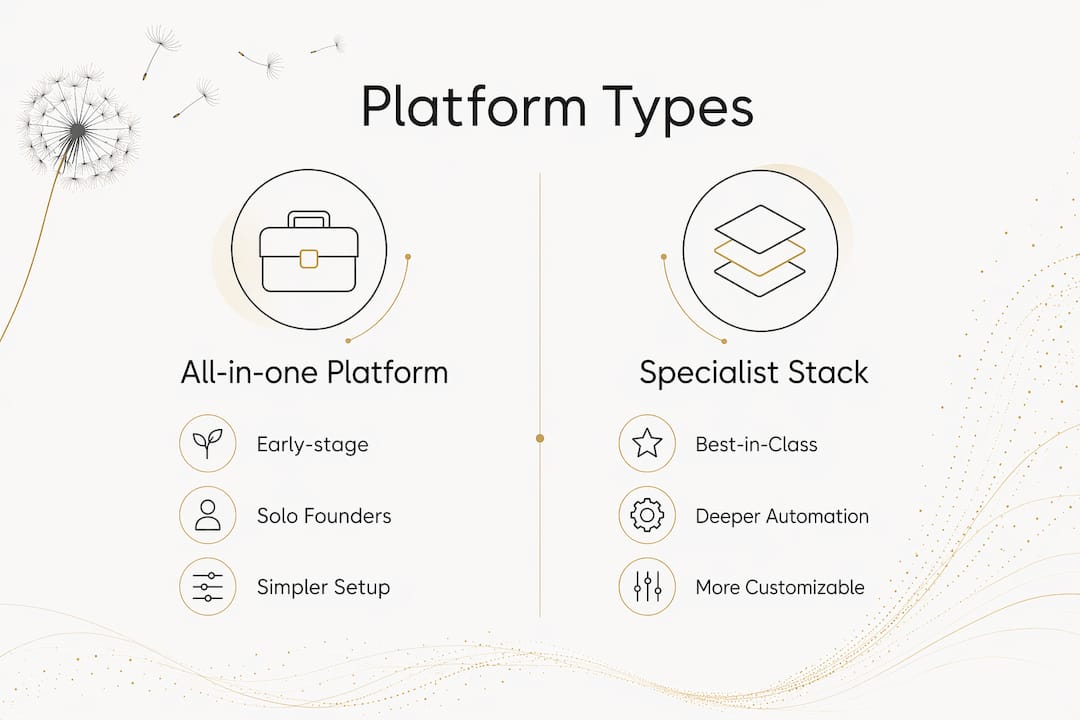
The right choice depends on your revenue stage, team size, and how clearly you have defined your workflows. Choosing before you know your workflows is the most common and most expensive mistake.
How do interconnected systems create resilience and scale?
The Entrepreneur Infrastructure Model™ defines five core systems that every business needs: credibility, communication, operations, technology, and growth. These five do not operate independently. They form what the model calls an Infrastructure Flywheel™, where each system feeds the next. When they are aligned, growth compounds. When one is missing or broken, the whole flywheel slows.
The sequence matters as much as the components. Effective system design starts with credibility infrastructure, meaning your website, positioning, and proof of expertise. Communication systems come next, covering how you attract and nurture leads. Operations follow, then technology to automate what you have already validated manually, and finally growth systems to scale what works.
Most entrepreneurs get this backward. They buy automation tools before they have a clear sales process. They set up project management software before they know what their delivery workflow actually looks like. The result is a tech stack that creates more friction, not less.
Systems thinking shifts your focus from isolated problems to interconnected processes. That shift moves a business from founder-dependent to infrastructure-supported. When you remove yourself as the bottleneck, the business can serve clients, generate revenue, and handle operations without you being present at every step.
Pro Tip: Draw your current business on a whiteboard as five boxes: credibility, communication, operations, technology, and growth. Draw arrows between them. Every missing arrow is a gap where work falls through and your time gets consumed.
Disconnects between systems cause the most common founder bottlenecks. A marketing system that generates leads but has no connection to a CRM means every new inquiry requires manual follow-up. A project management tool that does not connect to invoicing means billing always gets delayed. Connected data flows between sales, operations, and finance are critical for avoiding siloed information, especially as teams grow beyond 5 to 10 people.
What are best practices for implementing digital systems?
The single most important rule is this: document before you automate. Manual mapping of tasks for 3 to 4 weeks before adopting new software prevents you from embedding broken workflows into your tech stack. Automation makes a good process faster. It makes a bad process fail faster and at greater scale.
Follow this sequence when building your digital infrastructure:
- Write down every repeating task you do in your business for two to four weeks. Note the trigger, the steps, and the outcome.
- Identify which tasks are truly repeatable and which require judgment. Only repeatable tasks are good automation candidates.
- Choose your core system first. For most early-stage entrepreneurs, that is a CRM or an all-in-one platform that handles contacts, tasks, and basic communication.
- Connect your financial system so invoicing and payment tracking are automatic from the start.
- Add marketing automation once your lead generation process is consistent and documented.
- Integrate specialist tools only when a core system cannot handle a specific function you need daily.
- Audit your stack every 90 days. Remove tools you are not using. Consolidate where possible.
Tool fatigue is real and underestimated. Entrepreneurs often accumulate subscriptions without a clear plan, and the result is a fragmented tech stack where data lives in five places at once. Prioritizing connected data models where sales, operations, and finance share information automatically prevents the data silos that slow growth.
Pro Tip: Map your workflows on paper or in a simple doc for three to four weeks before buying any new tool. You will see patterns you did not know existed, and you will avoid paying for features you will never use.
Most small and mid-sized businesses can set up a unified platform in 5 to 10 days without five-figure consulting fees. Speed of setup is not the goal, but knowing that implementation does not require months of work removes a major mental barrier for entrepreneurs who have been putting it off.
How do you choose the right tools for your growth stage?
Revenue is the clearest signal for which type of system fits your business right now. Entrepreneurs under $5,000 monthly revenue typically save time and reduce complexity by using all-in-one platforms. Businesses above that threshold often benefit from deeper automation through specialist tools that connect via integrations.
This is not a rigid rule. It is a starting point. The real question is whether your current workflows are stable enough to automate. If your sales process changes every month, a complex specialist stack will require constant reconfiguration. An all-in-one platform gives you room to iterate without breaking integrations.
Consider these factors when evaluating your options:
- Integration and interoperability. Can your tools share data without manual exports? If not, you will spend hours reconciling records.
- Automation depth. Does the platform let you build conditional workflows, or does it only send basic email sequences?
- Learning curve. A tool your team avoids using is worse than a simpler tool they use every day.
- Cost at scale. Some platforms charge per contact or per user. Run the math at 2x your current size before committing.
Reassess your tech stack at every major business milestone. What works at $3,000 per month in revenue will not serve you at $30,000 per month. The goal is to build a digital strategy for growing businesses that evolves with your operations, not one you have to rebuild from scratch every time you grow.
Pro Tip: Before switching platforms, list every tool you currently pay for and mark each one as “daily,” “weekly,” or “rarely.” Cut everything in the “rarely” column. You will likely free up budget for one better-connected tool.
Key Takeaways
Digital systems work when they are built in sequence, connected across functions, and validated manually before automation is added.
| Point | Details |
|---|---|
| Define before you buy | Map your repeating tasks for 3 to 4 weeks before choosing any software. |
| Follow the infrastructure sequence | Build credibility, then communication, operations, technology, and growth in that order. |
| Match tools to revenue stage | Businesses under $5,000 monthly revenue benefit most from all-in-one platforms. |
| Connect your data | Sales, operations, and finance must share data automatically to prevent bottlenecks. |
| Audit regularly | Review your tech stack every 90 days and remove tools you are not using daily. |
Why most entrepreneurs build systems in the wrong order
The pattern I see most often is this: an entrepreneur buys a project management tool, a CRM, an email platform, and a scheduling app in the same month, then spends the next three months trying to make them talk to each other. None of it was mapped first. None of it was tested manually. The result is a system that requires more management than the manual process it replaced.
The uncomfortable truth about automating business processes is that automation does not fix confusion. It amplifies it. If your client onboarding process is unclear, automating it will send confusing emails faster and to more people. The fix is always to clarify the process first, then automate the clear version.
What actually works is starting smaller than feels comfortable. Pick one core system, run it manually for a month, then automate the parts that are genuinely repeatable. That approach feels slow. It is not. It is the fastest path to a tech stack that actually reduces your workload instead of adding to it.
The entrepreneurs I have seen build the most durable operations share one trait: they think of their business as an interconnected system, not a collection of separate projects. When you see your personal brand website, your CRM, your content calendar, and your invoicing tool as one organism, you make better decisions about where to invest time and money.
— Christopher
Moderatemurmurations builds digital systems that work from day one
Moderatemurmurations helps entrepreneurs and small business owners build fast, clean digital infrastructure without the months of setup or the consultant fees. From AI-assisted websites and landing pages to full digital systems including CRM setup, content structure, and automated workflows, the work is built around your actual business stage.

If you are ready to move from scattered tools to a connected system, the Moderatemurmurations build page outlines exactly what is included and how quickly you can get started. For entrepreneurs who want a complete online presence built and ready to grow, launch your business online with a setup designed for your current stage and your next one.
FAQ
What are digital systems for entrepreneurs?
Digital systems for entrepreneurs are connected tools and defined processes that handle repeating business functions automatically. They cover sales, operations, marketing, finance, and communication working together as one infrastructure.
How do I know which digital tools my business needs?
Start by documenting every repeating task you do for two to four weeks, then identify which tasks are stable enough to automate. Revenue stage is also a reliable guide: businesses under $5,000 monthly revenue typically benefit most from all-in-one platforms.
What is the Entrepreneur Infrastructure Model™?
The Entrepreneur Infrastructure Model™ is a framework that defines five core business systems: credibility, communication, operations, technology, and growth. These systems work in sequence to build sustainable, founder-independent business infrastructure.
How long does it take to set up a digital system?
Most small businesses can set up a unified CRM and operations platform in 5 to 10 days. The manual workflow mapping that should come before setup typically takes 3 to 4 weeks and is the most important part of the process.
What is the biggest mistake entrepreneurs make with digital tools?
The most common mistake is automating before documenting. Entrepreneurs adopt tools before their workflows are clear, which embeds inefficiencies into the system and creates more management work, not less.