Ten Content Types Every Service Website Needs to Convert
Ten Content Types Every Service Website Needs to Convert

Service websites succeed or fail on a short list: a homepage that routes visitors, service pages that convert them, case studies that prove results, a pricing and FAQ page that removes doubt, a contact page with almost no friction, and a pillar content hub that pulls in new prospects through search. Testimonials, a process page, an email lead magnet, and one video asset round out the list. That is a concise set of content types, and none of it works if you try to build all of it at once.
We recommend a simple rule: if your site gets little or no traffic yet, fix the six core pages first, since they are what turn any visitor you already have into an inquiry. If you already get steady traffic but few leads, your problem is usually discovery content, so a pillar page and two or three cluster posts should come next.
Here is the shortlist and why each one earns its place:
- Homepage — routes visitors to the right service page in under ten seconds.
- Service pages — do the actual convincing; this is where “maybe” becomes “yes.”
- Case studies — supply proof that your process produces results, not just promises.
- Pricing and FAQ — answer the two questions every prospect is silently asking: “can I afford this” and “what if it doesn’t work.”
- Contact/booking page — removes the last friction point before someone reaches out.
- Pillar content — the long-form hub post that search engines and prospects find first.
- Cluster blog posts — narrower posts that link back to the pillar and to service pages.
- Process page — shows what working with you actually looks like, week by week.
- Testimonials — short, specific quotes that reinforce case studies throughout the site.
- Video or podcast — a discovery channel for prospects who would rather watch or listen than read.
New sites: build the six core pages before writing a single blog post. Sites with existing traffic but flat lead volume: publish one pillar page and connect it to your best service page with clear internal links.
Key Takeaways
Service websites convert best when the six core pages are built before any discovery content, and proof content with a single quantified outcome consistently outperforms qualitative praise alone.
| Point | Details |
|---|---|
| Fix conversion pages first | Build the homepage, service pages, pricing, and contact page before writing blog content. |
| Quantify every case study | Include at least one measurable outcome, like hours saved or a percentage lift, in each case study. |
| Use the pillar-and-cluster model | Publish one 2,000 to 4,000 word pillar page linked to two or three shorter cluster posts. |
| Commit to two channels for 90 days | Choose one discovery channel and one relationship channel before adding a third. |
| Track inquiries, not just traffic | Measure conversion rate to contact and assisted conversions monthly using UTM tagging. |
| Get it built faster | Moderatemurmurations builds core pages, proof content, and pillar posts as a single launch project. |
Table of Contents
- The Six Core Pages Every Service Website Needs
- High-Leverage Content That Directly Increases Conversions
- Discovery Content That Fills Your Service Pages With Traffic
- Matching Content Types to the Buyer’s Journey
- A 90-Day Framework for Prioritizing Your Content
- Getting More Mileage Out of Every Piece You Publish
- Metrics That Actually Prove Your Content Is Working
- Why Most Service Providers Get the Order Wrong
- Get Your Core Pages and Content Built Without the Guesswork
- Frequently Asked Questions
- Sources
The Six Core Pages Every Service Website Needs
A practical site anatomy for service businesses assigns each page exactly one conversion job, and that constraint is what makes the framework useful. Most service sites fail not because they lack content, but because every page tries to do three jobs at once and ends up doing none of them well.
Here is what each page needs to accomplish, and the content elements that make it work:
- Homepage. Its only job is routing. State who you serve, what outcome you deliver, and give visitors one primary call to action, not five competing buttons. Service cards below the fold let visitors self-select into the right service page without reading your entire site.
- Service pages. This is where conversion actually happens. Each page needs an audience-specific headline (not “Our Services” but “Bookkeeping for Freelance Designers”), a clear statement of outcomes, defined scope, a short process outline, a pricing range, one proof element, and a single call to action repeated near the top and bottom.
- About page. Credentials matter less than most owners think, but trust signals matter enormously. Include a real photo, a short origin story explaining why you do this work, and a plain statement of why a stranger should trust you with their problem.
- Proof and case studies. Structured case studies with real numbers and visuals do more conversion work than almost any other content type on the site. A strong case study includes the client’s starting context, the specific steps you took, and one quantified outcome. Even a modest number, like hours saved per week or a percentage increase in bookings, builds more trust than a glowing paragraph with no data behind it.
- Pricing and FAQ. Published ranges, even broad ones, filter out mismatched leads before they ever contact you. Pair pricing with an FAQ section that answers the objections you hear most often on discovery calls: timeline, what’s included, what happens if the project scope changes.
- Contact page. Keep the form short: name, email, one qualifying question, done. Add a phone number if you take calls, and a single line explaining what happens next (“We’ll respond within one business day with a few questions before booking a call.”).
Pro Tip: Write your “what happens next” line before you build the contact form. If you can’t describe your own follow-up process in one sentence, prospects will sense that uncertainty and hesitate to submit.
Consultants and coaches in particular benefit from tightening this sequence, since how consultant websites convert clients often comes down to whether the service page answers the visitor’s specific problem or a generic version of it.
High-Leverage Content That Directly Increases Conversions
Four content types do most of the heavy lifting once a visitor is already considering you: case studies, process pages, service guides, and pricing pages. These aren’t discovery tools. They exist to close the gap between “interested” and “booked.”
A strong case study follows a simple structure: problem, approach, measurable outcome. Start with the client’s situation before you arrived, describe the specific steps you took (not a vague “we optimized their strategy”), and end with one number that proves it worked. Quality case studies for service providers need the client’s context, the provider’s actual steps, and a measurable result, and even a single quantified stat dramatically increases how much a prospect trusts the claim. Add one client quote and a relevant image or screenshot, and follow basic image selection guidance so the visual loads fast without looking compressed or blurry.
Process pages solve a different anxiety: uncertainty about what happens after someone signs the contract. Lay out a timeline with named stages, clarify who does what (you versus the client), list deliverables at each stage, and tell the client exactly how to prepare before the engagement starts. This page reduces post-sale buyer’s remorse more than any testimonial can.
Service guides go further than a standard service page by answering the questions a prospect would otherwise ask on a discovery call. Expanding a thin service page into a genuine how-to or what-to-expect guide reduces the friction of unfamiliarity, particularly for services buyers don’t purchase often, like estate planning, brand strategy, or major renovations.
Pricing pages work best with real structure:
- Published ranges instead of “contact us for a quote,” even if the range is wide.
- A clear “what’s included” list broken out by tier or package.
- Scope bullets that show exactly where the engagement starts and stops.
- Filtering language that discourages mismatched leads without sounding exclusionary, such as “best suited for teams of 5 to 50”.
One overlooked detail: case studies with even one quantified outcome, a dollar figure, a time saved, a conversion lift, consistently outperform case studies built entirely on qualitative praise, because a single hard number gives skeptical readers something concrete to evaluate.
Discovery Content That Fills Your Service Pages With Traffic
Core pages convert visitors you already have. Discovery content brings you new visitors in the first place, and the most reliable model for service providers is pillar-and-cluster publishing.
A pillar page is a long, thorough post that covers a topic your ideal client searches for broadly. Cluster posts are shorter and each one answers a narrower question while linking back to both the pillar and the relevant service page. A pillar-and-cluster model paired with a relationship channel like LinkedIn gives service providers a repeatable way to attract the right prospects and then qualify them through specific service pages, rather than hoping generic blog traffic converts on its own.
- Pick one pillar topic tied directly to your highest-value service, not a broad industry theme.
- Draft two or three cluster posts that each answer a specific sub-question your ideal client would type into a search bar.
- Choose one discovery channel where you’ll consistently publish, whether that’s SEO-driven blog content or video.
- Choose one relationship channel for nurturing prospects who aren’t ready to buy yet, like email or LinkedIn.
- Commit to both for 90 days before judging results or switching approaches.
Video and podcasts work well as discovery channels, but only if you’re genuinely comfortable being on camera or on mic consistently. If that’s not you, prioritize long-form SEO writing instead; a well-structured pillar post can outperform a sporadically-updated YouTube channel by a wide margin. Shopify’s guidance on content ideation recommends experimenting with formats and aligning them to whichever channel your business can actually sustain, since consistency beats format novelty almost every time.
Pro Tip: Don’t launch three channels at once. Pick one discovery channel and one relationship channel, commit to both for 90 days, and only add a third channel once the first two are producing measurable traffic or replies.
A single pillar post can be repurposed into five or more distribution assets, which the next section covers in detail. That repurposing potential is exactly why the pillar deserves more upfront effort than any single cluster post.
Matching Content Types to the Buyer’s Journey
Content works when it matches where the prospect actually is, not where you wish they were. A pricing page shown to someone who has never heard of you converts poorly. A pillar post shown to someone ready to book feels like a detour. Service websites need distinct content for three stages: awareness, consideration, and decision.
Awareness stage prospects don’t know you exist yet and are often still defining their problem. The goal here is discovery, not conversion:
- Short social posts and explainer clips that surface a common pain point.
- SEO-driven listicles and explainer blog posts that answer broad questions.
- Short videos under two minutes that introduce a concept, not a sales pitch.
Consideration stage prospects know they have a problem and are comparing solutions. The goal is to move them toward contacting you, not to close the sale yet:
- Long-form guides and pillar content that demonstrate depth of expertise.
- Detailed service pages with process explainers and defined scope.
- Webinars or recorded walkthroughs for higher-ticket services.
Decision stage prospects are evaluating you specifically against one or two alternatives. The goal is conversion:
- Case studies with quantified outcomes.
- Pricing pages with published ranges and FAQ.
- Testimonials placed directly on service and contact pages.
- The contact or booking page itself.
The internal linking pattern matters as much as the content itself. Every cluster post should link to its pillar and to the most relevant service page, so a reader who arrives through an awareness-stage blog post can move to a consideration-stage service page in one click, then to a decision-stage case study in a second. Treating the homepage as a router rather than a sales pitch keeps this flow intact instead of forcing every visitor through the same generic landing experience regardless of what stage they’re actually in.
A 90-Day Framework for Prioritizing Your Content
Most service providers try to build everything at once and finish nothing. A tighter framework works better: figure out what’s actually missing, pick one asset per lane, and give yourself a real deadline.
- Diagnose the gap first. If you lack core conversion pages (service pages, pricing, contact), fix those before writing a single blog post. If your core pages are solid but traffic is flat, your gap is discovery content, and a pillar page becomes the priority instead.
- Map each content type to expected impact and effort. A case study takes a few hours and can lift conversion immediately. A pillar page takes days and pays off over months. Pick exactly one “convert” asset and one “discover” asset to complete this quarter, not five of each.
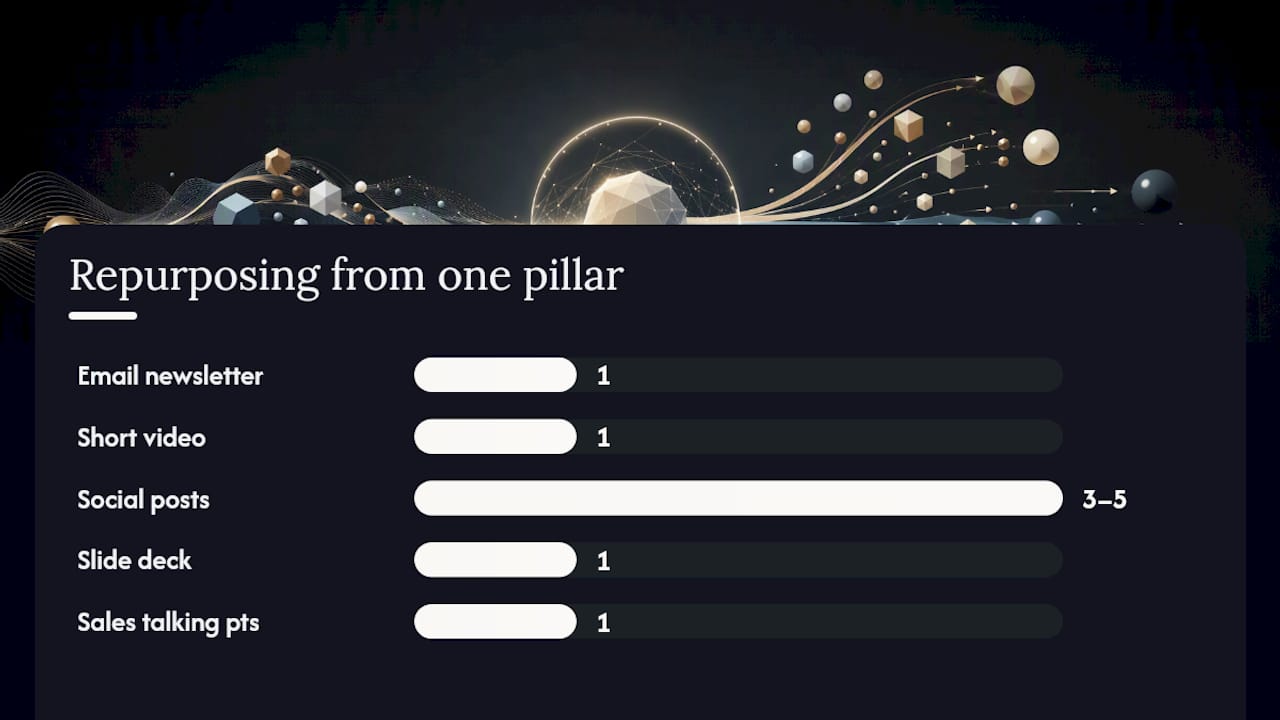
- Set a repurposing plan before you publish anything. Decide in advance how your pillar page will become an email, a short video, three social posts, and a slide deck, so the repurposing work doesn’t get skipped once the main asset is done.
- Use minimum specs to avoid endless revision. A service page needs at least 400 words, one CTA, and one proof element before it’s ready to publish. A case study needs one quantified outcome before it counts as finished. A pillar post needs at least 2,000 words and links to two service pages.
Pro Tip: Set a hard word count floor and a publish date before you start writing, not after. Open-ended content projects for service businesses rarely ship on time, and a vague “make it comprehensive” brief is the fastest way to stall a launch. Readers planning their first year of content often find it useful to review content strategy examples for small businesses built around this same quarterly structure.
Getting More Mileage Out of Every Piece You Publish
A single pillar post shouldn’t live and die as one blog entry. HubSpot’s repurposing guidance recommends turning original content into multiple derivative formats, and the ROI math favors this heavily: one long asset can become five distribution pieces with a fraction of the original effort.
From one pillar page, you can typically pull:
- An email newsletter that summarizes the core argument and links back to the full post.
- A short video or reel covering the single most useful takeaway.
- Three to five social posts, each built around one subsection of the pillar.
- A slide deck version for speaking engagements or client presentations.
- Sales talking points your team can reuse on discovery calls.
Not everything belongs behind a gate. Educational blog posts, FAQs, and process explanations should stay freely available, since their job is building trust and search visibility. Reserve gating for genuinely high-effort resources, like a detailed calculator, a proprietary framework document, or a template that took real time to build.
Before you hit publish on anything, run through a short technical checklist: a canonical URL, basic metadata (title tag, meta description), internal links to at least one service page and one related cluster post, and a visible call to action. Skipping this step is the most common reason strong content underperforms.
Metrics That Actually Prove Your Content Is Working
Most service providers track pageviews and stop there, which tells you almost nothing about revenue impact. The metric that matters most is inquiries: calls booked and forms submitted, plus your conversion rate from visitor to contact.
Track these in order of importance:
- Primary KPI: inquiries and conversion rate. How many visitors actually contact you, and what percentage of total visitors that represents.
- Assisted conversions. Which pages a prospect visited before contacting you, even if the last page they viewed wasn’t the one that convinced them.
- Time on page for pillar content. A long average time signals the piece is actually being read, not just scanned and abandoned.
- Watch-through rate for video. If prospects drop off in the first fifteen seconds, the hook needs work regardless of production quality.
Run small experiments before assuming a page is finished. Test two CTA phrasings on your top service page for a month. Test showing a pricing range versus “contact for pricing” and compare inquiry volume. Test a case study with a photo against one without.
Keep reporting simple: tag your content links with UTM parameters, check assisted conversions monthly, and review inquiry volume against publishing dates so you can see which pieces are actually driving contact, not just traffic.
Why Most Service Providers Get the Order Wrong
The biggest mistake we see isn’t a lack of content. It’s sequencing content backward, building a blog before the service pages it’s supposed to support even exist. A brilliant pillar post driving traffic to a vague, generic service page is wasted effort; the traffic arrives and leaves without converting.
The framework in this article works because it forces a decision most owners avoid: fix conversion before you invest in discovery. A 90-day plan we’d apply with a service client typically means weeks one and two on the six core pages, weeks three through six on one case study and one pricing rewrite, and the remaining weeks on a single pillar page with two supporting clusters.
Every claim here rests on structure and sequencing, not personal case history, credentials, or client testimonials, though those add real weight when you have them to include.
Get Your Core Pages and Content Built Without the Guesswork
Everything in this article assumes you have time to write service pages, structure case studies, and build a pillar post yourself. Most service providers don’t, and that’s the gap Moderatemurmurations exists to close.
We build AI-assisted websites, brand copy, and SEO content specifically around the framework above: six core conversion pages first, proof content that includes real numbers, then pillar and cluster content once the foundation is solid. Instead of months of back-and-forth with a traditional agency or a blank page staring back at you, we map your service pages, pricing structure, and case studies in a single project, built to launch fast rather than drag through endless revision cycles.
If your site is missing service pages, a pricing page, or a real case study, start with a free consultation to see how quickly your core pages can go live. Our “Launch Your Business Online in Days” package is built for exactly this: getting the six pages that actually convert in front of prospects, fast.
Frequently Asked Questions
What content types for service provider websites should I build first? Start with the six core pages: homepage, service pages, about, proof or case studies, pricing and FAQ, and contact. These directly convert the traffic you already have, while discovery content like blog posts and video should come once those pages are solid.
How long should a pillar page be compared to a cluster post? A pillar page typically runs 2,000 to 4,000 words and covers a broad topic tied to your main service. Cluster posts run 800 to 1,500 words, answer a narrower question, and link back to both the pillar and the relevant service page.
Do I need video content on my service website? Not necessarily. Video works well as a discovery channel if you’re genuinely comfortable appearing on camera regularly. If not, long-form SEO writing tends to perform just as well and requires less ongoing production effort.
How many case studies does a service website actually need? Three to five well-structured case studies, each with a quantified outcome, generally outperform a large gallery of thin, vague examples. Depth and a real number matter more than volume.
What’s the fastest way to know if my content is working? Track inquiries (calls and form submissions) and your visitor-to-contact conversion rate. Pageviews alone don’t tell you whether content is moving prospects toward booking, but inquiry volume does.
Sources
- Website content ideas: 20 ways to spark content for your website
- How to find content ideas for your business (content ideation)
- The 6 Pages Every Service Business Website Needs
- Using images effectively (Williams College IT)