Content Strategy Examples for Small Businesses in 2026
Content Strategy Examples for Small Businesses in 2026

A content strategy is the system that defines what you publish, why you publish it, and how it reaches the right people. Most small business owners confuse it with a blog calendar. That confusion is expensive. The best content strategy examples for small businesses share three traits: a clear goal, a defined audience, and a focused set of channels. Models like Hub and Spoke and the lean 1-1-1 framework give you a repeatable structure. Tools like HubSpot, Grammarly, and Google Search Console help you execute and measure. This article breaks down each model with real examples so you can pick what fits your business today.
1. What are content strategy examples for small businesses?
Content strategy is the operating system for content creation, distribution, and maintenance. It is not a list of post ideas. It defines your goals, your audience, your channels, and the rules that keep everything consistent over time. Without that structure, content wastes time and budget.
The two most proven frameworks for small businesses are Hub and Spoke and the 1-1-1 model. Hub and Spoke builds deep SEO authority around a core topic. The 1-1-1 model keeps lean teams focused on one goal, one audience, and two or three channels. Both frameworks work because they force you to make decisions before you create anything.

A dental practice, a landscaping company, and a solo marketing consultant all need different content. What they share is the need for a clear system that connects every piece of content to a business outcome.
2. How does the Hub and Spoke model work for small businesses?
The Hub and Spoke model organizes content around one comprehensive hub page supported by several focused spoke articles. The hub page covers 3,000–5,000 words on a core topic. Each spoke article targets a specific long-tail keyword that links back to the hub and to relevant service pages. This structure builds topical authority and tells search engines you are the expert on that subject.
A dental practice might build a hub page titled “Complete Guide to Family Dental Care in Austin.” Spoke articles would answer specific questions like “How often should kids get dental X-rays?” or “What is the difference between a crown and a veneer?” Each spoke drives its own search traffic and feeds readers back to the hub.
The Hub and Spoke model applies equally well to law firms, landscaping companies, and local service providers. A landscaping business could build a hub around “Lawn Care in Phoenix” with spokes covering irrigation, seasonal planting, and weed control. The model works because it matches how people actually search: broad question first, specific question second.
Here is what a working Hub and Spoke setup looks like in practice:
- Hub page: 3,000–5,000 words covering the core topic with internal links to all spokes
- Spoke articles: 6–10 focused posts, each targeting one specific customer question
- Internal links: Every spoke links back to the hub and to at least one service page
- Review cycle: Evaluate SEO and lead impact after 12 weeks of publishing
Pro Tip: Publish one spoke article per week. Consistency matters more than volume. After 12 weeks, check Google Search Console for ranking movement and adjust topics based on what is gaining traction.
3. How does the lean 1-1-1 content strategy drive focused marketing?
The 1-1-1 model is built for resource-limited teams. It means one goal, one audience, and 2–3 channels. That constraint is the point. When you try to be everywhere, you measure nothing and improve nothing.
Start with a measurable goal. “Generate 25 qualified leads per month from Instagram and email” is a goal. “Grow our brand” is not. A local coffee shop using this model might set a goal of adding 200 email subscribers in 90 days. Every piece of content serves that one goal. Instagram posts drive sign-ups. Email newsletters retain subscribers and convert them to regulars.
The 1-1-1 model forces you to ignore vanity metrics like follower counts and focus on measurable outputs like lead generation and client bookings. That shift alone separates businesses that grow from businesses that stay busy. A coaching business using this model might focus entirely on LinkedIn and a weekly email, skipping TikTok and Pinterest entirely.
Choosing your two or three channels is the hardest part. Use these filters:
- Where does your audience already spend time? Go there first.
- What format can you produce consistently? Video is powerful but only if you can publish it weekly.
- Which channel has a direct path to revenue? Email converts better than most social platforms.
- What can you measure clearly? Prioritize channels with built-in analytics.
Pro Tip: Run a 30-day channel test before committing. Post consistently on one platform, track click-throughs and inquiries, then compare results across two channels before deciding where to focus long-term.
4. Which content types and channels work best for small businesses?
Effective content types for small businesses include blog posts for SEO, how-to guides for education, customer stories for social proof, and industry insights for thought leadership. Each type serves a different goal. Matching the format to the goal is what separates content that converts from content that just fills space.
Blog posts and how-to guides build search visibility over time. Customer stories and testimonials close sales by reducing doubt. Short videos on Instagram or YouTube Shorts build awareness quickly. Email newsletters retain existing customers and drive repeat purchases. The channel you choose depends on where your audience is and what action you want them to take.
| Content Type | Best Channel | Primary Goal | Effort Level |
|---|---|---|---|
| Blog post | Website | SEO and organic traffic | Medium |
| How-to guide | Website or YouTube | Education and trust | Medium |
| Customer story | Website and email | Social proof and conversion | Low |
| Short video | Instagram or YouTube | Awareness and reach | High |
| Email newsletter | Email list | Retention and repeat sales | Low |
| Infographic | Pinterest or LinkedIn | Shareability and education | Medium |
Content must align with user needs and business goals to build trust and drive purchases or sign-ups. Publishing a blog post that answers a real customer question does more for your business than ten posts that exist only to fill a calendar.
5. How do real small businesses apply these content strategies?
Real-world application reveals what works and what gets abandoned. Three short examples show the pattern clearly.
A dental practice in a mid-size city built a Hub and Spoke structure around family dental care. The hub page ranked on page one of Google within four months. Six spoke articles each drove between 80 and 200 monthly visits. New patient inquiries from organic search increased measurably within the first quarter. The adjustment they made: two spoke topics underperformed, so they replaced them with questions pulled directly from patient intake forms.
A landscaping company used the 1-1-1 model to focus on one goal: booked consultations from Google search and email. They published one blog post per week answering common lawn care questions and sent a monthly email with seasonal tips. Within six months, their email list grew and consultation bookings from organic search doubled. The key was ignoring social media entirely until the first two channels were producing consistent results.
A solo digital consultant combined both models. She built a hub page on her website targeting her core service keyword, then used LinkedIn as her single social channel to distribute spoke content. Her email list became the conversion layer. This hybrid approach works well for service-based businesses where trust is the primary purchase driver.
The pattern across all three: start with one model, measure after 12 weeks, and adjust based on what the data shows.
6. How to choose the right content strategy for your small business
The right model depends on three factors: your goal, your available time, and your audience size. Hub and Spoke suits businesses focused on deep SEO and demonstrating expertise. The 1-1-1 model fits lean teams that need fast, measurable results from limited channels. A hybrid approach works once you have traction on at least one channel.
| Situation | Best Model | Why |
|---|---|---|
| New business, limited time | 1-1-1 | Forces focus and fast measurement |
| Established business, SEO goal | Hub and Spoke | Builds authority over 3–6 months |
| Service business with niche audience | Hybrid | Combines SEO depth with channel focus |
| E-commerce or product business | Hub and Spoke + email | Drives traffic and retains buyers |
Most small business owners mistake content strategy for a blog calendar. True strategy includes governance: who creates content, who approves it, how topics get chosen, and how results get measured. Without those rules, content efforts collapse after the first month of enthusiasm.
Pro Tip: Build a lightweight content operating system before you start publishing. Write down your goal, your audience, your two or three channels, and one person responsible for each task. That single document prevents the most common reason small business content fails: no one owns it.
Key takeaways
A focused content strategy built around one clear goal and a defined audience consistently outperforms scattered publishing across many channels.
| Point | Details |
|---|---|
| Strategy beats calendars | Define goals, audience, and governance before creating any content. |
| Hub and Spoke builds SEO authority | Use a 3,000–5,000 word hub with 6–10 spoke articles reviewed every 12 weeks. |
| 1-1-1 model drives lean results | Focus on one goal, one audience, and 2–3 channels to measure real ROI. |
| Match content type to goal | Blog posts build search traffic; customer stories close sales; email retains buyers. |
| Governance prevents failure | Assign ownership and review cycles so content efforts last beyond the first month. |
What I have learned about content strategy for small businesses
The biggest mistake I see small business owners make is treating content strategy as a production problem. They think the answer is more posts, more platforms, more output. It is not. The answer is fewer decisions made more deliberately.
Every business I have worked with that saw real results from content did one thing consistently: they picked a model, committed to it for at least 90 days, and measured the right things. Not followers. Not impressions. Leads, bookings, and email sign-ups. Those numbers tell you whether your content is working.
The businesses that struggled shared a different pattern. They spread effort across five platforms, published inconsistently, and had no clear owner for content decisions. Without clear governance, content lacks coherence and wastes resources. That is not a creativity problem. It is a systems problem.
My honest recommendation: start with the 1-1-1 model. Pick one goal, one audience, and two channels. Run it for 90 days. Review what moved. Then decide whether to expand or go deeper. The businesses that build content into a real growth engine do it by stacking small, measured wins over time. Not by launching everywhere at once.
— Christopher
Ready to build your content presence fast?
Knowing the right model is step one. Building the infrastructure to execute it consistently is where most small businesses stall. Moderatemurmurations builds fast, clean websites, SEO content, and digital systems designed for small businesses that need results without the complexity.
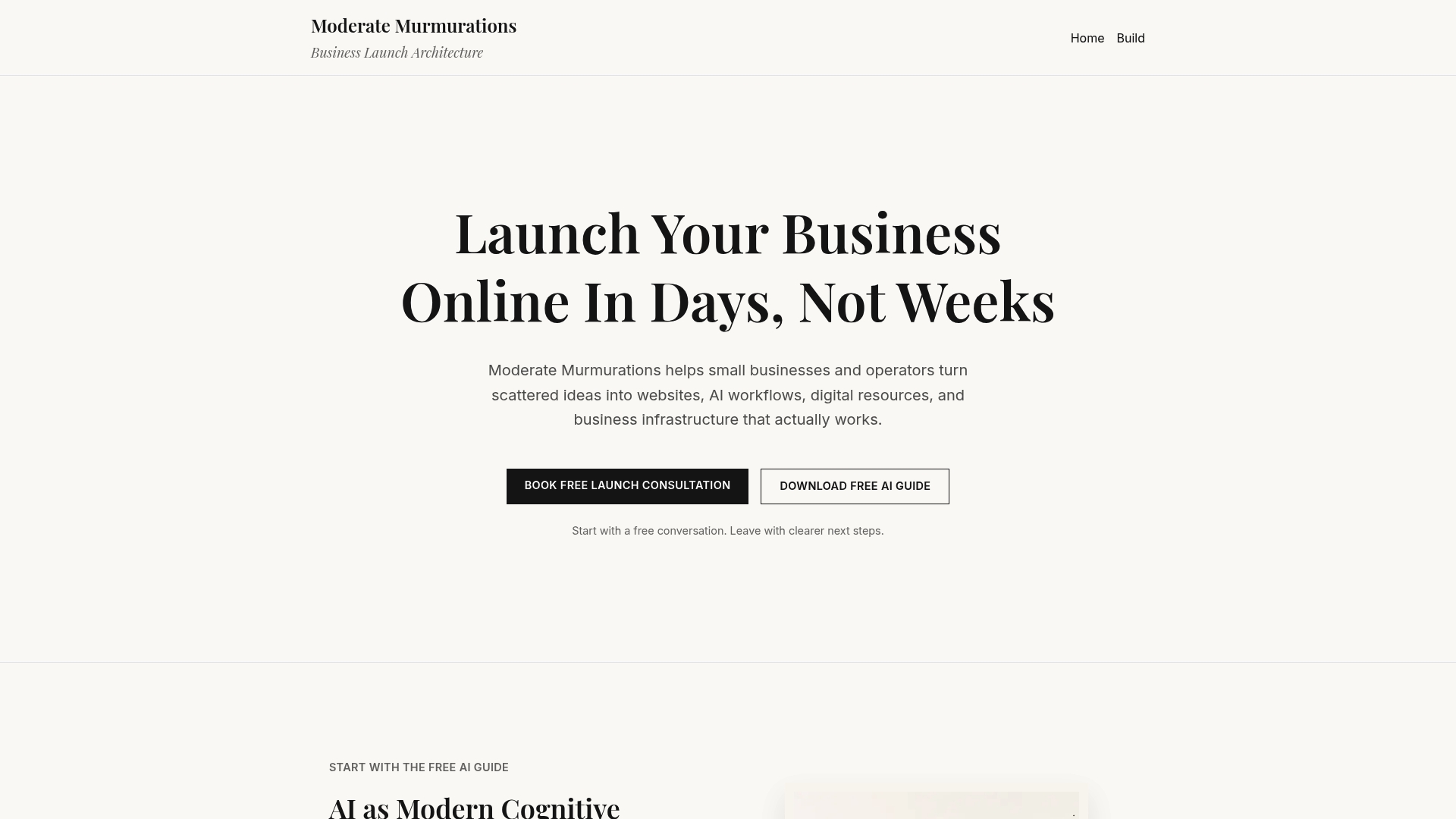
Whether you need a website that supports your Hub and Spoke structure or a content system built around your 1-1-1 goals, Moderatemurmurations handles the build so you can focus on your business. If you want to explore marketing automation alongside your content plan, that infrastructure is part of what we set up. Visit Moderatemurmurations to see how quickly you can go from idea to a working online presence, or go straight to the build page to get started.
FAQ
What is a content strategy for a small business?
A content strategy is a system that defines what you publish, who it is for, and how it connects to a business goal. It includes governance, channel selection, and a review process, not just a list of topics.
What is the Hub and Spoke content model?
The Hub and Spoke model uses one long-form hub page (3,000–5,000 words) supported by 6–10 shorter spoke articles that each target a specific customer question and link back to the hub.
How many channels should a small business focus on?
Most small businesses get better results by focusing on 2–3 channels rather than spreading across many. The 1-1-1 model recommends picking channels where your audience already spends time and where you can measure direct results.
How long does it take to see results from a content strategy?
The Hub and Spoke model typically shows measurable SEO and lead impact after 12 weeks of consistent publishing. The 1-1-1 model can show lead generation results faster when focused on high-converting channels like email.
What is the difference between a content strategy and a content calendar?
A content calendar is a scheduling tool. A content strategy is the system behind it, covering goals, audience definition, channel selection, governance, and measurement. The calendar is one output of the strategy, not the strategy itself.