Coaching Website Launch Pitfalls: What to Fix First
Coaching Website Launch Pitfalls: What to Fix First

Most coaching websites fail for the same handful of reasons: fuzzy messaging, missing conversion paths, broken booking flows, and zero pre-launch testing. Fix these first:
- Vague headline → Rewrite it to name your client and their outcome in one sentence.
- No clear services page → Add package names, pricing, and one CTA per offer.
- Competing CTAs → Cut every button except the one that leads to booking.
- No booking or payment system → Connect a scheduler and payment processor before launch, not after.
- Slow mobile load → Compress images and test on an actual phone.
- No testimonials or proof → Add one specific outcome story, even a process example.
- Untested forms → Submit every form yourself and confirm the email lands.
- No analytics → Install tracking before your first visitor arrives, not after.
- Missing privacy policy → Publish one before you collect a single email address.
- No pre-launch checklist → Run a full click-through as if you were a stranger.
Pro Tip: If you only fix one thing, fix your booking flow. A beautiful site that fails to convert a click into a scheduled call has zero return on the time you spent building it.
Key Takeaways
A coaching website converts when its messaging, structure, and booking flow are tested end to end before launch, not patched after visitors start bouncing.
| Point | Details |
|---|---|
| Fix messaging first | Rewrite your headline to name your client and their outcome in one sentence. |
| Test the full booking path | Book, pay, and confirm intake emails yourself before inviting real visitors. |
| Limit CTAs per page | Keep one primary call to action per page to avoid decision fatigue. |
| Prioritize mobile speed | Aim for under three seconds load time on core pages to protect bookings. |
| Launch lean, then improve | Moderate Murmurations helps coaches ship a working, booking-ready site fast, then iterate with short sprints. |
Table of Contents
- Why Fuzzy Niche and Weak Messaging Sink Coaching Sites
- What Pages Does a Coaching Website Actually Need?
- Why Coach-Centric Copy Fails to Convert Visitors
- How Do You Build Trust Without a Long Client List?
- Does Mobile Speed Really Affect Bookings?
- What Usually Breaks in Booking and Payment Flows?
- What Legal Basics Does a Coaching Site Need Before Launch?
- What Should Your Pre-Launch Checklist Include?
- How Long Should Launching a Coaching Website Take?
- How Do You Avoid Overdesigning Your Launch Site?
- Why Skipping a Content Plan Costs You Visitors
- Why Branding Consistency Matters More Than You Think
- Why Your Site Needs a Maintenance Plan From Day One
- A Fast Launch Beats a Perfect One
- How Moderate Murmurations Gets Coaches Launched Fast
- Sources
Why Fuzzy Niche and Weak Messaging Sink Coaching Sites
Your homepage headline has one job: tell a visitor who you help and what changes for them. Most coaching sites skip this and lead with the coach’s own story or a generic phrase like “unlock your potential.” That forces visitors to guess whether they’re in the right place, and guessing kills clicks.
Try this three-line exercise before you write a word of homepage copy:
- Name your target client in plain terms (“mid-career managers feeling stuck”).
- State the transformation you deliver (“confident, promotable leadership”).
- Attach a timeframe or metric (“in 90 days”).
Two quick swaps show the difference. “Helping you become your best self” becomes “Helping burned-out managers land a promotion in 90 days.” “Life coaching for growth-minded people” becomes “Career clarity coaching for professionals switching industries after 30.”
- If your hero line doesn’t answer who plus what outcome in one sentence, rewrite it before doing anything else.
- Test the line on a friend outside your industry; if they can’t repeat your niche back to you, it’s still too vague.
Our guide on writing a value proposition for entrepreneurs walks through this exercise in more depth.
What Pages Does a Coaching Website Actually Need?
A coaching website needs six pages to function as a working client acquisition tool: Home, About, Services, Booking, Blog, and a Privacy Policy, and each one should do exactly one job.
- Home introduces your niche and outcome, then points to Services or Booking.
- About builds trust and credibility, not a full biography.
- Services explains packages, pricing, and proof, with one CTA per offer.
- Booking/Contact removes every distraction between “interested” and “scheduled.”
- Blog/Resources answers common questions and supports search visibility.
- Privacy Policy protects you legally and reassures visitors handing over contact details.
The most common structural error is stacking multiple competing CTAs on one page, a “Book Now” button next to a newsletter signup next to a “Follow me” prompt. Visitors freeze when given too many choices. Keep one primary CTA per page and remove or downgrade the rest.
Why Coach-Centric Copy Fails to Convert Visitors
Outcome-led copy converts better than feature lists because visitors care about their own results, not your certifications or methodology. A “12-week program with weekly calls and workbooks” tells them what they get; it doesn’t tell them what changes.
Try these swaps:
- “Certified life coach with 10 years of experience” → “Helped 40+ clients switch careers without starting over.”
- “Contact me to learn more” → “Book a free strategy call.”
- “My coaching philosophy” → “How this works for you.”
- “Services” → “Programs that get you promoted.”
Add reassuring microcopy near booking and pricing, phrases like “No obligation, 20-minute call” reduce hesitation exactly where visitors are most likely to abandon.
How Do You Build Trust Without a Long Client List?
Visible, specific proof placed in at least two spots on your site, homepage and services page, improves booking intent more than generic testimonials scattered anywhere. A vague “great coach!” quote does less work than a sentence showing situation, intervention, and result: “Sarah felt stuck in middle management. After 12 weeks of coaching, she negotiated a director-level offer.”
- Put one proof element in your homepage hero and another on the services page.
- Add a one-line credibility statement near your bio photo.
Pro Tip: No clients yet? Publish a detailed process walkthrough or a training-outcome statement instead of inventing testimonials. Specificity builds trust even without a track record.
Does Mobile Speed Really Affect Bookings?
Mobile load speed and uptime affect bookings more than visual polish. A visitor who taps your link on their phone and waits five seconds for a hero image to load is already halfway to leaving.
Test performance with Google PageSpeed Insights or Lighthouse, and always check your booking page on an actual phone, not just a resized browser window.
Run through this before launch:
- Compress every image before uploading.
- Lazy-load anything below the fold.
- Choose hosting built for small business traffic, not a bargain shared plan.
- Enable HTTPS and browser caching by default.
Aim for under three seconds on mobile for your core pages. Coaching sites that act like static digital business cards rather than working conversion tools tend to ignore this, and it shows in abandoned booking attempts.
Pro Tip: Test your slowest page, usually the one with the most images, not your homepage. That’s where visitors actually drop off.
What Usually Breaks in Booking and Payment Flows?
Broken flows are the most common reason new clients disappear after booking. A visitor schedules a call, but the confirmation email never arrives, or payment processes without triggering the intake form. Every one of those gaps costs you a client who already said yes.
Every booking should automatically trigger three things:
- Payment gets processed and confirmed.
- An intake form gets sent immediately.
- A confirmation email arrives with clear next steps.
Run this test yourself before launch: book a session, complete a test payment, confirm the intake email arrives, and verify program access works. Testing the full conversion path end to end, not just clicking through pages, catches what a visual review misses.
A minimal stack of a booking tool, payment processor, and simple client management system covers most solo coaches. Add automation layers only once volume makes manual follow-up unmanageable.
What Legal Basics Does a Coaching Site Need Before Launch?
Include a Privacy Policy and basic intake disclaimers before you publish. Beyond that, the minimum checklist covers a cookie notice where applicable, SSL-secured intake forms, clear payment and refund terms, and consent language if you record sessions or keep notes.
If you collect sensitive health information, provide formal assessments, or work with clients across multiple states or countries, talk to an attorney. This isn’t legal advice, just a starting checklist.
What Should Your Pre-Launch Checklist Include?
A structured soft launch, sharing the site with a small test group and watching how they navigate, catches the expensive mistakes a solo review misses, because users interact with a new site differently than its builder expects.
Run through this order before you hit publish:
- Click every link and button on every page.
- Complete a full booking and payment test.
- Submit every form and confirm analytics fires correctly.
- Test on at least two mobile devices and two browsers.
- Check basic accessibility: text contrast, alt text, keyboard navigation.
- Confirm SEO meta titles, descriptions, and H1 tags are filled in.
- Run a backup and restore test on your hosting platform.
- Ask a friend with zero context to try booking a session and watch where they hesitate.
- Keep a staging copy or backup ready so you can roll back fast if something breaks post-launch.
Pro Tip: A checklist covering pages, messaging, booking, SEO fields, and mobile rendering catches what most coaches miss on their first launch. Run through it twice, once yourself and once with a test user.
How Long Should Launching a Coaching Website Take?
Simple site builders let most coaches publish in one to four days if copy and images are ready. A basic custom WordPress build typically takes one to three weeks. Fully custom design with original copywriting can stretch to four to eight weeks or longer.
- DIY builder: 1 to 4 days, limited SEO control, fastest to launch.
- Basic WordPress: 1 to 3 weeks, more flexibility, more maintenance.
- Custom design and copy: 4 to 8+ weeks, highest polish, highest cost.
Cost tracks the same pattern: template builds run lean, while custom design, professional copywriting, and payment integrations push the price up. Define your minimum viable pages and launch on that timeline instead of delaying for a perfect design.
How Do You Avoid Overdesigning Your Launch Site?
Your minimum viable site needs to answer three questions: who you help, what changes for them, and how to book a call. Everything else is secondary at launch.
- One outcome-led hero headline.
- A services section with one CTA per offer.
- A working booking page or form.
- One proof element.
- Basic SEO fields filled in.
- Analytics installed and tested.
Branding and photography matter, but they shouldn’t delay your conversion flow. Timebox design decisions, limit your first integrations to essentials, and schedule two short improvement sprints in the 30 to 90 days after launch instead of chasing perfection before you publish.
Why Skipping a Content Plan Costs You Visitors
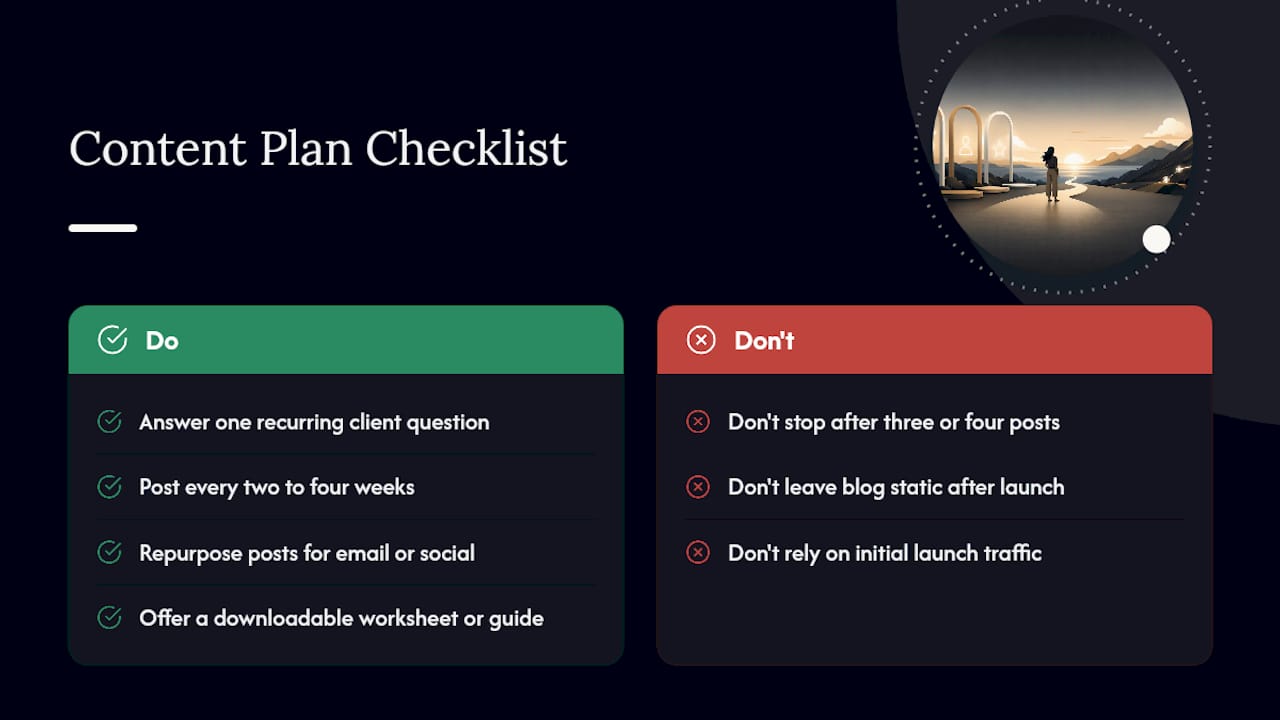
A blog you never update tells visitors you’ve gone quiet, and search engines notice the same thing. Coaches often publish three or four posts before launch, then stop once bookings start trickling in. That’s backward: fresh content is what keeps bringing new visitors back after the initial launch traffic fades.
You don’t need a content calendar with fifty ideas. Pick one recurring question your ideal client asks, then answer it in a short post once every two to four weeks. A career coach might answer “how do I negotiate a raise without sounding pushy.” A wellness coach might cover “what to eat before a morning workout.” These posts double as answers to real search queries and as material you can repurpose for email or social.
Resource pages work the same way. A downloadable worksheet or a short guide gives visitors a reason to hand over their email address before they’re ready to book a call. Treat your blog and resources section as a pipeline, not decoration. Leaving it static after launch is one of the quieter reasons traffic plateaus within a few months.
Why Branding Consistency Matters More Than You Think
Branding confusion shows up in small ways that add up fast: a warm, approachable tone on your About page next to a stiff, corporate services page. A logo color that shows up nowhere else on the site. A font on your booking page that doesn’t match your homepage.
None of these mistakes are fatal alone. Together, they make a visitor feel like they’ve clicked into a different business partway through their visit, and that sense of inconsistency erodes trust exactly when you need it most.
Fix this by defining three things before you write a single page: your color palette, your font pairing, and your tone of voice, formal or conversational, direct or warm. Apply all three across every page, every email template, and every downloadable resource. If your Instagram bio sounds nothing like your website copy, pick one voice and rewrite the other to match. Consistency isn’t about looking fancy. It’s about visitors trusting that the person on your About page is the same one who’ll show up on their first coaching call.
Why Your Site Needs a Maintenance Plan From Day One
A website isn’t a one-time project. Plugins need updates, links break, testimonials go stale, and your services evolve, but most coaches launch and then never touch the site again until something visibly breaks.

Set a simple maintenance rhythm before launch: check for broken links and outdated testimonials once a quarter, update your services page whenever your offers change, and review your booking flow every few months to confirm nothing has quietly stopped working. If you’re on WordPress, plugin and security updates need regular attention or your site becomes a target. Site builders handle more of this automatically, which is part of why many solo coaches prefer them for the first year.
Put a recurring reminder on your calendar now, quarterly is enough for most solo coaching practices, rather than waiting for a client to tell you your booking link is dead.
A Fast Launch Beats a Perfect One
The coaches who struggle most aren’t the ones with bad ideas. They’re the ones who spend three months perfecting a homepage while their actual booking flow sits untested. In our work helping small businesses get online fast, the single highest-leverage fix is almost always the same: clarify the services page headline and confirm the booking flow actually works end to end.
One coach we advised had spent weeks agonizing over color palettes while her contact form silently failed to send. Fixing that one broken form did more for her bookings than any design change would have.
If you’re staring down a growing list of launch tasks and want a second set of eyes, Moderate Murmurations offers a free consultation to help you triage what matters first.
How Moderate Murmurations Gets Coaches Launched Fast
You get an AI-assisted website built for booking, not just browsing, paired with clear copy, working integrations, and SEO foundations, all handled without you learning a page builder. Moderate Murmurations handles website design, launch copy, booking integration, and SEO setup so you don’t have to piece together five different freelancers and hope they talk to each other.
The process runs in three steps: a free consultation to understand your niche and goals, a scoped plan with a clear timeline and price, and a fast, working launch. You keep full ownership of your copy, your booking system, and your analytics dashboard from day one; we handle the build, the integrations, and the testing that catches problems before your first visitor does.
If your coaching site is still stuck in the planning stage, or already live and quietly leaking bookings, book a free consultation and get a clear plan for what to fix first.
Sources
- How to Build a Coaching Website That Converts
- Soft-launch strategies to boost user acquisition | Adjust