One Page Brand Voice Guide With Paste Ready Examples for Busy Teams
One Page Brand Voice Guide With Paste Ready Examples for Busy Teams

A brand voice guide should define a stable personality (3 to 5 traits, plainly written) and a separate tone map showing how that personality shifts across channels and situations. The single most useful format is a one-page rubric: traits with guardrails, a tone matrix, and a few before/after examples. Skip the 20-page manual. Open the template in the section below and start filling it in today.
TL;DR:
- A brand voice guide should be concise, with 3 to 5 core traits supported by real examples and clear boundaries to ensure consistency.
- Regular training, a tone matrix with 4 to 6 dimensions, and quarterly audits help maintain and calibrate tone across channels.
- Use a one-page template that defines voice, audience, traits, word usage, and channel-specific tone examples for easy adoption.
- Governance relies on designated owners, clear escalation, and continuous calibration like workshops and monthly review sessions.
- The most effective guides are brief, actively used, and tested against real content, rather than lengthy manuals that are rarely referenced.
Table of Contents
- What Is a Brand Voice Guide, and Why Does It Matter?
- How Do You Choose Your Core Voice Traits?
- Building a Tone Matrix You Can Actually Train Teams On
- What Should Your One-Page Brand Voice Template Include?
- How Do You Roll Out and Govern Brand Voice So It Sticks?
- How Moderate Murmurations Applies This in Practice
- Where Most Teams Get Brand Voice Wrong
- Get Your Brand Voice Guide Built and Applied
- Sources
What Is a Brand Voice Guide, and Why Does It Matter?
Your brand voice is the personality that stays constant no matter where someone encounters your business: warm, direct, playful, technical, whatever it is. Tone is how that personality bends to fit context. A wellness brand’s voice might be “grounded, warm, and plainspoken.” Its tone shifts from reassuring in a support email to energetic in a launch post, without ever sounding like a different company. Confusing the two is the most common reason brand voice guides fail. Teams write one document trying to nail down a fixed identity and a flexible delivery style at the same time, and it collapses under its own contradictions. Separating a short, fixed voice identity from a dynamic tone calibration system is what makes a guide usable long term, according to practitioner analysis from BrandVM.
The business case is not abstract. Brands that apply their voice and tone consistently see revenue gains of 23% to 33%, according to research cited by Sprinklr, and that consistency compounds brand recognition over time rather than delivering a one-time bump. For a service provider or small brand, a distinct voice also functions as a trust asset. JOHN LUKE frames it as something that can justify premium pricing, because clients associate a recognizable communication style with competence before they have any other evidence to go on.
You should prioritize building or updating a voice guide when any of these are true:
- Multiple people (or an AI tool) write customer-facing copy and the output feels inconsistent from piece to piece.
- You’re rebranding, launching, or expanding into a new channel like paid ads or support chat.
- You’ve noticed engagement or reply rates dip and can’t isolate a strategy problem, only a “this doesn’t sound like us” problem.
- You’re onboarding freelancers, agencies, or AI writing tools and need a fast way to get them calibrated.
Pro Tip: If you can’t tell whether an old blog post or a brand-new one was written first, your voice isn’t distinct enough yet. That blind test is the fastest gut check you have.
How Do You Choose Your Core Voice Traits?
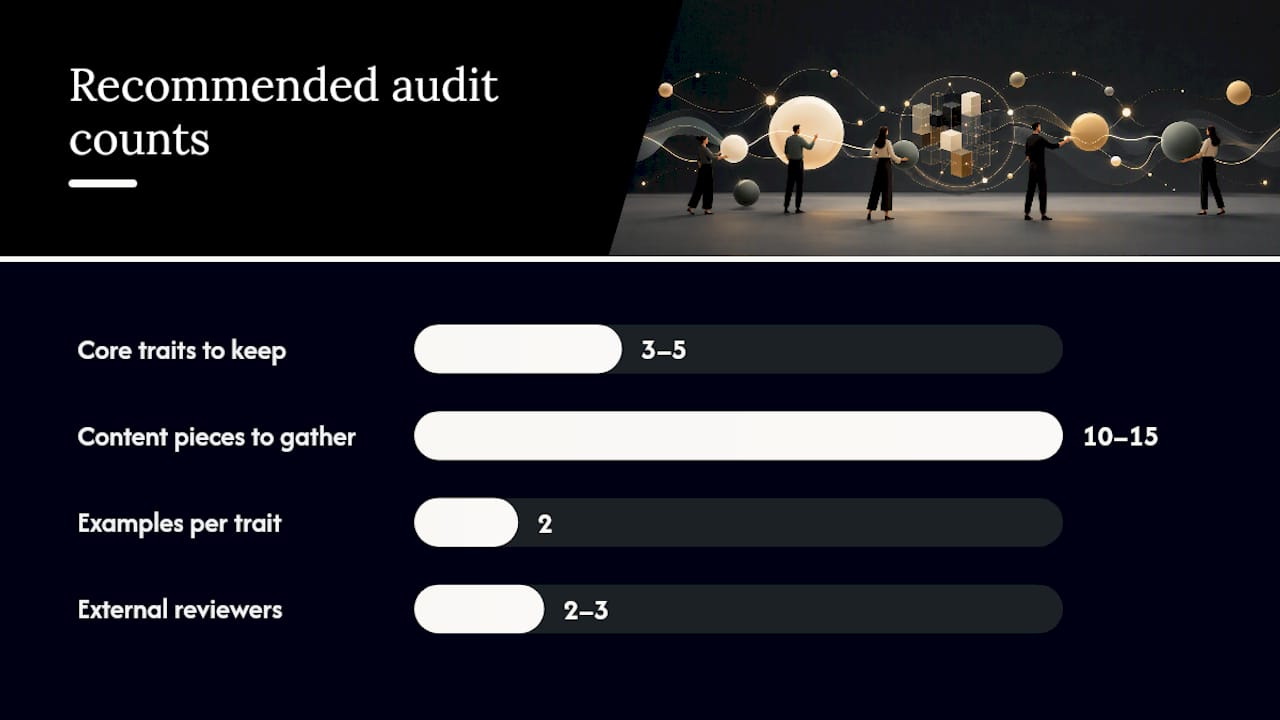
Most guides list traits pulled out of thin air during a brainstorm. The ones that actually get used come from an audit of what your brand already sounds like when it’s working. Recommended practice is to land on 3 to 5 core personality traits, not more, according to guidance from Sprinklr, because a longer list dilutes decision-making instead of sharpening it.
Run the audit in this order:
- Pull your best-performing content. Gather the 10 to 15 pieces (emails, posts, product pages) that got the strongest response, and read them back to back.
- Mine customer language. Pull direct quotes from reviews, support tickets, and sales calls. Customers often describe your brand more precisely than your team does internally.
- Name the pattern, not the aspiration. Write down what the content actually sounds like, not what you wish it sounded like.
- Cut to 3 to 5 traits. If two traits describe the same behavior, merge them.
- Stress-test each trait against a hard message. Draft a layoff notice, a price increase, or a complaint reply in that voice. If the trait breaks down under pressure, refine it now.
Each trait needs three parts to be usable, not just aspirational:
- Definition: one clear sentence describing the trait in plain language.
- What it sounds like: two real or rewritten examples showing the trait in action.
- What it does not mean: the boundary that stops the trait from being misread (for example, “warm” does not mean “casual to the point of unprofessional”).
Mailchimp’s content team builds its guidelines around exactly this kind of structure: a persona-driven voice paired with concrete rules, so writers make repeatable choices instead of guessing, according to the Mailchimp Content Style Guide. Before a trait goes live, run it past two or three people outside marketing. If they can’t apply it to a real sentence within five minutes, the definition is still too vague.
Building a Tone Matrix You Can Actually Train Teams On
Voice stays fixed. Tone moves, and it needs rules just as concrete as your traits do. Practical guidance recommends limiting tone to 4 to 6 dimensions and scoring each one numerically, so calibration becomes something you can teach and review rather than something you argue about, according to Benly. The four dimensions that cover most brands:
- Formality (casual to formal)
- Humor (serious to playful)
- Energy (calm to high-energy)
- Respect versus irreverence (deferential to bold)
Score each dimension from 1 to 5 for every channel, so “default” is a number, not a feeling.
| Channel | Formality | Humor | Energy | Default tone shift |
|---|---|---|---|---|
| Social media | 2 | 4 | 4 | Playful, quick, conversational |
| Email marketing | 3 | 2 | 3 | Warm and direct, light on jokes |
| Customer support | 2 | 1 | 2 | Calm, patient, zero sarcasm |
| Product copy | 3 | 2 | 3 | Clear first, personality second |
| Paid ads | 2 | 3 | 5 | High energy, punchy, short |
| Crisis communication | 4 | 1 | 1 | Formal, careful, no humor at all |
Notice that crisis communication is the outlier on every dimension. That’s deliberate. A brand that’s playful everywhere else needs an explicit, written override for the one context where playful reads as tone-deaf. Teams that skip this row are the ones who post a joke the same week as a service outage.
Use the matrix two ways. During editorial review, an editor scores a draft against the target numbers for that channel and flags anything more than one point off in either direction. During quarterly audits, pull a sample of published content per channel and check the average score against the target. HubSpot recommends building this kind of rubric into recurring training and audit cycles rather than treating the document as a one-time reference, and pairs it with monthly calibration sessions to keep the whole team’s instincts aligned, according to HubSpot.
Pro Tip: Give the crisis row to your most anxious team member to write. They’ll catch the tone risks a confident copywriter tends to miss.
What Should Your One-Page Brand Voice Template Include?
A one-page voice identity paired with a couple of pages of channel examples and do/don’t rewrites gets read and adopted far more reliably than a dense manual, based on practitioner findings from AIFLOWCHAT. Here’s the field list that makes a one-pager complete:
- Voice in three words (e.g., “grounded, direct, warm”)
- Primary audience line (one sentence describing who you’re talking to and what they care about)
- 3 to 5 traits, each with a definition, an example, and a boundary
- Words we use / words we avoid (a short two-column list, 8 to 10 entries each)
- Tone by channel (a condensed version of the matrix above)
- Two or three quick examples showing the voice applied to a real message
Before/after rewrites do more teaching than any paragraph of description. Three worth keeping on hand:
- Marketing headline. Before: “Our platform offers innovative solutions for your business needs.” After: “Get a working website in two weeks, not two months.”
- Support reply. Before: “We apologize for the inconvenience and appreciate your patience during this matter.” After: “That’s frustrating, and we’re sorry it happened. Here’s what we’re doing to fix it.”
- Social post. Before: “We are excited to announce our newest feature update!” After: “New feature just dropped. Here’s what changes for you.”
Each “after” line does the same thing: cuts filler, names a concrete outcome, and sounds like a person talking. Run every piece of content through a short validation check before it publishes: does it match at least 3 of your traits, does the tone score fall within one point of the channel target, and would a stranger recognize it as yours without seeing the logo? If a wellness brand is building this kind of template from scratch, the process of creating a wellness brand online presence usually starts with the same three questions.
How Do You Roll Out and Govern Brand Voice So It Sticks?
A guide that lives in a shared drive and gets opened once during onboarding is a guide that fails within a quarter. Governance is what keeps it alive.
Start with roles. Every team needs one voice owner (usually a brand or content lead) who has final say on disputes, and one or two approvers per channel who review before publish. Escalation should be simple: if a piece doesn’t score within range on the tone matrix, it goes back to the writer with the specific dimension flagged, not a vague “this doesn’t feel right” note.
Training works best in three stages:
- A 90-minute workshop where the team stress-tests the traits against real, difficult messages.
- A 30-day pilot on a single channel, usually social or email, where every piece gets scored before publishing.
- Monthly calibration sessions where the team reviews a handful of live examples and re-scores them together.
HubSpot’s guidance backs embedding voice training into onboarding directly, plus running short monthly sessions to build shared intuition beyond what any document alone can teach, based on the same HubSpot analysis referenced above.
Measurement closes the loop. Run a quarterly consistency audit: pull 10 to 15 pieces across channels, score each on the tone matrix, and track the average drift from target over time. Watch for engagement metrics that move alongside voice consistency. Brands maintaining consistent voice application see the 23% to 33% revenue uplift mentioned earlier, and that pattern tends to show up gradually across retention and repeat engagement, not as a single spike. Revisit the guide itself every 12 to 18 months, or sooner if you rebrand, enter a new market, or notice the traits no longer describe what customers actually say about you.
How Moderate Murmurations Applies This in Practice
We build this exact structure into client engagements: a short workshop to surface real traits, a one-page rubric, then sample pages that put the voice into action across a homepage, an email, and a social post. It’s the fastest path from “we know our brand should sound a certain way” to content that genuinely reads that way.
[Case study placeholder]
[Client testimonial placeholder]
When clients use AI-assisted copy tools to speed up production, the rubric becomes the guardrail. Feed the trait definitions and tone matrix into your prompt before generating anything, and review output against the same checklist you’d use for a human draft. AI drifts toward generic phrasing fast without that anchor.
Where Most Teams Get Brand Voice Wrong
The failure I see most often isn’t a bad voice. It’s a 15-page document nobody opens after week one. Long guides feel thorough, but thoroughness isn’t the goal. Usability is. A one-page rubric that a freelancer can absorb in ten minutes will outperform a polished manual every time, because it actually gets referenced under deadline pressure.
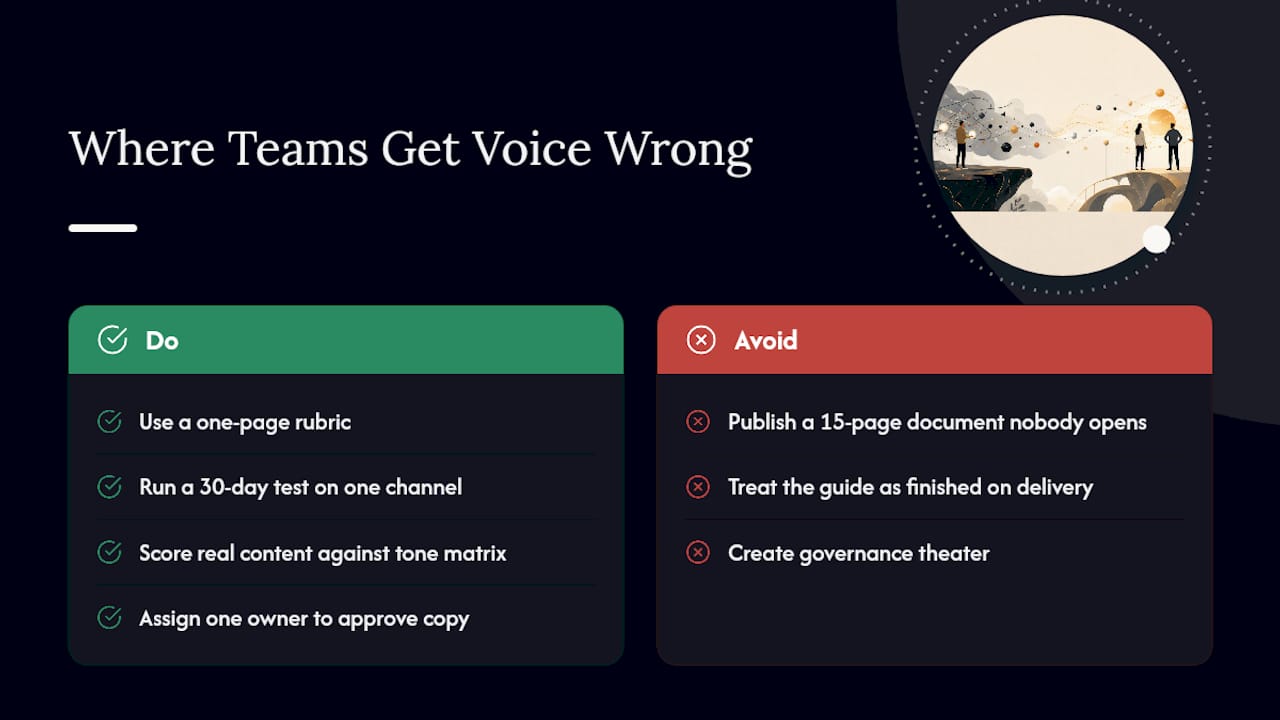
The second mistake is treating the guide as finished on delivery. Run a 30-day test on one channel before rolling voice out everywhere. Score real content against your tone matrix, adjust the traits that broke down in practice, then expand.
For solo founders and small teams, skip the governance theater. You don’t need a committee. You need one person with the rubric taped above their desk, checking new copy against it before it ships.
— Christopher
Get Your Brand Voice Guide Built and Applied
A faster route to a working brand voice guide compared to piecing one together from templates and trial-and-error rewrites is to move from workshop to a finished one-page rubric and live sample pages in a matter of weeks, with the voice already tested against a homepage, an email, and a social post.
This fits small business owners, creators, wellness brands, and service providers who need their messaging locked down before a launch, a rebrand, or a push into new channels. Typical engagements include a short discovery session, a one-page rubric, a tone matrix built for specific channels, and sample pages to hand off to a writer, freelancer, or AI tool. For service firms weighing whether the investment pays off, the same technology consulting principles around clear messaging apply directly to voice work, and firms exploring how consistent branding builds trust and increases sales will find the rubric slots neatly into that same framework.
If your team is still guessing at tone channel by channel, book a free consultation with Moderatemurmurations and get your one-page rubric started this week.
Sources
- Brand Voice Strategy: How to Build Brand Guidelines | Sprinklr
- Voice and Tone | Mailchimp Content Style Guide
- Consistent brand voice: How to be unmistakable no matter what the channel | HubSpot
- What Is Brand Voice? Belief, Voice, and Tone | JOHN LUKE
- Benly