10 Brand Story Examples Small Businesses Can Copy Without a Big Budget
10 Brand Story Examples Small Businesses Can Copy Without a Big Budget

Studying strong brand story examples reveals the exact techniques marketers can reuse: a defined tension, a customer cast as the hero, and one repeatable creative object or scene. This article breaks down ten brands, including Apple, Nike, Patagonia, and Figs, and hands you a fill-in-the-blank template to build your own.
TL;DR:
- A strong brand story hinges on a clear tension, a customer as hero, a specific scene or object, and an emotional payoff that resonates quickly.
- Brands that focus on a well-defined, repeatable narrative system, such as an object or scene, build consistent creative assets that sustain engagement over time.
- Avoid common mistakes like making the brand the hero, being too abstract, or constantly changing the story, as these dilute emotional connection and trust.
- Small businesses benefit most by choosing narrow, underserved audiences and building stories around concrete customer frustrations and simple visual objects.
- Developing one clear, specific tension and sticking to it across all content formats builds loyalty and turns audiences into advocates, not just passive viewers.
Table of Contents
- What Is a Brand Story, Really?
- What Makes a Brand Story Actually Work
- Five Types of Brand Stories You Can Choose From
- 10 Brand Story Examples Worth Studying (and What to Steal From Each)
- How to Write Your Own Brand Story (Step by Step)
- What Figs and Graza Prove About Creative Systems at Scale
- Why Brand Stories Drive Engagement and Loyalty, Not Just Attention
- The Most Common Ways Brand Stories Go Wrong
- Author Perspective: What to Prioritize First
- How Moderatemurmurations Turns a Brand Story Into a Launch
- Sources
- FAQ
What Is a Brand Story, Really?
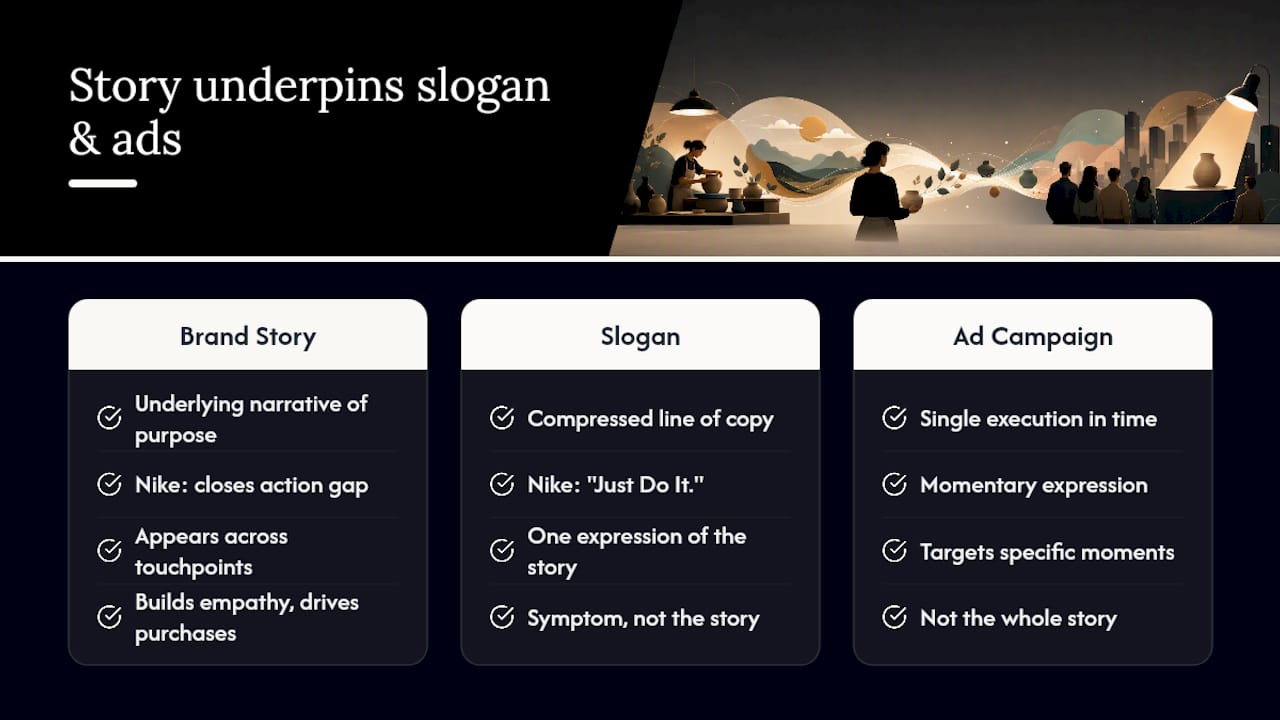
A brand story is the underlying narrative that explains why a company exists and who it exists for. It’s different from a slogan, which is a compressed line of copy, and different from a single ad campaign, which is one execution of the story at a moment in time. The story is the thing underneath both.
Nike’s slogan is “Just Do It.” Nike’s brand story is about the psychological gap between wanting to act and actually acting, and how the brand positions itself as the voice that closes that gap. The slogan is a symptom of the story, not the story itself.
Brand stories show up everywhere a customer touches the business: the “About” page, the founder’s Instagram captions, the return policy email, the way a salesperson describes the product in a shop. A brand messaging framework exists precisely because inconsistency across these touchpoints confuses customers and dilutes trust.
The commercial stakes are real. Harvard Business School’s research on brand storytelling notes that compelling stories break through advertising clutter by building empathy and emotional connection, which moves customers from simply being aware of a brand to actually buying from it. That’s the entire economic case for spending time on narrative instead of just running more ads.
For a small business owner, this matters because you’re competing against companies with bigger budgets. A sharp story is often the only lever available that a bigger competitor can’t simply outspend.
What Makes a Brand Story Actually Work
Most brand stories fail for the same reason: they describe the company instead of dramatizing a problem. A working brand story has five ingredients, and missing even one usually shows up as a story that sounds fine but converts nobody.
- A real tension. Not “we love coffee” but a specific, nameable frustration the founder or customer faced.
- The customer as hero. The brand plays supporting role, handing the customer the tool, not standing center stage taking credit.
- A concrete object or scene. A green bottle, a scrub top, a torn jacket tag. Abstraction is forgettable; objects stick.
- A repeatable system. One story format that can be told again in a new ad, a new post, a new hire’s onboarding deck, without reinventing the whole narrative.
- An emotional payoff. Relief, pride, belonging, defiance. Something the reader can feel in under ten seconds.
Run any draft through this quick checklist before you publish it:
- Does it name a specific tension, or just a vague category benefit?
- Is the customer doing the winning, or is the brand?
- Can you picture one concrete scene from the story?
- Could a teammate retell this story correctly after hearing it once?
The stakes for getting this right are backed by more than instinct. HBS’s research on brand storytelling points to emotional connection as the mechanism that actually pushes customers from browsing to buying, not the polish of the production.
Pro Tip: Read your story out loud to someone who’s never heard of your business. If they ask “wait, what does this company actually do?” halfway through, the tension isn’t clear enough yet.
Five Types of Brand Stories You Can Choose From
Not every business needs the same narrative shape. Picking the right type for your constraints (budget, product, audience) matters more than picking the most dramatic one.
- Origin story. Built around the founder’s own frustration or discovery moment. Works well when the founder has a genuinely unusual background or the product came from solving their own problem.
- Customer story. Centers a real customer’s transformation, with the brand as the tool that made it possible. Fits service businesses and B2B brands where trust matters more than drama.
- Mission-driven story. Anchored in a cause or standard the brand refuses to compromise on. Requires the mission to be structurally true (built into the product or supply chain), not bolted on as marketing.
- Product-as-hero story. The object itself, its design, its ingredients, its packaging, does the storytelling. Fits brands with one distinctive, photogenic product.
- Cultural or values story. Built on a belief about how the world should work, told repeatedly until it becomes shorthand for the brand. Requires patience and consistent repetition over months, not one campaign burst.
A solo consultant or wellness brand with no production budget usually gets more mileage from a customer story or an origin story than from a mission-driven story that needs years to prove credibility. A product-led ecommerce brand, by contrast, often does best leaning into the product-as-hero format, since it needs no cast, no location, and no script.
10 Brand Story Examples Worth Studying (and What to Steal From Each)
1. Apple: The Rebel Positioned Against the System
Apple’s origin story isn’t really about computers. It’s about two guys in a garage positioned against faceless corporate conformity, a tension made explicit in the 1984 Macintosh launch ad. The product changed dramatically over four decades; the underlying story (the individual against the system) barely moved.
Takeaway: Separate your permanent narrative tension from your current product line. Products get replaced. A well-chosen tension doesn’t expire.
2. Nike: Turning the Customer Into the Athlete
Nike rarely tells you about shoe technology in its biggest campaigns. It tells you a runner got up before sunrise, or an amateur kept going after everyone quit watching. The company is a supporting character; the buyer plays the athlete.
Takeaway: Write your next piece of marketing copy with the customer as the subject of every sentence, and your brand only as the object they’re using.
3. Patagonia: A Mission Baked Into the Business Model
Patagonia’s “Don’t Buy This Jacket” campaign told customers to consume less, directly at odds with normal retail incentives. It worked because the mission was structural: the company’s actual supply chain, repair programs, and environmental grants backed the claim.
Takeaway: Before you lead with a cause, ask whether your operations actually support it. A mission story collapses fast once the surface claim gets checked against the business behind it.
4. Figs: Obsessive Focus on One Underserved Audience
Figs built its business by focusing entirely on healthcare workers, a group the scrubs industry had largely ignored for design and comfort. That narrow focus and the customer feedback loop it created helped the company grow into a billion-dollar business.
Takeaway: Pick the most specific, underserved version of your audience you can find. A narrower story usually beats a broader one because it’s easier to make it feel personal.
5. Graza: Making the Packaging the Whole Creative Asset
Graza’s green squeeze bottle isn’t just packaging, it’s the entire creative engine. By designing a product that photographs and films well on its own, Graza built a storytelling flywheel that turned into a $40 million brand, largely through organic and creator content rather than expensive production.
Takeaway: Ask whether your product’s physical design could become your cheapest, most repeatable content asset. If the object itself is interesting to look at, you need far less script.
6. Dove: Redefining the Category Instead of Selling Soap
Dove’s “Real Beauty” work shifted the entire conversation in personal care advertising away from unattainable standards and toward how women actually saw themselves. It succeeded because it picked a genuine cultural tension, not because it invented a new bar shape.
Takeaway: Sometimes the strongest brand story isn’t about your product at all. It’s about naming a frustration your entire category has been ignoring.
7. Warby Parker: A Founder Problem Everyone Recognized
Warby Parker’s origin story starts with a founder losing an expensive pair of glasses and being shocked at replacement prices. It’s a small, specific, relatable frustration, and it directly explains the company’s pricing model.
Takeaway: The best origin stories connect a personal annoyance directly to the business decision it produced. If your founding story doesn’t explain a real feature of your business, it’s decoration, not story.
8. Google: The Garage Story as Proof of Scrappiness
Google’s founding narrative, two Stanford students building a search algorithm in a rented garage, gets repeated because it signals that scale doesn’t require pedigree. The company still uses “garage” imagery in internal culture references decades later.
Takeaway: If your business started small and scrappy, don’t sand that detail off as you grow. It’s often the most trust-building part of the whole story.
9. Who Gives A Crap: Purpose With Product Quality Behind It
This toilet paper brand launched with a 50-hour stunt and built its identity around donating profits to sanitation projects, but the story only held up because the product itself was genuinely good, illustrated by the brand’s growth into a purpose-driven business with real impact figures behind it.
Takeaway: A charitable hook gets attention once. Product quality is what makes people repeat-purchase and repeat-tell the story for you.
10. Smalls: One Repeatable Joke, Told Everywhere
Pet food brand Smalls built its “Is Cat” campaign around a single, deliberately absurd creative device repeated across formats until audiences started remixing it themselves, a case documented by Smalls’ own marketing lead.
Takeaway: A small, disciplined creative constraint, repeated relentlessly, often beats a big idea used once.
How to Write Your Own Brand Story (Step by Step)
Writing a brand story that actually works is a sequence, not a brainstorm. Skip a step and the story reads generic even with good writing.
- Name the tension first. Write one sentence describing the specific frustration your customer had before finding you. Be concrete: not “people want convenience” but “she was throwing out browning avocados twice a week.”
- Cast the customer as hero. Rewrite that sentence with your customer as the subject taking action, and your brand appearing only as the tool that helped.
- Choose one concrete object or scene. Pick something visual and specific: a bottle, a receipt, a kitchen counter at 7 a.m. Abstract claims don’t photograph or stick in memory.
- Build the arc. Tension, decision, small proof of change. Three beats is usually enough; resist adding a fourth.
- Pick your channel and constraint before you write more copy. A story built for a 90-second video needs a different edit than one built for a landing page headline.
Here’s a fill-in-the-blank template to draft your first pass:
Before [customer] found us, they struggled with [specific tension]. They tried [common alternative], but it [specific failure]. Then they discovered [your product/service], which let them [concrete action]. Now [specific, sensory result].
Once you have a draft, test it in small pieces rather than launching it everywhere at once. Brands that scale past roughly $20 million in revenue tend to formalize this as an anchor/bridge/activation system: one polished “anchor” asset that states the story fully, a handful of “bridge” pieces that adapt it to different formats, and a stream of lower-production “activation” content, often creator-made, that keeps repeating the same underlying tension in casual form.
Pro Tip: Give creators a one-page brief that asks them to describe how they personally experienced your brand’s core tension, not a script to read. That format produces noticeably more authentic user-generated content than a scripted ad.
If you’re a solo founder with no production budget, prioritize the anchor asset first, since a single strong story document (even just written copy for your homepage and About page) gives every future format something consistent to pull from.
What Figs and Graza Prove About Creative Systems at Scale
Figs and Graza look like completely different businesses, medical apparel and olive oil, but both built the same underlying mechanic: a repeatable creative constraint that didn’t require reinventing the story for every new post. Figs earned that consistency through obsessive attention to one audience’s real needs, which built the kind of customer loyalty that shows up in its investor reporting. Graza earned it through a packaging decision that made the product itself the recurring visual.
The lesson for a service business or a two-person team isn’t “invent something as clever as a green bottle.” It’s “find the one object, line, or scene you can point a camera at repeatedly, and build your content calendar around reusing it instead of writing something new every time.”
Neither brand got there overnight. Both required real investment in understanding one audience deeply before the “simple” creative constraint became obvious. Small brands should expect that groundwork phase, not skip straight to copying the output.
Why Brand Stories Drive Engagement and Loyalty, Not Just Attention
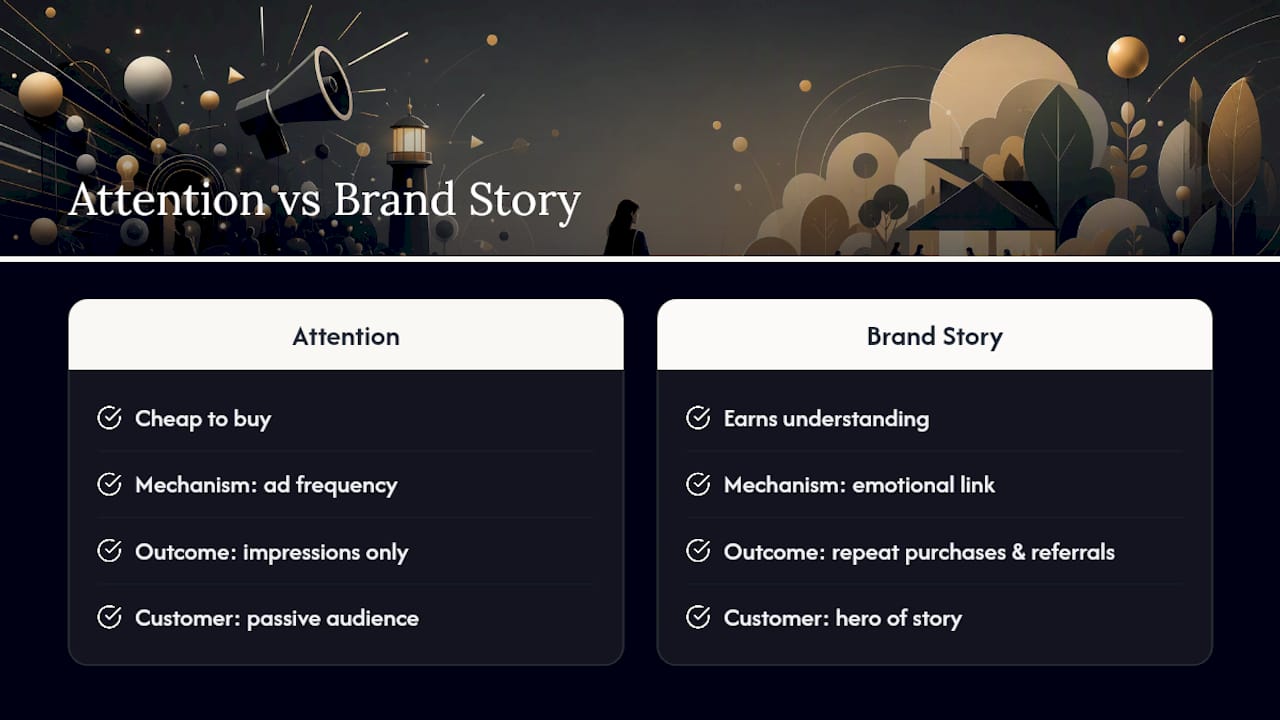
Attention is cheap. A good brand story earns something harder: a customer who feels the brand understands them, which is the actual mechanism behind repeat purchases and referrals. HBS’s research on storytelling frames this directly, arguing that the emotional connection a story builds is what moves someone from merely being aware of a brand to actually buying and, critically, staying loyal afterward.
Loyalty shows up in behavior, not sentiment. A customer who feels like the hero of your brand’s story is more likely to tag your product in their own content, defend your brand in a comment thread, or recommend it unprompted, because retelling the story is, in effect, retelling their own experience. That’s a fundamentally different relationship than one built on discount codes or ad frequency.
This is also why the customer as hero principle matters practically, not just artistically. When the brand takes center stage in its own marketing, the customer has nothing to project themselves onto. When the customer is the hero and the brand plays enabler, the story becomes something the reader can adopt as their own narrative, which is a large part of why it gets shared instead of scrolled past.
For a small business without a media budget, this engagement effect is the real return on investment for time spent on storytelling. A weak, generic story might still generate impressions. A specific one generates advocates, and advocates cost nothing to acquire twice.
The Most Common Ways Brand Stories Go Wrong
Most brand story failures trace back to one of five recurring mistakes, and they’re worth checking your own draft against before you publish anything.
- Making the brand the hero. Copy that centers “we believe” and “our mission” instead of what the customer overcame reads as self-congratulation, not narrative.
- Staying too abstract. Vague claims like “quality you can trust” have no concrete scene behind them, so nothing sticks in memory.
- Chasing a mission the business doesn’t actually support. A cause-driven story collapses fast once a customer checks whether the supply chain or business model backs the claim.
- Changing the story every quarter. Brands that rewrite their narrative with every new campaign never build the repetition that makes a story recognizable.
- Overproducing the first asset. Spending the entire creative budget on one polished anchor video, with nothing left for the smaller bridge and activation content that actually builds reach, wastes the story before it gets tested.
The fix for most of these isn’t more creativity. It’s discipline: pick one tension, one hero, one repeatable object, and resist the urge to redecorate the story every time you get bored of it internally. Customers rarely get bored of a story as fast as the marketer telling it does.
Author Perspective: What to Prioritize First
If you’re starting from zero, don’t try to build all five story elements at once. First, narrow your audience until the tension feels specific, not aspirational. Second, pick one creative constraint (an object, a phrase, a scene) and commit to it for months, not days. Third, build a small feedback loop, even five customer conversations, before you scale any format. Test the tension in one low-cost post before you invest in a polished anchor asset.
— Christopher
How Moderatemurmurations Turns a Brand Story Into a Launch
A sharp brand story is only half the job. It still has to become a homepage, a landing page, and copy that actually converts, which is where most small businesses stall out after the strategy work is done. Our service builds the website, landing pages, and brand copy around the story you’ve already drafted, so the tension, hero, and concrete details from your template above show up consistently from your homepage to your checkout page.
That means faster turnaround than hiring a traditional agency, and a system built for how small teams actually work: one clear story, translated into launch-ready assets, without months of back-and-forth. If you’re deciding how to present customer transformations, our guide to testimonial page examples pairs well with the customer story format covered above. For a wellness brand or service provider building this out from scratch, our piece on creating a wellness brand’s online presence walks through the empathy-driven approach in more depth.
Ready to see your story live? Book a free consultation and bring your draft template. We’ll map it directly onto a launch plan.
Sources
- Figs: How a Scrubs Brand Became a $1B Business (2026) - Shopify
- How Graza Turned Its Olive Oil Tin Into a $40M Brand Storytelling Engine – D2C Times
- What Is a Brand Story? The Importance & 5 Compelling Examples - Harvard Business School Online
FAQ
What is an example of brand storytelling?
Warby Parker’s founding story, a customer losing an expensive pair of glasses and being shocked by replacement costs, is a clear example because it directly explains the brand’s low-price positioning rather than just describing the product.
How do you write a brand story?
Name the specific tension your customer faced, cast the customer as the hero of the story, pick one concrete object or scene to anchor it, build a short three-beat arc, and choose your channel before writing the final copy.
What is Apple’s brand story?
Apple’s story centers on the individual challenging conformity and faceless institutions, a tension established in its earliest advertising and carried through decades of product changes without altering the underlying narrative.
What is a brand story?
A brand story is the underlying narrative explaining why a company exists and who it serves, distinct from a slogan or a single campaign because it stays consistent across every customer touchpoint, from the website to customer service emails.
Why do brand stories matter for small businesses specifically?
A specific brand story is one of the few marketing advantages a small business can build without a large budget, since Harvard Business School’s research on storytelling ties emotional connection, not production value, to the shift from awareness to purchase.