Automation Consulting for Small Businesses: A Practical Guide
Automation Consulting for Small Businesses: A Practical Guide

Automation consulting turns recurring website, marketing, and AI workflow tasks into reliable systems that save time and increase revenue. For a solo owner, a wellness practice, or a small service team, that typically means three things delivered and handed over to you: a working landing page with lead capture and routing, a CRM and email sequence wired to your intake, and at least one AI-assisted workflow that replaces a manual handoff. BCG research confirms that the majority of transformation effort goes into organization and change management, not the technology itself, so the right consultant guides you through both. A good starting point is a 30-minute discovery call or a one-week audit of your most time-consuming recurring tasks.
- Working landing page with lead capture and automated routing
- CRM and email sequence connected to your intake or booking flow
- One AI-assisted workflow replacing a manual, repeated handoff
Key Takeaways
Automation consulting for small businesses works best when it starts with a clear process map, a fast pilot, and a named internal owner who takes over at handover.
| Point | Details |
|---|---|
| Start with a busywork audit | Spend one week mapping recurring tasks by frequency and time cost to find your highest-ROI automation first. |
| Expect a staged timeline | A well-run engagement runs 8 weeks: diagnostic, pilot, build, training, and a 30–90 day stabilization window. |
| Budget realistically | Small-business projects covering one to three automations typically run $5,000–$25,000 depending on complexity. |
| Demand six deliverables | A legitimate engagement hands over a process map, roadmap, tool rationale, specs, deployed automations, and a runbook. |
| Moderatemurmurations | Offers done-for-you AI-assisted websites, landing pages, and workflow setup with full client ownership at handover. |
Table of Contents
- What does automation consulting actually mean for small businesses?
- Who benefits most from hiring a consultant for automation?
- What services should a good automation consultant deliver?
- What does the delivery process look like, and how long does it take?
- How much does automation consulting cost, and how do you estimate ROI?
- How do you evaluate and choose the right automation consultant?
- Two short examples of automation consulting in practice
- How to prepare for your first consult and what to expect in 30/60/90 days
- A note on what actually makes these projects work
- Moderatemurmurations: done-for-you digital systems for small businesses
- Sources
What does automation consulting actually mean for small businesses?
The phrase “automation consulting” covers a wide range of services, and most of what ranks online is about industrial systems, PLC programming, and factory controls. That is not what this guide is about. Here, automation consulting means a consultant or agency helps you identify, design, build, and hand over website, marketing, and AI workflow automations specific to your business. The recognized industry term for the broader discipline is business process automation (BPA), and the tools involved are platforms like Zapier, Make, and n8n, AI assistants, landing page builders, CRM integrations, and lightweight AI agents.
What is not covered: industrial machinery, enterprise ERP replacements, or large-scale Robotic Process Automation programs built for corporations. Those are different services with different price tags and different teams.
Scope of a small-business automation engagement:
- Workflow platforms (Zapier, Make, n8n) connecting your existing tools
- AI assistants and chatbots for intake, FAQ, and scheduling
- Landing pages and lead capture forms with automated follow-up
- CRM and payment integrations (Stripe, Calendly, HoneyBook, and similar)
- Content publishing automation for blogs, social, and email
Who benefits most from hiring a consultant for automation?
The clearest candidates are solo owners and small teams of 2–25 people who are spending senior hours on tasks a system could handle. Wellness professionals, service providers, coaches, and creators who sell products or services online tend to see the fastest returns because their workflows are repetitive and well-defined.
Watch for these signals in your own business:
- Leads wait more than a few hours for a response because follow-up is manual
- Onboarding new clients takes days of back-and-forth email
- A senior person (often you) handles exceptions that a clear process could prevent
- Content publishing requires manual copying, formatting, or scheduling each time
- Invoices, contracts, or intake forms are sent one by one
Korix notes that the highest ROI in service businesses comes from automating processes that appear automated on the surface but still rely on senior staff to resolve exceptions. That hidden layer of manual effort is where most of the time loss actually sits. A one-week busywork audit of your recurring tasks by frequency and time cost will surface those processes quickly.
What services should a good automation consultant deliver?
A legitimate engagement produces concrete deliverables you own at handover. Jahanzaib every buyer should expect: a process map, an automation roadmap, tool rationale, implementation specs, deployed automations, and a handover document. Beyond those, the core service categories for small-business clients include:
- Rapid diagnostic and roadmap: A documented map of your current process and a prioritized list of what to automate first
- Landing pages and lead capture: A published page with a working form, lead routing, and confirmation sequence
- CRM and email sequence wiring: Your CRM connected to intake, with automated follow-up emails triggered by actions
- Payment and booking integration: Stripe, Calendly, or equivalent connected to your confirmation and onboarding flow
- Content publishing automation: Blog posts, newsletters, or social content scheduled and published without manual steps
- Chatbots and AI assistants: A deployed chat widget handling FAQ, intake questions, or appointment booking
- Monitoring and error handling: Alerts when a workflow breaks, with a clear recovery path
- Documentation and handover: Written runbooks, recorded walkthroughs, and admin credentials transferred to you
You own everything: credentials, code, prompts, and runbooks. A consultant who retains access or IP after handover is a red flag. For practical website automation tools that fit small-business budgets, the off-the-shelf platforms above are usually the right starting point.
What does the delivery process look like, and how long does it take?
A well-run engagement follows a staged process that limits risk and produces usable results at each step.
| Stage | Duration | Key Deliverable | Client Input Required |
|---|---|---|---|
| Rapid diagnostic | 1–2 weeks | Process map, prioritized roadmap | Access to tools, sample data, KPI baseline |
| Pilot / proof-of-concept | 2–4 weeks | One working automation in production | Named owner, test data, feedback |
| Build and integrate | 3–8 weeks | Full automation suite deployed | Credentials, content, approval checkpoints |
| Training and handover | 1–2 weeks | Runbooks, recorded walkthroughs, transferred access | Team availability for sessions |
| Iterate and stabilize | 30–90 days | Monitoring alerts, refined flows, operations manual | Error reports, usage feedback |
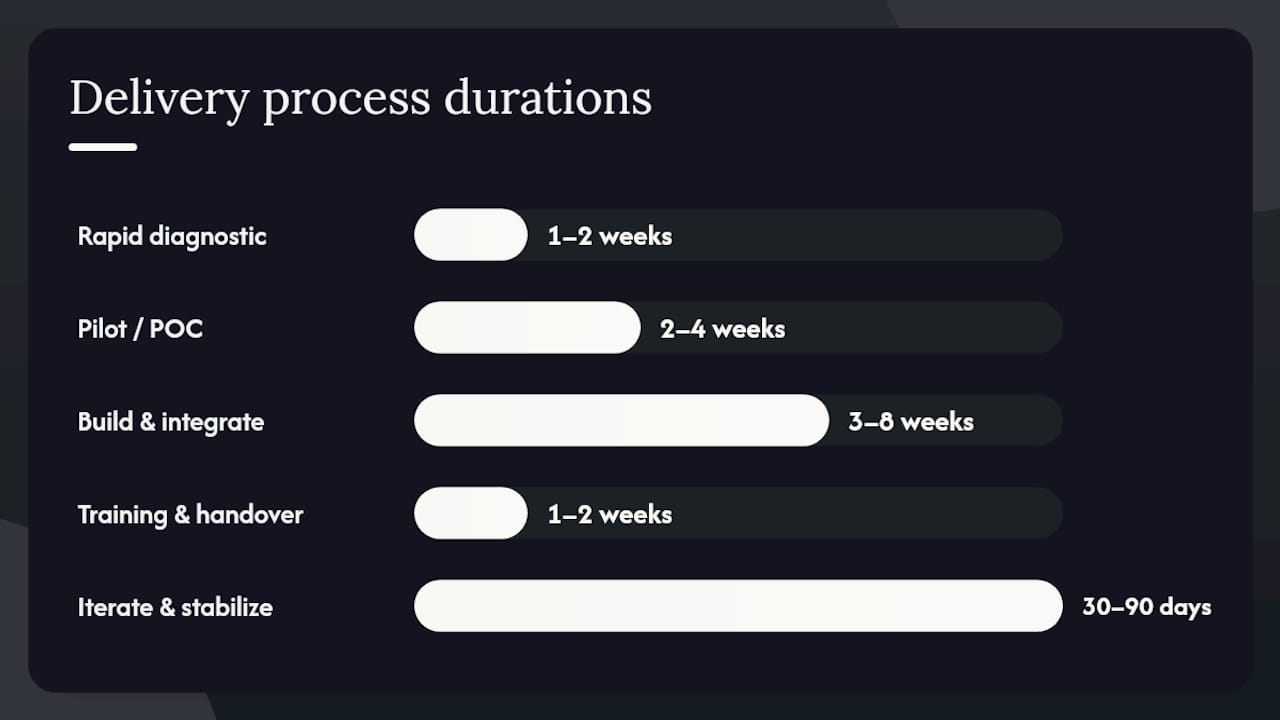
Korix describes a 21-day pilot that delivers a production-ready automation by day 22 for well-scoped, single-workflow projects. That timeline is realistic when the process is clearly defined and test data is ready before the build starts. Northern Star recommends validating co-pilot tools for 60–90 days before committing larger budgets, which maps naturally to the iterate-and-stabilize stage above.
Pro Tip: Name one internal owner before the project starts. Without that person, even a well-built system stalls at handover.
Good AI workflow design starts with a clear process map, not a tool selection. The tool choice follows the process, not the other way around.
How much does automation consulting cost, and how do you estimate ROI?
Pricing models vary by scope and consultant type. SUPALABS breaks down the main categories: strategy consultants charge higher rates for roadmaps and advisory work; implementation specialists charge less per hour but do the build. Common structures include:
- Fixed-price pilot: One scoped automation delivered for a set fee, lowest risk for first engagements
- Time and materials: Hourly or daily rate, works when scope is uncertain
- Retainer: Monthly fee for ongoing builds, monitoring, and iteration
- Outcome-linked fee: Partial payment tied to a measurable result (conversion rate, hours saved)
For small-business projects covering one to three automations, typical project bands run from a few thousand to tens of thousands of dollars depending on complexity and the consultant’s experience level. A simple ROI calculation: multiply hours saved per month by your effective hourly rate, then divide the project cost by that monthly saving to get your payback period in months.
Off-the-shelf platforms like Zapier, Make, and n8n are the right starting point for most Tier 1 workflows. Custom builds are justified when volume is high, the integration is unique, or you need to own the infrastructure outright. Starting off-the-shelf validates value before you invest in a custom build. For a broader view of automation’s role in scaling a service business, the iterative approach consistently outperforms big-bang builds.
How do you evaluate and choose the right automation consultant?
Vetting a consultant comes down to five dimensions: technical depth, domain experience, implementation history, methodology, and communication. SUPALABS emphasizes evaluating technical depth and process-first discipline over tool-first pitches.
Questions to ask in a first call:
- Can you show me a runbook from a past project?
- Walk me through how you handle a broken workflow at 2 AM.
- Why did you choose that tool over the alternatives for that client?
- Can you share a reference who can speak to outcomes, not just delivery?
- Who owns the credentials and code at handover?
Red flags to watch for:
- Promises a complex build in under four weeks with no pilot phase
- Cannot explain tool choice beyond “it’s what we use”
- Vague or absent IP and handover terms in the contract
- No monitoring or error-handling plan
- Leads with a tool demo before mapping your process
A consultant who cannot show you a clear AI strategy and a documented handover process is selling you a dependency, not a system.
Two short examples of automation consulting in practice
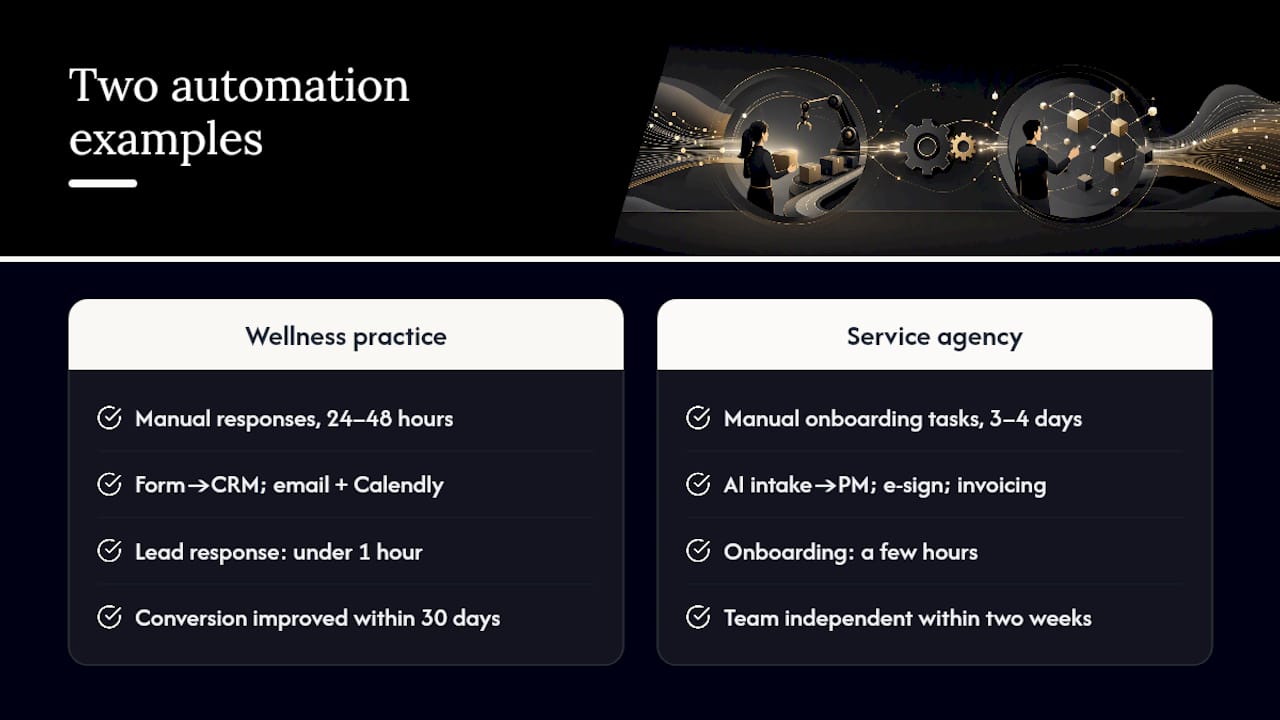
Example 1: Lead response for a wellness practice. A solo practitioner was responding to new inquiries manually, often 24–48 hours later. After a diagnostic and a three-week pilot, a landing page with an intake form connected to her CRM triggered an immediate personalized email sequence and a Calendly booking link. Lead response dropped to under one hour. Conversion from inquiry to booked call improved measurably within the first 30 days. The key success factors: a clear process map built before any tool was selected, a small set of real test leads used during the pilot, and one named staff member trained on the monitoring alerts.
Example 2: Onboarding automation for a service agency. A five-person agency was spending senior hours on client onboarding: sending contracts, collecting intake forms, issuing invoices, and scheduling kickoff calls, all manually. An AI-assisted intake form connected to their project management tool, e-signature platform, and invoicing system cut onboarding from three to four days down to a few hours. The consultant delivered a runbook and a recorded walkthrough at handover, and the team ran the system independently within two weeks.
How to prepare for your first consult and what to expect in 30/60/90 days
Arriving prepared shortens the diagnostic phase and reduces your project cost. Before your first call, gather:
- A written description of the process you want to automate (even a rough list of steps)
- Sample data or example inputs the workflow would handle
- Your current KPI baseline (how long the task takes, how often it runs, what it costs)
- Admin access or login credentials for the tools involved
- The name of one internal person who will own the system after handover
30/60/90 starter plan:
- Days 1–30: Diagnostic complete, roadmap agreed, pilot automation in production
- Days 31–60: Full build deployed, team trained, monitoring alerts active
- Days 61–90: Iteration based on real usage, operations manual delivered, system stabilized
Pro Tip: Northern Star recommends having an operations manual by day 90 that includes your tool list, workflow library, and prompt library. That document is what makes the system yours, not the consultant’s.
For a deeper look at AI adoption for small business owners, the same staged approach applies whether you are starting with one workflow or planning a broader digital system.
A note on what actually makes these projects work
The technology in a well-run automation engagement is rarely the hard part. What separates projects that stick from ones that get abandoned is whether a real person inside the business owns the system after handover. BCG’s research on AI-enabled service transformations makes this point clearly: the majority of transformation effort is organizational, not technical. Co-designing with the people who will actually use the system, naming an accountable owner, and building simple monitoring into the handover are what determine whether the automation runs six months later or sits unused.
At Moderatemurmurations, the focus has always been on fast, handover-ready pilots built inside the client’s own stack, with documentation the client can read and maintain. AI-assisted websites and digital systems for small businesses, creators, and wellness brands work best when the client owns every credential, every prompt, and every runbook from day one. Change management is not a soft add-on; it is where the ROI is actually realized.
Moderatemurmurations: done-for-you digital systems for small businesses
Skip the agency retainer and the months-long build. Moderatemurmurations delivers AI-assisted websites, landing pages, lead capture systems, email sequences, and AI workflow setup for small businesses, creators, wellness brands, and service providers, at a pace and price that fits a small-business budget.
You get a working system you own: the credentials, the copy, the workflows, and the documentation. The first step is a free discovery call where we map your highest-priority process, identify the fastest pilot, and give you a clear scope before any money changes hands. Book your free consultation and walk away with a roadmap whether or not you hire us.
Sources
- Reinventing service operations with AI | BCG
- AI Workflow Automation for Service Businesses (2026)
- How to Use AI Inside Your Service Business Operations (2026 Practical Playbook)
- Business Automation Consultant: Services, Cost & How to Hire | SUPALABS Blog
- AI Automation Consultant Deliverables: What You Get in 2026
- AI Automation for Service Businesses: 9 Workflows to Automate First (With ROI)