Small Businesses: Turn AI Website Design into Conversion Ready Sites
Small Businesses: Turn AI Website Design into Conversion Ready Sites

AI website design can turn a short brief into a usable multi-page site draft in minutes, but it almost always needs human direction to fit your brand and convert visitors into customers. If you need a quick minimum-viable site or a low-cost launch, a builder alone will get you there. If growth and conversion matter more than speed, pair that draft with a specialist who can polish the messaging and structure.
TL;DR:
- AI website builders can generate multi-page structures, copy, and responsive layouts within minutes, but often require human refinement for quality and effectiveness.
- Supplying a brand kit and clear goals in your prompt improves output consistency and helps shape a site that aligns with your brand identity.
- Suitable projects for AI builders include portfolios, MVPs, and simple online stores, but complex user flows and custom integrations still need expert input.
- Choosing the right tool involves checking editability, export options, SEO controls, hosting flexibility, and transparent pricing or cancellation policies.
- The fastest path from draft to launch combines quick AI prototyping with professional polishing of messaging, SEO, and conversion strategies.
Table of Contents
- How Does AI Website Design Actually Work?
- What Can AI Website Design Actually Generate for You?
- Which Websites Are a Good Fit for AI Builders?
- How Do You Choose the Right AI Website Tool or Service?
- What’s the Step-by-Step Workflow for a Production-Ready Site?
- How Moderate Murmurations Blends AI Speed With Human Judgment
- What Does AI Website Design Cost, and How Long Does It Take?
- Where Is AI Website Design Actually Headed?
- Launch Your Site Faster With Professional AI-Assisted Design
- Sources
How Does AI Website Design Actually Work?
AI website design tools run on prompt-driven generation. You describe your business, and the system produces layouts, copy, and styling in one pass, the same approach Figma’s AI web design tools use to turn a written brief into a working draft. Under the hood, this is often called agentic AI, meaning the system doesn’t just generate a static page. It can act more like a junior designer, making decisions about structure, hierarchy, and content placement based on your input.
The typical lifecycle looks like this:
- Prompt: You describe your business, goals, and audience in plain language.
- Scaffold: The AI drafts a site structure, deciding how many pages you need and what belongs on each.
- Generate: It fills that scaffold with copy, images, and layout choices.
- Refine: You or a designer adjust colors, wording, and layout in an editable canvas.
- Publish: The finished site goes live, either hosted by the tool or exported elsewhere.
That “refine” step separates good tools from frustrating ones. Some platforms lock you into their generated output with minimal editing room. Others, including Webflow’s AI site builder, aim to produce a full multi-page foundation with a reusable design system, so the site stays editable and scalable well past the first draft. A handful of tools, like Anima, even let you export clean HTML, CSS, or React code, which matters if you ever want to move off the platform without rebuilding from scratch.
What Can AI Website Design Actually Generate for You?
A modern AI builder can produce a surprising amount on the first pass: multi-page scaffolds (home, about, services, contact), written copy for each section, stock or AI-generated imagery, and layouts that already adjust for mobile and desktop screens. Feed it a brand kit, meaning your colors, fonts, and logo files, and the output looks noticeably less generic. Figma’s documentation on AI web design generation notes that supplying a brand library at the prompting stage measurably improves consistency across pages, rather than leaving you to fix mismatched fonts later.
Pro Tip: Before you open any AI builder, write down your three most important pages and the one action you want each visitor to take. That short list will shape a better prompt than any amount of trial and error inside the tool.
Here’s what you typically get, and where the gaps show up:
- Home, about, services, and contact pages generated together as a coherent set.
- Draft copy that captures tone reasonably well but rarely nails your specific value proposition.
- Responsive layouts that work on phones and desktops without extra configuration.
- Export paths ranging from a hosted site to full code export or CMS population, depending on the platform.
The limitations tend to show up in the details: edge-case user flows (multi-step booking forms, complex filtering), custom integrations beyond basic plug-ins, and conversion polish, meaning the specific wording and layout choices that actually move a visitor toward booking or buying. Tools like Framer address some of this by pairing generation with editable layers and CMS connections, but even there, the first draft is a starting point, not a finished product.
Which Websites Are a Good Fit for AI Builders?
Match your project to the right tool by asking how much is riding on the site converting a stranger into a customer.
- Quick launches and portfolios. A personal site, a portfolio, or a one-page announcement is close to ideal AI-builder territory. Low stakes, straightforward structure, fast turnaround.
- MVPs and simple online stores. If you’re testing an idea or need a basic storefront with a handful of products, an AI draft gets you live fast enough to start collecting real feedback.
- Conversion-critical or brand-sensitive sites. A wellness practice booking new clients, a service business competing on trust, or any site where the words on the page directly affect revenue usually needs a specialist’s eye on messaging and structure.
- Custom integrations. Once you need a CRM connection, a booking system with specific logic, or anything beyond a contact form, hand-coded work or an AI-assisted professional saves you from fighting the platform’s limits.
- The hybrid path. Generate the AI prototype yourself, then bring in a professional to refine messaging, tighten conversion paths, and handle anything the builder can’t. This tends to be faster and cheaper than starting from a blank page with an agency.
How Do You Choose the Right AI Website Tool or Service?
Run any tool or service through the same short checklist before committing time or money.
- Editability: Can you actually rearrange sections and rewrite copy, or does the tool lock certain elements?
- Brand kit support: Does it accept your logo, fonts, and colors at the prompting stage, or only after generation?
- SEO controls: Can you edit page titles, meta descriptions, and heading structure directly?
- Performance: Does the generated site load quickly, or does it carry bloated code you can’t touch?
- Hosting and export terms: Are you locked into their hosting, or can you export code and move elsewhere later?
- Pricing model: Is it a flat subscription, usage-based, or does customization trigger extra fees?
During a trial or a vendor call, ask directly: “What happens to my site if I cancel my subscription?” and “Can I export the code, or am I stuck on your hosting permanently?” Builders that support export, similar to what Anima’s AI website builder offers, give you a real exit path instead of a permanent dependency.
Pro Tip: Treat the free trial like a stress test, not a demo. Try to break something. Delete a section, swap the brand colors, and add a new page. If the tool fights you at every step, that friction will still be there after you’ve paid for the annual plan.
Watch for red flags: vague pricing that only reveals itself after you’ve built something you don’t want to lose, no code export option at any tier, and generated copy so generic it could belong to any business in your industry.
What’s the Step-by-Step Workflow for a Production-Ready Site?
Getting from AI draft to launch-ready site follows a fairly consistent pattern, whether you’re doing it yourself or working with help.
- Prepare your assets first. Gather your logo, brand colors, fonts, and a clear one-sentence goal for the site before you open any tool. A reference styling context, even something as simple as a one-page brand kit document, dramatically improves what the AI produces.
- Write a specific prompt. Include your audience, your main offer, the tone you want (professional but warm, for instance), and one or two example pages you admire. Vague prompts produce vague sites.
- Refine in layers. Fix structure first, then copy, then visual details. Replace every placeholder image and stock phrase before you touch anything cosmetic.
- Run SEO and accessibility checks. Confirm heading structure, alt text, and page titles are in place before publishing.
- Publish, then watch the data. Push to staging first if the tool allows it, then go live and start reviewing analytics within the first week to catch problems early.
Pro Tip: Draft your prompt in a separate document first, not directly into the tool. You’ll write a sharper brief when you’re not also fighting a text box that’s about to generate an entire website.
This mirrors the workflow Moderate Murmurations uses on client projects, detailed further in our guide to prompt engineering for design and copy generation.
How Moderate Murmurations Blends AI Speed With Human Judgment
Our process starts where most AI builders stop: a rapid AI-generated prototype, built fast so you can see structure and direction immediately. From there, we shift into messaging and conversion polish, rewriting copy that was technically fine but wasn’t actually selling anything, then move into launch support, meaning SEO structure, analytics setup, and a site that’s ready to grow instead of just ready to look at.
The gains from that middle step are concrete, not cosmetic:
- Copy that speaks to a specific customer problem instead of generic industry language.
- Page structure and internal linking built around how search engines actually crawl a site.
- Conversion paths (calls to action, form placement, page order) tested against how real visitors move through a site.
Teams that combine automatic generation with a human review pass consistently report higher final quality and conversion than AI output left untouched. We cover the mechanics of that hybrid process in more detail in our pieces on AI workflow design and AI coaching for new business launches.
What Does AI Website Design Cost, and How Long Does It Take?
Timelines split sharply depending on how far you push past the first draft.
- AI draft alone: Minutes to a couple of hours, depending on how many revisions you run through the prompt.
- Polished, launch-ready site: Days to a few weeks, once you factor in content refinement, SEO checks, and testing.
- Full custom build with integrations: Several weeks, largely driven by how many outside tools (CRM, booking, payment processing) need to connect cleanly.
Cost follows a similar split. A basic AI builder subscription runs the price of a monthly plan, often cheaper than a single hour of freelance design work. Costs climb once you add customization, custom code, or integration work, since that’s labor a template can’t fully replace. Platforms that support publishing directly to hosting and analytics infrastructure can shorten the path from draft to live site considerably, but connecting those pieces correctly still takes deliberate setup, not just a checkbox.
Where Is AI Website Design Actually Headed?
Agentic integrations, meaning AI agents that connect directly to backends and real-time data rather than just generating static layouts, will keep expanding what these tools can build without a developer touching code. That shift makes brand systems and measurement more valuable, not less. A tool can generate pages fast, but only clear brand guidelines and real analytics turn that speed into something that actually works over time. Human oversight on conversion and compliance isn’t going anywhere soon.
— Christopher
Launch Your Site Faster With Professional AI-Assisted Design
Get a live, professional website quickly without being stuck editing a generic AI draft alone. We start with a rapid AI-generated prototype, then move into the part most builders skip: messaging that actually converts, SEO-ready structure, and hands-on launch support so your site is doing real work from day one.
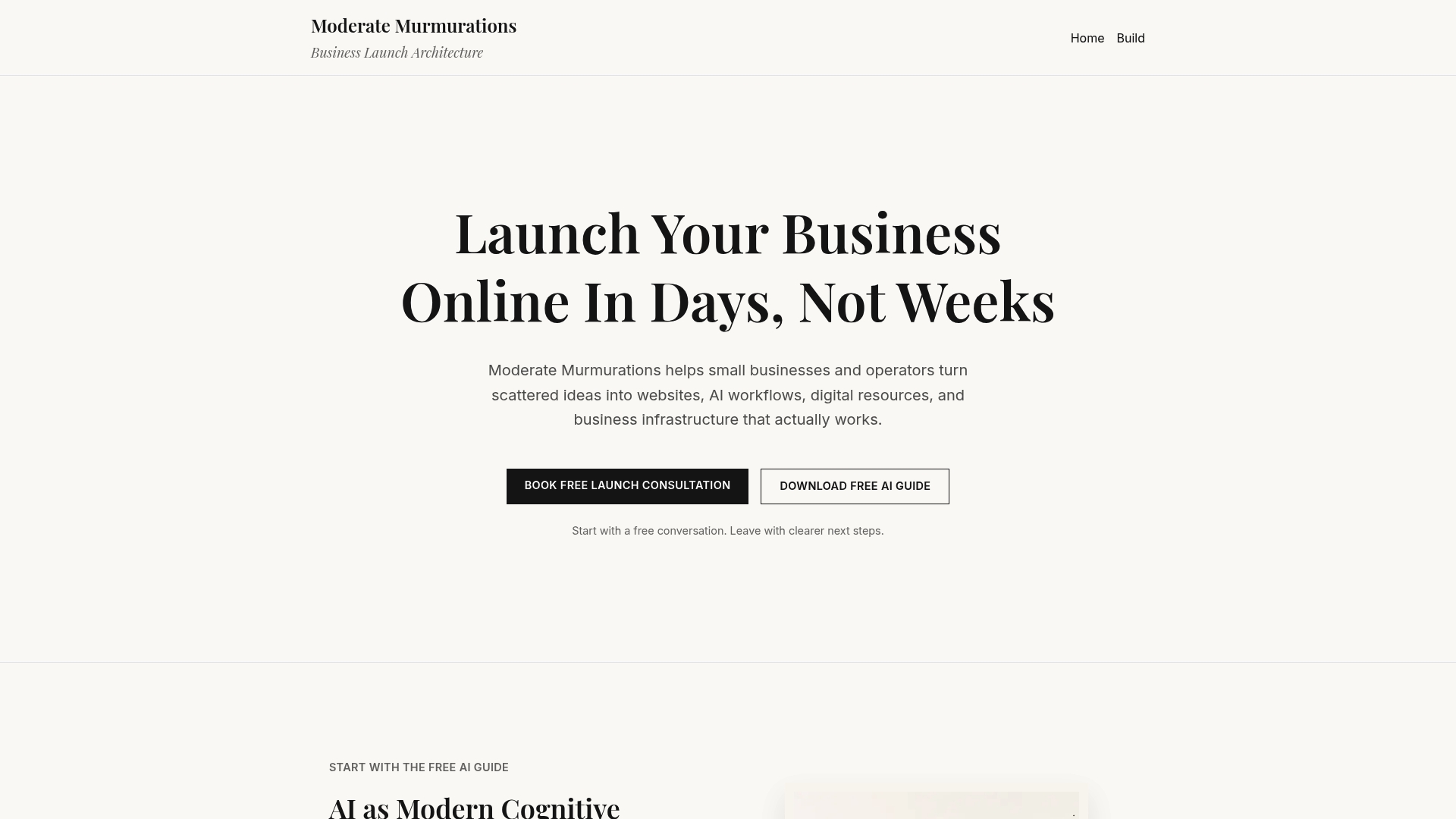
This approach fits small business owners, coaches, consultants, and wellness brands who want speed without sacrificing a site that sounds like them and ranks the way it should. If your current site feels generic, or you’re starting from nothing but an idea, book a free consultation through Moderate Murmurations and we’ll map out what a fast, polished launch actually looks like for your business.