AI Strategy for Small Businesses: Your 2026 Roadmap
AI Strategy for Small Businesses: Your 2026 Roadmap

An effective AI strategy is a focused plan that connects AI tools directly to your business goals, so every hour you spend on content, website design, or client work moves faster and produces better results. Deloitte’s research confirms the strongest approaches start with business goals as the north star, not with technology. For small businesses and creators, that means picking the right AI use cases for your workflows before you ever open a new tool.
A solid artificial intelligence roadmap for small businesses includes these core elements:
- Clear business goals tied to measurable KPIs
- Data readiness so your AI tools have clean, usable inputs
- Workflow selection focused on high-impact, repeatable tasks
- Human ownership of every AI-assisted process
- Continuous measurement to track real results over time
Table of Contents
- How to build your AI strategy step by step
- How AI improves your website and content design
- What Moderatemurmurations has learned about AI and digital growth
- Key takeaways
- Why the “start with tools” instinct leads you astray
How to build your AI strategy step by step
A phased approach keeps implementation manageable and reduces the risk of wasted effort. Research from RAND Corporation and IBM identifies unclear objectives and poor data quality as the top reasons AI projects fail. Starting with a clear plan prevents both.
-
Assess your workflows. Map your five most time-consuming, repeatable tasks. Look for places where you spend hours on structured work that follows a predictable pattern, like writing product descriptions, drafting SEO content, or updating page layouts.
-
Define your KPIs. Decide what success looks like before you choose any tool. Faster content turnaround, higher search rankings, or more consistent brand copy are all measurable targets.
-
Pick one use case. Founder-led businesses compress AI rollout to a shorter timeline by focusing on a single high-impact use case rather than trying to automate everything at once.
-
Run a pilot. Test your chosen use case on a small scale for 4–6 weeks. Document what works, what breaks, and where the output needs human review.
-
Build governance early. Budget allocation best practices recommend dedicating a significant portion of your AI budget to integration and data work, and a smaller portion to training and change management. Even for a solo business, that ratio holds.
-
Deploy and train. Roll out to your full workflow only after the pilot proves value. Make sure every person who touches the process knows how to use it and what to check.
-
Scale and measure. Expand to neighboring workflows once the first one runs reliably. High-performing organizations commonly achieve higher returns on AI investments compared to the broader industry by planning for optimization from day one.
Pro Tip: Name a single human owner for every AI workflow you build. No committees. One person is responsible for outputs, quality checks, and refinements. This single decision prevents more stalls than any tool upgrade.
How AI improves your website and content design
AI tools that automate repetitive website tasks, including SEO optimization, content suggestions, and design personalization, give small businesses a real edge in creative workflows. The gains show up in both speed and consistency.
“The most successful AI adopters actively redesign jobs and workflows around AI to create new roles emphasizing human-AI collaboration and oversight.” — Deloitte State of AI, 2026
Practical benefits for website and content work include:
- AI-generated copy drafts that your voice and brand guidelines then shape
- Automated SEO structure applied to new pages before you publish
- Personalized layout suggestions based on visitor behavior data
- Faster iteration on landing pages without starting from scratch each time
Data privacy matters here. Incorporating AI governance early protects sensitive client information and keeps you compliant with regulations like the California Consumer Privacy Act. For creators handling subscriber data or client files, this is not optional.
Moderatemurmurations applies exactly this approach when building AI-assisted websites for small businesses. Clean structure, search-ready copy, and automated content workflows are built in from the start, not added later. You can explore how automation shapes B2B marketing to see how these principles extend across professional services.

What Moderatemurmurations has learned about AI and digital growth
The most common mistake we see is treating AI as a shortcut rather than a system. A creator who uses an AI writing tool without a clear content brief gets generic output. The same creator with a defined brand voice document, a content structure template, and a weekly review process gets output that actually sounds like them.
AI works best when it handles the repeatable parts of your workflow so you can focus on the judgment calls. That means writing the first draft of a page, not deciding what the page should say. Generating three headline options, not choosing which one fits your audience. The human layer is where your competitive advantage lives, and AI for competitive advantage only compounds when that layer stays strong.
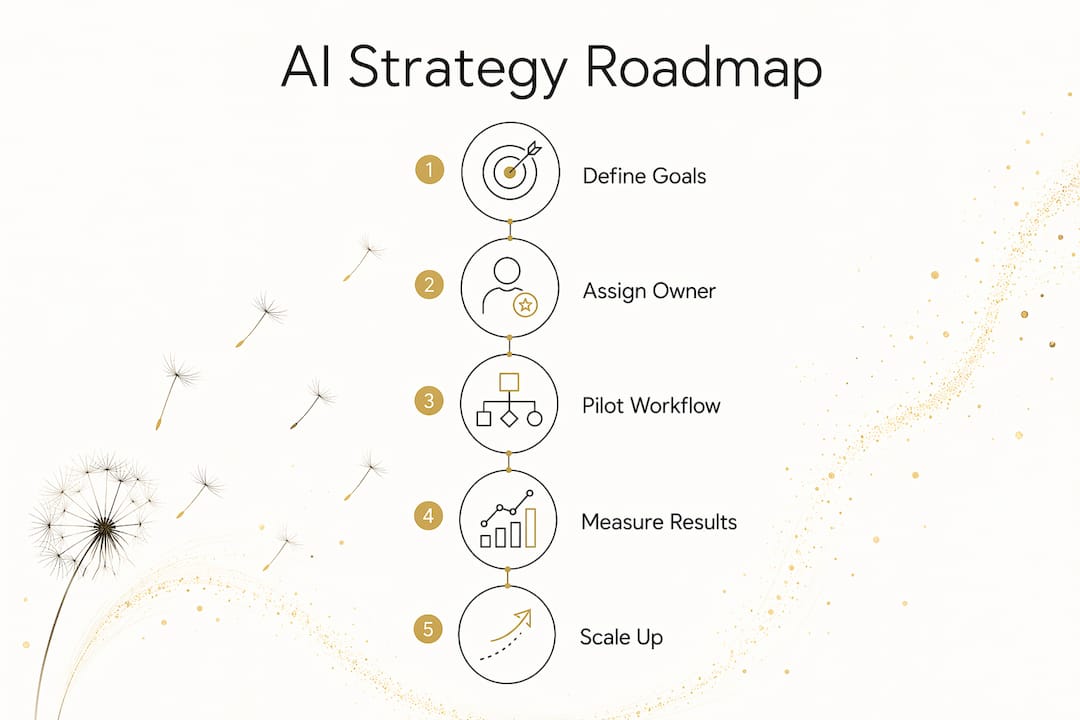
For small businesses, the right pace is deliberate. One workflow, proven and running, is worth more than five half-built automations. We have seen clients go from a scattered content process to a consistent publishing rhythm in under two months, simply by applying a single AI-assisted drafting workflow with clear ownership and a weekly check-in.
Ready to put this into practice? Moderatemurmurations builds fast, clean, AI-assisted websites and content systems for small businesses and creators across the United States.
Launch your business online in days, not months, with AI workflows built in from the start. Or explore the full range of website and digital systems we build for growing businesses.
Key takeaways
An effective AI business strategy starts with your goals, not your tools, and scales only after a single use case proves its value.
| Point | Details |
|---|---|
| Start with business goals | Align every AI initiative to a measurable KPI before selecting any tool. |
| One use case at a time | Founder-led businesses reach results in 6–9 months by focusing on a single workflow first. |
| Budget for integration | Dedicate 40% of your AI budget to data and integration work, not just software. |
| Assign clear ownership | Name one human owner per workflow to maintain quality and momentum. |
| Measure from day one | High performers achieve 5:1 returns by tracking ROI continuously, not after the fact. |
Why the “start with tools” instinct leads you astray
The pull toward trying every new AI tool is real, especially when your feed is full of demos showing instant results. But the gap between a demo and a working business system is where most small business AI efforts quietly stall.
The honest truth is that AI amplifies whatever process you already have. A clear, organized content workflow gets faster and more consistent with AI. A vague, reactive one just produces vague, reactive output faster. The technology is not the variable. Your clarity about what you need is.
For creators and small business owners, the most useful thing you can do right now is write down your three most repetitive tasks and ask which one has a clear, measurable outcome. That is your first AI use case. Build a digital system around it, prove it works, then expand. Everything else is noise until that first workflow runs reliably.