Four Checkpoints for AI SEO Content Teams That Keep Humans in the Loop
Four Checkpoints for AI SEO Content Teams That Keep Humans in the Loop

AI SEO content works when a person owns the final edit, not when a model publishes untouched. It fails when teams treat generation as the finish line instead of the first draft. Used correctly, AI speeds up research, outlines, and optimization, but it still hallucinates facts and drifts from brand voice, so human review stays non-negotiable for anything touching accuracy, legal exposure, or original insight.
TL;DR:
- Human review remains essential for AI SEO content, especially for factual accuracy, brand voice, legal compliance, and original insights.
- AI tools work best for stable, structured content like explainers, step-by-step guides, data roundups, and page updates, while sensitive topics require caution.
- Structuring content with answer capsules, schema, timestamps, and clear citations significantly improves AI citation and visibility in answer engines.
- An effective workflow involves defining a detailed brief, separate outline and draft generation, focused section prompts, and rigorous editorial QA before publishing.
- Ongoing monitoring for hallucinations, outdated facts, duplicate content, and voice drift is crucial to maintaining quality and AI content effectiveness.
Table of Contents
- What “AI SEO Content” Means and When to Use It
- Categories of AI SEO Tools and What Each One Actually Does
- Building a Human-in-the-Loop Workflow That Actually Works
- How Do You Structure Content So AI Systems Can Find and Cite It?
- The Practical Checklist: From Brief to Publish
- What Should You Actually Measure Beyond Rankings?
- How to Evaluate AI Tools Before You Commit Budget
- How AI can be used to build SEO-friendly content
- Ethical Considerations and Transparency in Using AI-Generated Content
- Best Practices for Integrating AI Content With Traditional SEO Strategies
- Case Studies Demonstrating Successful AI SEO Content Implementations
- Should You Handle This In-House or Bring in Outside Help?
- How a managed service can help you build AI SEO content that performs
- Sources
What “AI SEO Content” Means and When to Use It
AI SEO content describes any workflow where a language model helps draft, research, structure, or optimize a page that’s built to rank and get cited, with a person directing the process from brief to publish. That’s the working definition used here, and it’s narrower than what most vendors imply. The model doesn’t replace the strategist. It compresses the time between “we need a page on this” and “we have a publishable draft.”
That distinction matters because not every content type benefits equally. Google’s own guidance on AI content frames the technology as a tool for producing structured, extractable answers, not as a substitute for accurate, well-reviewed information. The content types where AI earns its keep tend to share a few traits: the facts are stable, the structure is predictable, and the value comes from clarity rather than lived experience.
Content that’s a strong fit for AI drafting:
- Educational explainers where the underlying facts don’t shift often (definitions, how-something-works pieces)
- Step-by-step how-to content with a clear, repeatable structure
- Data-backed roundups where the model can organize research a person has already gathered
- Scaling updates to existing pages: refreshing stats, expanding an outline, adding a missing subtopic
Content that needs extra scrutiny or should stay human-led:
- Legal or regulatory guidance, where a wrong sentence carries real liability
- Health and medical content, where hallucinated mechanisms or dosages can cause harm
- Personal narrative, founder stories, or anything claiming lived experience the model doesn’t have
- Original reporting, proprietary research, or first-party data analysis
The pattern is simple. If the content’s value depends on facts a model can get wrong, or on a human voice it can’t authentically produce, keep the human closer to the wheel.
Categories of AI SEO Tools and What Each One Actually Does
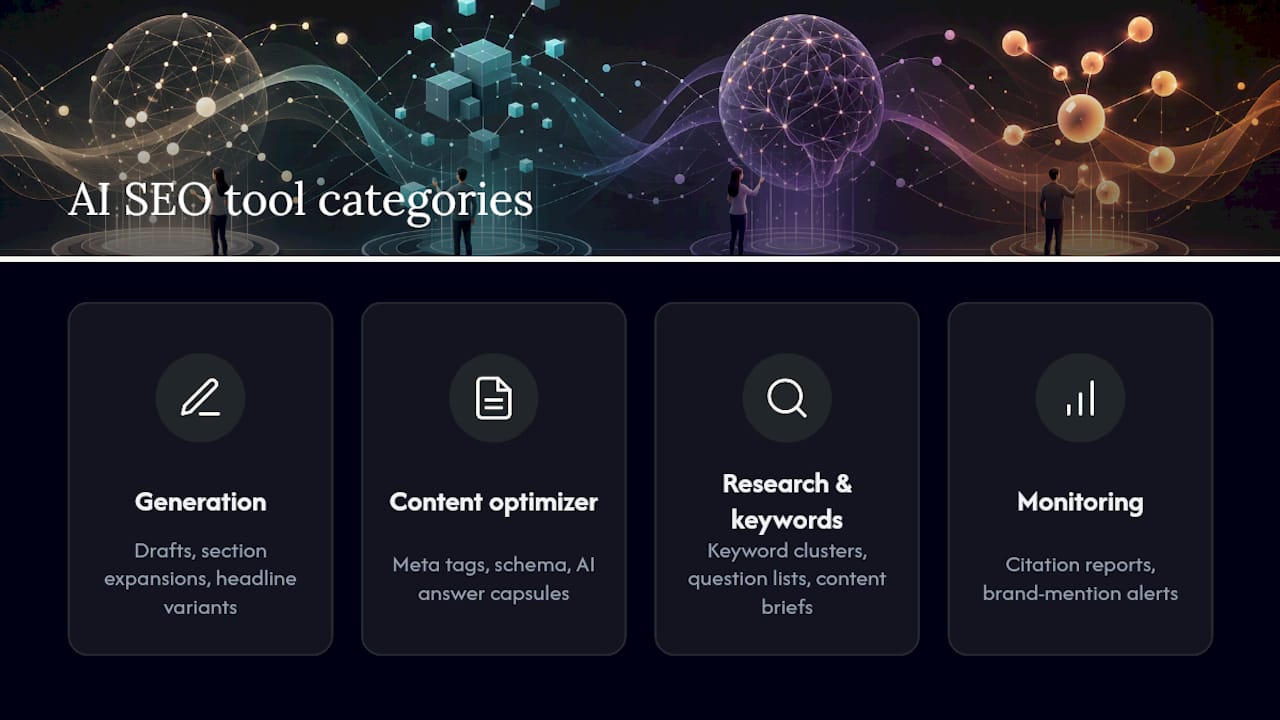
Most teams buy the wrong tool because they shop by hype instead of function. AI SEO tooling splits into six distinct categories, and understanding what each one outputs saves you from paying for overlap.
Generation assistants draft outlines, sections, and full articles from a prompt or brief. This is the category most people mean when they say “AI content tool.” Output: drafts, section expansions, headline variants.
Content optimizers focus on structuring existing or drafted content for both classic search engines and AI answer engines, sometimes described as GEO (generative engine optimization) or AEO (answer engine optimization). These tools suggest meta tags, schema markup, and answer capsules designed to be lifted directly into an AI response. Platforms like Ayzeo’s content optimizer build around exactly this: shaping passages so they’re structurally easy for an AI system to extract and cite.
Research and keyword assistants pull search volume, related questions, and competitive gaps, then hand that data to a writer or generation assistant. Output: keyword clusters, question lists, content briefs.
Schema and markup helpers generate the structured data (FAQPage, Article, HowTo) that helps both traditional crawlers and AI systems parse a page’s intent. Output: JSON-LD snippets, validation reports.
Editorial workflow platforms manage the human side: assigning drafts, tracking edits, routing approvals. Output: task queues, version history, style-guide enforcement.
Monitoring and visibility tools track whether your content shows up in AI answers, not just traditional rankings. Output: citation reports, brand-mention alerts across AI search surfaces.
How these map to a team depends on size and budget. A solo consultant might run one generation assistant and a free schema validator. A ten-person content team usually needs research tools plus an editorial workflow platform to avoid chaos when five writers use AI drafts simultaneously. Enterprise teams often pay for monitoring tools specifically because rank tracking alone no longer tells the full visibility story. Licensing costs scale from a monthly subscription per seat to enterprise contracts with API access and dedicated support. Choose based on which gap in your current workflow actually costs you time, not on which category has the flashiest demo.
Building a Human-in-the-Loop Workflow That Actually Works
HubSpot’s practitioner survey found something worth sitting with: performance gains from AI content showed up consistently only when human editing was part of the process. AI alone, without a review layer, wasn’t a reliable path to better rankings. That single finding should shape how your team structures every AI-assisted article.
Here’s a workflow we’ve refined for exactly this reason:
- Build the brief first. Before any prompt gets typed, define the audience, the three to five questions the piece must answer, target keywords, and any data points that need to appear. A brief without these elements produces a generic draft no matter how good the prompt is.
- Generate the outline separately from the draft. Prompt for structure first (“Create an outline covering X audience’s questions about Y, ordered by search intent”), review it, then prompt for section drafts against the approved outline.
- Draft in sections, not one long pass. Shorter prompts focused on a single H2 at a time produce more usable output than asking for a full 2,000-word article in one shot.
- Generate metadata separately. Meta titles, descriptions, and schema suggestions need their own targeted prompt, since bundling them with the draft often produces generic, truncated results.
- Run editorial QA before anything goes live.
That last step deserves its own checklist:
- Fact-check every statistic, date, and named claim against a primary source
- Edit for voice: cut phrases that sound like every other AI draft
- Add at least one original example, data point, or observation the model couldn’t have generated
- Insert citations to real, checkable sources
- Confirm no section contradicts another (a common AI failure mode in longer drafts)
Team roles matter here too. One person should own prompting and drafting, a second should own editorial approval, and a third (sometimes the same person as the second) owns the actual publish action. Splitting these roles, even on a two-person team, prevents the “I already read it once so it must be fine” trap.
Pro Tip: Keep a running document of prompts that produced strong drafts for your brand voice. Reusing a proven prompt structure saves more time than trying to write a better one-off prompt each time.
For teams building this muscle for the first time, a structured AI training process for your writers pays off faster than any single tool purchase.
How Do You Structure Content So AI Systems Can Find and Cite It?
AI search systems extract and cite passages, not entire pages. That means the old goal of “rank on page one” now sits alongside a new one: “be the passage the AI quotes.” Content with statistics and named citations gets 30 to 40 percent higher visibility in AI-generated responses compared to vague, uncited claims, according to LLM SEO analysis, which is reason enough to rebuild your structural habits.
The core tactic is the answer capsule: a tight, 40 to 60 word passage placed right after a question-style heading that directly answers the question with no throat-clearing. Write it so it could be lifted verbatim into a chat response and still make sense out of context.
Beyond the capsule, a few structural elements consistently correlate with AI citation:
- FAQPage and Article JSON-LD schema, which help AI crawlers parse intent and content type, not just keyword relevance
- Visible “last updated” timestamps, since freshness signals matter more to AI systems than most SEO teams assume
- Clean crawlability, meaning no content locked behind client-side-only rendering that a bot has to execute JavaScript to see
- Confirmed access for GPTBot and other AI crawlers in your robots.txt, checked explicitly rather than assumed
- A submitted sitemap to Bing, since Bing’s index feeds several AI answer engines that many teams forget to check separately from Google Search Console
Pages that combine FAQ schema with clearly structured answer passages show up disproportionately often in AI-cited results, which tells you the structural work isn’t cosmetic. It’s the difference between content an AI system can parse confidently and content it has to guess about.
Original data matters here too. A model deciding what to cite favors specific, sourced claims over generic statements, because a named source gives it something concrete to attribute. If your article’s only claim is “many businesses see better results,” no AI system has a reason to quote it.
The Practical Checklist: From Brief to Publish
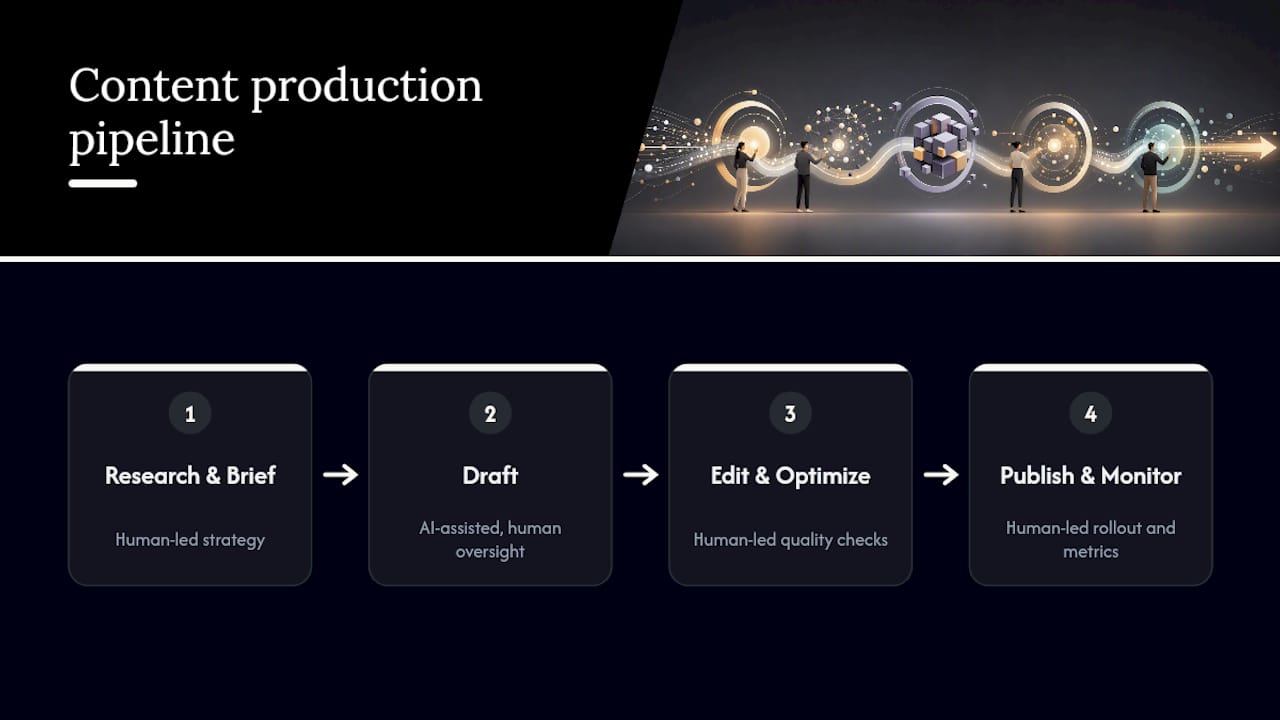
Every AI-assisted article should move through the same four checkpoints, regardless of who’s writing or which tool is generating the draft.
- Pre-write. Confirm the actual search intent behind the target query, gather sources and data you’ll cite, and pull in any stakeholder input (a subject-matter expert, a client’s product specifics) before a single prompt gets written.
- Draft. Use your proven prompt templates for outline, then sections, then metadata. Build the answer capsule for each major heading as you go, not as an afterthought during editing.
- Post-write QA. Fact-check every claim, add original examples a model couldn’t invent, insert real citations, and add FAQ or Article schema plus meta tags.
- Publish and monitor. Submit the URL for indexing, add internal links from and to related pages, and set a calendar reminder to check performance at 30 and 90 days.
| Stage | Primary action | Owner |
|---|---|---|
| Pre-write | Confirm intent and gather sources | Strategist or lead writer |
| Draft | Generate outline, sections, metadata via prompts | Writer |
| Post-write QA | Fact-check, add originality, insert schema | Editor |
| Publish and monitor | Submit for indexing, track KPIs at 30/90 days | Publisher or SEO lead |
Skipping the pre-write stage is the most common shortcut teams take, and it’s the one that costs the most later. A draft built on a vague or wrong intent still reads fine, which is exactly why the mistake survives all the way to publish. Catching intent mismatches costs five minutes before drafting. Catching them after publish costs a full rewrite.
For teams managing multiple pages at once, a repeatable visibility checklist keeps this four-stage process from sliding back into ad hoc publishing once the initial excitement about AI speed wears off.
What Should You Actually Measure Beyond Rankings?
Rank tracking alone can’t tell you whether AI-assisted content is working, because a page can rank fine on Google while never showing up in an AI answer, or vice versa. The KPIs worth watching sit in three buckets: traffic quality, conversion behavior, and AI-specific visibility.
On traffic quality, watch qualified organic sessions rather than raw pageviews. AI-assisted scaling tends to produce more pages, and more pages can inflate total traffic while the average visit quality drops. On conversion behavior, track assisted conversions and engagement metrics like time on page and scroll depth, since these reveal whether the content actually satisfies intent or just matches a keyword. On AI visibility, track citation appearances across AI answer engines where possible, along with branded search lift, since AI citations often drive brand recognition before they drive direct clicks.
The failure modes worth watching for:
- Hallucinations, where the model states a confident but false fact, especially around statistics, dates, or named entities
- Duplicate or commodity content, where scaled AI drafts start reading interchangeably across dozens of pages
- Stale facts, since a model’s training data has a cutoff and won’t know about a recent regulatory change or product update
- Voice drift, where each new AI draft edges slightly further from the brand’s established tone until the whole site sounds generic
Mitigating these takes ongoing maintenance, not a one-time fix: schedule periodic content pruning to catch pages that have gone stale, run sample audits across a percentage of published AI-assisted pages each quarter, and keep a named human accountable for every published piece so no article is an orphan nobody’s responsible for correcting.
Pro Tip: Set a recurring quarterly audit of your ten highest-traffic AI-assisted pages specifically for fact drift. Statistics that were accurate at publish often age out within a year.
How to Evaluate AI Tools Before You Commit Budget
Choosing an AI SEO tool by feature list alone is how teams end up paying for three overlapping subscriptions. Evaluate against these criteria instead:
- Real capability versus marketing claim. Ask for a live demo using your actual content, not a canned example, and see how the output handles your specific niche or voice.
- Workflow fit. Does it integrate with your existing CMS and editorial calendar, or does it create a separate silo your team has to check manually?
- Export and ownership. Confirm you retain full rights to and control over generated content, and that you can export everything if you switch tools later.
- Data privacy. Understand whether your prompts and drafts train the vendor’s model or stay private to your account.
- Retraining cadence. Ask how often the underlying model updates and how the vendor handles factual drift between updates.
- Cost versus realistic ROI. Price against time actually saved in your workflow, not against a vendor’s projected productivity multiplier.
During a demo, ask pointed questions: What happens when the model doesn’t know an answer, does it hedge or guess? Can output be regenerated section by section, or only as a whole draft? How does the tool handle brand voice guidelines you provide upfront?
Structure your trial as a two to four week proof of concept using real briefs from your actual editorial queue, not test content. Measure time from brief to publishable draft, editor hours spent per piece, and whether the output needed heavy rewriting or light polish. That comparison, run against your current process, tells you more than any vendor’s case study.
How AI can be used to build SEO-friendly content
A common effective process follows the same structure we’ve laid out here: a brief defines intent and sources, an AI draft handles the first structural pass, and a human editor rewrites for voice, checks every fact, and adds the schema and metadata that make a page easy for both search engines and AI systems to parse before anything publishes.
The gap between an AI draft and a publishable page is almost always the editing pass, not the generation step. Teams that skip straight from prompt to publish are the ones who end up rewriting everything six months later.
That’s a workflow philosophy used for projects aimed at small businesses, creators, and service providers who need content that performs without needing a full in-house content team to produce it.
Ethical Considerations and Transparency in Using AI-Generated Content
Readers and search engines both respond better to content that’s honest about how it was made. That doesn’t mean every article needs a disclaimer banner, but it does mean a few practices are worth building into your standard process rather than treating as optional extras.
First, don’t fabricate authority. If a piece implies firsthand experience, expertise, or testing that didn’t happen, that’s a credibility problem whether AI wrote the sentence or a person did… Second, disclose AI involvement where it materially affects trust, particularly in health, financial, or legal content where readers assume a qualified person is speaking. Third, respect the source material AI draws from: don’t let a model paraphrase a competitor’s proprietary research or a paywalled study closely enough that it functions as unlicensed republishing.
There’s also a quieter ethical issue: content flooding. Publishing dozens of thin AI-assisted pages just to claim keyword coverage devalues the search results for everyone and typically gets penalized once search engines catch the pattern. The SEO fundamentals that applied before AI still apply now. A page needs to earn its place by being genuinely useful, not just by existing.
Transparency, in practice, means your team can answer a simple question honestly: if a reader knew exactly how this page was made, would they trust it any less? If the answer is yes, the process needs adjusting before the content needs publishing.
— Christopher
Best Practices for Integrating AI Content With Traditional SEO Strategies
AI content doesn’t replace the fundamentals; it sits on top of them. Keyword research, internal linking, technical crawlability, and backlink earning all still matter exactly as much as they did before generative tools existed. The mistake teams make is treating AI as a separate strategy instead of an accelerant inside the existing one.
Start by keeping your keyword and intent research human-led, then let AI help execute against that research rather than generate the strategy itself. A model can draft faster than a strategist can type, but it can’t judge which keyword actually matters to your business model or which content gap represents real revenue opportunity.
Internal linking deserves particular attention. AI-generated drafts often produce isolated pages with no natural connection to your existing content, since the model doesn’t know your site’s architecture unless you tell it. Build internal linking into your brief template explicitly, specifying which existing pages the new content should reference and which future pages should link back to it.
Technical SEO checks, crawlability, page speed, mobile rendering, still apply regardless of how a page’s content got written. An AI-generated article on a slow, poorly indexed page performs no better than a human-written one and the same spot.
The strongest integration comes from treating AI as one stage in a pipeline your team already understands: research, brief, draft, edit, optimize, publish, monitor. Insert AI at the draft stage and let the rest of the pipeline stay exactly as rigorous as it was before.
Case Studies Demonstrating Successful AI SEO Content Implementations
The clearest pattern across documented AI content implementations isn’t a single dramatic before-and-after. It’s a consistent, smaller signal: teams that paired AI drafting with structured human editing reported measurable performance gains, while teams relying on AI output with light or no review saw flat or inconsistent results, a pattern confirmed across HubSpot’s survey of more than 300 web strategists.
That survey also found AI-assisted headline testing produced improved click-through rates in some A/B tests, though results varied enough across teams that human refinement of the final headline remained a meaningful factor in the outcome. The lesson isn’t that AI headlines are unreliable. It’s that AI-generated variants work as a starting pool for human judgment to narrow, not as an automatic winner to publish untouched.
The practical takeaway for your own implementation: don’t chase a dramatic case study from a single high-profile brand. Build your own small, internal comparison instead. Track a handful of AI-assisted pages against a handful of traditionally written ones over a quarter, using the same KPIs, qualified sessions, assisted conversions, and citation appearances, and let that comparison guide whether your process needs more human review or less friction in the drafting stage. The most useful case study is the one your own content calendar generates.
Should You Handle This In-House or Bring in Outside Help?
The decision usually comes down to three signals: capacity, speed requirements, and how complex your brand voice and compliance needs are. A team with an in-house writer who has bandwidth to learn prompting and run QA can absolutely build this workflow internally, and a resource like AI strategy guidance can shortcut the learning curve.
Agencies typically bring three things a stretched internal team lacks: proven prompt templates already tuned for search intent, editorial QA processes built from having made the mistakes already, and the bandwidth to move fast without pulling your team off other priorities.
If you’re testing the waters, start with a small pilot of three to five pages using your current team. If that pilot reveals more editorial bottleneck than bandwidth allows, a consult with a specialist is the faster next step. If compliance or brand complexity is high, get expert input before scaling either way.
How a managed service can help you build AI SEO content that performs
A managed alternative to building this entire workflow from scratch can handle AI-assisted site builds, content production, and workflow setup so your team gets the speed benefits of AI without spending months figuring out prompts, schema, and editorial QA on your own.

Engagements typically start with a free consultation to look at current content, goals, and where AI-assisted production could save the most time without sacrificing quality. From there, clients can scope a project, whether that’s a full website build, an ongoing content production pipeline, or an AI workflow setup that trains an existing team to run this process independently going forward. The process also includes building in the structural details that matter for AI visibility: schema markup, answer capsules, and fresh, citation-ready content structured the way today’s search and AI systems expect it.
If your team is weighing whether to build this in-house or get help launching it faster, book a free consultation and we’ll walk through what a managed setup would look like for your specific content needs.
Sources
Google’s own AI optimization guide covers structured, extractable answers and human review standards. For workflow evidence, HubSpot’s practitioner survey documents where human-in-the-loop editing produced measurable gains. For technical LLM optimization tactics, see the LLM SEO guide covering schema, freshness, and citation eligibility. For hands-on prompt and drafting advice, Neil Patel’s AI content generation guide and Babylovegrowth’s content brief framework both offer practical starting templates.
- AI optimization guide — Google Developers
- Is AI-Generated Content Good for SEO?: 300+ Web Strategists Weigh In — HubSpot
- LLM SEO: The Complete Guide to Ranking in AI Search (2026) — SEO Inspector Hub
- AI Content Optimizer - Create SEO & GEO Optimized Content | Ayzeo