AI Productivity Strategies That Actually Work in 2026
AI Productivity Strategies That Actually Work in 2026

AI productivity is the application of artificial intelligence tools and techniques to measurably increase the efficiency and quality of work in personal and organizational settings. Workers using AI automation save 11–15 hours per week, yet only 13% of companies report measurable improvement in organizational performance. That gap between individual gains and company-wide results is the central challenge of artificial intelligence in productivity. The strategies below address both sides of that gap, with evidence from 2026 research and practical guidance for professionals who want results that last.
1. What is AI productivity and why does the gap matter?
AI productivity refers to the measurable gains in output, speed, and quality that workers achieve by using AI tools in their daily workflows. The industry term for this broader category is intelligent process automation, which covers everything from AI-assisted writing to fully automated multi-step workflows. The 11–15 hours per week saved per worker is a significant individual gain. The fact that only 13% of organizations see company-level performance improvements tells you that most businesses are not yet capturing that value at scale.
The gap exists because individual efficiency does not automatically translate into team or organizational output. A worker who drafts reports twice as fast still depends on slow approval chains, misaligned priorities, and outdated processes. Closing the gap requires deliberate workflow design, not just tool adoption.

2. Automate repetitive administrative tasks first
The fastest wins in AI for workplace productivity come from removing low-value, high-frequency tasks. Email triage, meeting summaries, data entry, and status report generation are all strong candidates. These tasks consume hours each week without requiring judgment or creativity, which makes them ideal for AI automation.
AI workflow automation tools can handle calendar scheduling, draft routine client responses, and generate first-draft reports from structured data. The key is to identify tasks that follow a predictable pattern. If you can describe the task in a clear set of rules, AI can execute it reliably.
- Email drafting and triage: AI reads incoming messages and drafts prioritized responses based on your communication history.
- Meeting notes and summaries: AI transcribes calls and extracts decisions, action items, and deadlines automatically.
- Data entry and formatting: AI pulls structured data from documents and populates spreadsheets or CRM fields without manual input.
- Status report generation: AI aggregates project data and writes weekly updates in your preferred format.
Pro Tip: Start with one task category per week. Automate email drafting in week one, meeting summaries in week two. Stacking automations gradually reduces friction and builds team confidence.
3. Use agentic AI to cut costs and speed up complex workflows
Agentic AI refers to AI systems that complete multi-step tasks independently, without requiring a human prompt at each stage. These systems plan, execute, and adjust their own workflows. Agentic AI users reduce token consumption by 45–55% compared to standard prompt-and-response patterns. Lower token consumption means lower API costs and faster task completion.
The practical application is significant. Instead of prompting an AI tool five separate times to research, outline, draft, edit, and format a document, an agentic workflow handles all five steps in sequence. You review the output once. That shift from interactive to autonomous operation is where the real efficiency gains appear.
79% of organizations report improved employee outcomes after adopting AI tools, and 81% of leaders see AI’s potential to change how work gets done through automation and personalized insights. Those numbers reflect organizations that moved beyond basic chat tools into structured AI workflows.
Pro Tip: Combine a “chat” mode for quick, one-off questions with a “cowork” mode for complex, multi-step projects. Chat handles fast lookups; cowork handles end-to-end deliverables. Using both together covers the full range of daily work.
4. Challenges and limitations you need to plan for
AI adoption creates real organizational challenges that most productivity articles skip over. Managers struggle to control the speed and volume of AI-enabled deliverables, which creates quality and workflow problems. When a team can produce three times the output, the bottleneck shifts from creation to review, approval, and coordination.
A second challenge is the reduction in junior hiring that AI automation triggers. Employment for AI-exposed junior roles has declined 16% while senior employment remains stable. That trend is dangerous. Junior roles are where domain expertise gets built. Fewer junior hires today means fewer experienced professionals in five to ten years.
AI’s current productivity boom is largely powered by experts who built their judgment before AI existed. When that cohort retires without a trained generation behind them, the productivity gains they enabled will erode with them.
A third challenge is output homogenization. When many teams use the same AI tools with similar prompts, the diversity of ideas and approaches narrows. This reduces the creative variation that drives real innovation. Organizations that rely entirely on AI-generated content risk producing work that sounds competent but lacks originality.
- Quality control gaps: Faster output requires faster review, which most teams are not staffed to handle.
- Expertise pipeline risk: Reduced junior hiring hollows out the next generation of domain experts.
- Innovation homogenization: AI-assisted work trends toward average outputs, compressing the skill distribution.
- Managerial overload: Leaders face new pressure to manage pace, not just people.
5. Advanced strategies for experienced AI users
Professionals who have moved past basic AI use can apply technical strategies to reduce costs and increase output quality. These methods require some setup but deliver compounding returns.
Daemon-based token optimizers
A daemon-based token optimizer runs in the background and automatically compresses prompts before they reach the AI model. These tools reduce token consumption by 45–65% by synthesizing repetitive instructions and stripping redundant context. For heavy AI users, this translates directly into lower monthly costs.
Routing proxies
A routing proxy directs each AI request to the cheapest model capable of handling it. Simple tasks go to free or low-cost local models. Complex tasks escalate to premium APIs. Routing proxies reduce AI subscription costs without sacrificing output quality on tasks that require it. The savings compound quickly for teams running hundreds of requests per day.
Prompt engineering and input compression
Prompt engineering is the practice of structuring your instructions to get better outputs with fewer tokens. Pre-compressing structured data before sending it to a large language model can reduce token usage by up to 70%. The technique involves removing redundant fields, summarizing background context, and using consistent formatting that the model processes efficiently.
| Strategy | Primary benefit | Complexity |
|---|---|---|
| Daemon token optimizer | 45–65% cost reduction | Low setup |
| Routing proxy | Tiered cost savings | Medium setup |
| Prompt compression | Up to 70% token reduction | Low to medium |
| Agentic workflows | Multi-step automation | Medium to high |
Pro Tip: Audit your AI tool invoices monthly. Identify which task categories consume the most tokens, then apply compression or routing to those categories first. You will see cost reductions within the first billing cycle.
6. Selecting and integrating AI tools for your team
Choosing the right AI software for productivity requires matching the tool to the task type, not just picking the most popular option. Two task categories define most professional AI use. “Chat” mode handles quick, single-turn questions and lookups. “Cowork” mode handles complex, multi-step projects that require context, iteration, and structured output. Most teams need both.
Effective AI adoption requires an AI Champion within the organization. This person guides the team from initial curiosity to habitual daily use. They identify which workflows benefit most from AI, run pilot tests, and build the internal knowledge base that makes adoption stick. Without an AI Champion, most teams plateau at surface-level use.
Grounding AI outputs in your organization’s own data is the single most important quality control step. An AI tool that draws on your company’s documents, client history, and internal processes produces far more relevant outputs than one working from general training data alone. This is the difference between a generic draft and a draft that actually fits your context.
- Pilot before scaling: Test AI tools on one workflow or one team before rolling out company-wide.
- Assign an AI Champion: Designate one person per team to lead adoption, track results, and share best practices.
- Ground outputs in your data: Connect AI tools to your internal documents, CRM, and project management systems.
- Review licensing costs carefully: Enterprise AI licenses vary widely. Audit actual usage against cost before committing to annual plans.
- Separate chat from cowork: Use lightweight tools for quick questions and full-context tools for complex deliverables.
For small businesses and creators, the role of automation in scaling follows the same logic. Start narrow, prove value, then expand.
Key Takeaways
AI productivity delivers the strongest and most lasting results when individual tool gains are connected to deliberate workflow design, cost management, and ongoing human skill development.
| Point | Details |
|---|---|
| Individual vs. organizational gains | Workers save 11–15 hours per week, but only 13% of companies see measurable performance improvement. |
| Agentic AI cuts costs | Agentic workflows reduce token consumption by 45–55%, lowering costs and speeding up complex tasks. |
| Junior hiring risk is real | A 16% decline in junior AI-exposed roles threatens the long-term expertise pipeline organizations depend on. |
| AI Champions accelerate adoption | Designating one person to lead AI adoption turns one-off experiments into lasting team habits. |
| Advanced users compress costs | Routing proxies and prompt compression reduce AI tool costs by 45–70% for high-volume users. |
What I’ve learned about sustaining AI productivity gains
The productivity numbers are real. Workers genuinely save hours every week, and well-designed AI workflows produce better first drafts, faster research, and cleaner data. But the organizations I see getting the most from AI are not the ones with the most tools. They are the ones that kept investing in their people at the same time.
The Brookings Institution’s research on AI expertise dependency makes a point that most productivity articles ignore. The current gains are powered by experts who built their judgment before AI existed. Those experts know when the AI output is wrong. They know what questions to ask. Junior employees who learn entirely through AI-assisted work may never develop that instinct.
My recommendation is direct: keep hiring and developing junior talent even when AI makes it tempting to reduce headcount. Pair AI tools with mentorship, not instead of it. The speed gains are real today. The expertise gap will be real in five years. You need to plan for both.
Balancing speed with quality also requires new management habits. When your team can produce three times the output, your review and approval processes become the bottleneck. Build those processes before you scale AI use, not after. The teams that do this well treat AI as a production accelerator and human judgment as the quality filter. That combination is what makes the gains sustainable.
— Christopher
AI-powered digital systems built for your business
Moderatemurmurations builds the digital infrastructure that makes AI productivity practical for small businesses, creators, and service providers. If your website, content, and workflows are not set up to support AI-assisted growth, the tools alone will not close the gap.
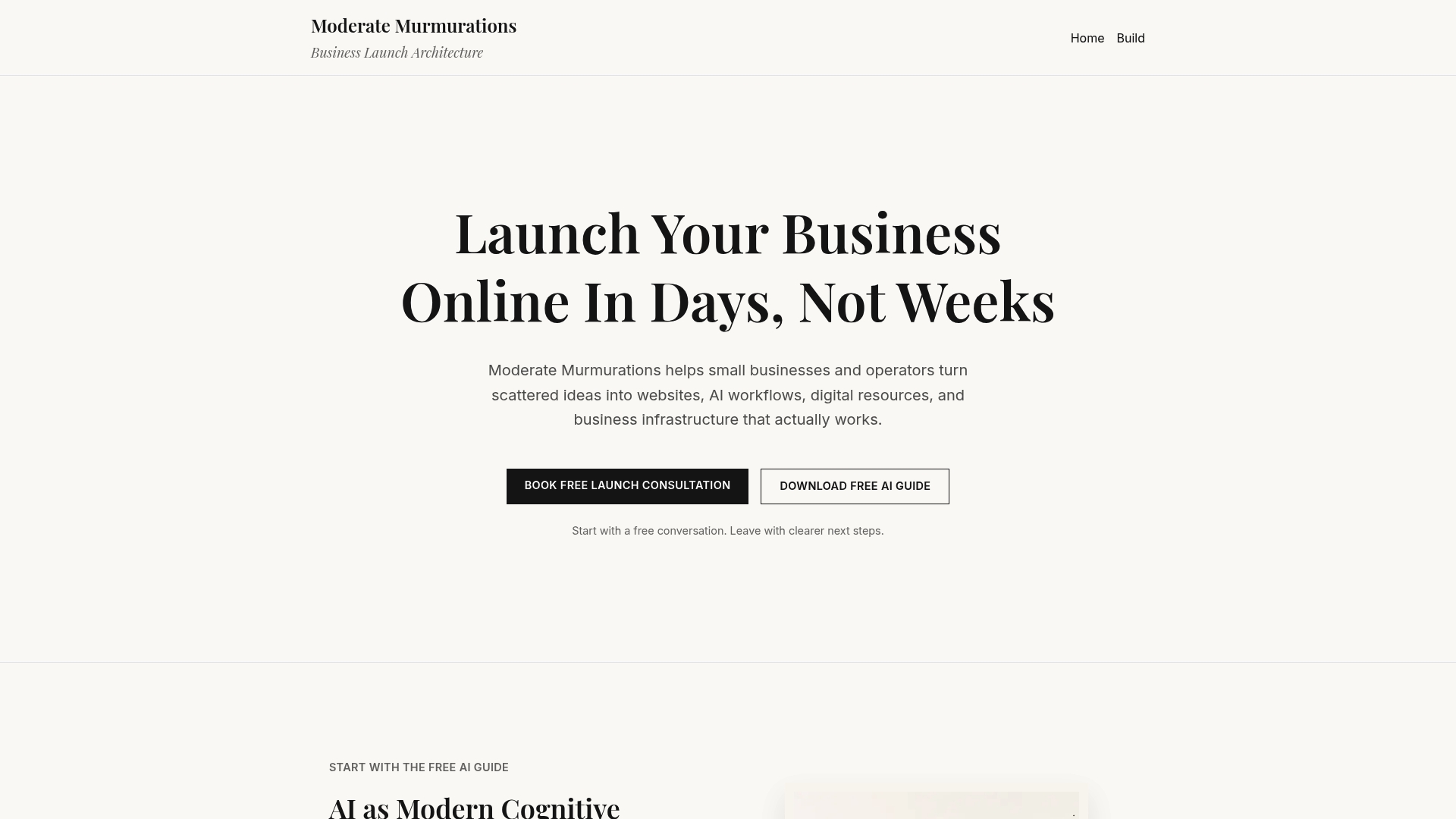
From AI-powered website launches to custom digital systems designed for real workflow efficiency, Moderatemurmurations helps you move from idea to polished online presence without the usual friction. Every build includes clear messaging, search-ready structure, and practical systems you can actually use. If you are ready to put AI to work in your business, explore what we build and see how quickly things can move.
FAQ
How much time can AI save per worker each week?
Individual workers save 11–15 hours per week with AI automation. That figure comes from tracked productivity data across knowledge work roles.
Why don’t AI productivity gains show up at the company level?
Only 13% of companies measure improved organizational performance despite widespread individual gains. The gap exists because faster individual output does not automatically fix slow approval chains, misaligned priorities, or outdated processes.
What is an AI Champion and why does a team need one?
An AI Champion is a designated team member who guides colleagues from initial AI curiosity to consistent daily use. Organizations with an AI Champion see faster adoption and more lasting productivity improvements than those without one.
How do routing proxies reduce AI tool costs?
A routing proxy directs each AI request to the cheapest model capable of completing it. Simple tasks go to free or low-cost models, while complex tasks escalate to premium APIs, reducing overall costs without sacrificing output quality.
What is the biggest long-term risk of AI productivity adoption?
The biggest risk is the reduction in junior hiring that AI automation triggers. A 16% decline in junior roles for AI-exposed positions threatens the pipeline of domain expertise that organizations will need in five to ten years.