AI Consulting for Small Businesses: Launch Fast and Get Found
AI Consulting for Small Businesses: Launch Fast and Get Found

If you run a small service business, a wellness brand, or a creator-led venture and need a launch-ready website, the right AI consulting engagement delivers a conversion-ready landing page, GEO/AEO-ready copy, structured schema, and practical AI workflows in 4–8 weeks. That is the short answer. Tools like Google Search Console, HubSpot AEO and Moderatemurmurations make the path concrete and measurable from day one.
Here is what a first engagement typically covers:
- A site and content audit (what exists, what is broken, what is missing)
- One conversion-ready landing page or site template
- JSON-LD schema (LocalBusiness, Service, FAQ) validated in Google Rich Results Test
- Google Business Profile cleanup and NAP consistency check
- Baseline measurement setup in Google Search Console and AI citation tracking
Pro Tip: Book a free consultation before you scope anything. A 30-minute call clarifies whether you need a full site build, a single landing page, or just a schema and GBP cleanup, and that decision alone can save you weeks of misdirected effort.
Key Takeaways
An SMB-focused AI consulting engagement delivers a conversion-ready site, validated schema, and AI workflows in 4–8 weeks when scoped clearly and measured from day one.
| Point | Details |
|---|---|
| Start with one landing page | A single schema-tagged, copy-complete page is the highest-leverage first deliverable for most SMBs. |
| Measure AI citations early | Check ChatGPT, Perplexity, and Google AI Overviews manually; many SMBs see early citation signals within 4–8 weeks. |
| Require schema proof | Ask any consultant for a Rich Results Test screenshot before signing; no proof means no real schema experience. |
| Use free tools first | Google Search Console, PageSpeed Insights, Rich Results Test, and AnswerThePublic cover the full starter workflow at no cost. |
| Moderatemurmurations | Offers done-for-you AI-assisted websites, schema, copy, and workflows with a free consultation and scoped proposals. |
Table of Contents
- What does an SMB-focused AI consulting engagement actually deliver?
- Who benefits and what measurable outcomes should you expect?
- What does a typical AI consulting engagement look like, step by step?
- How do you choose the right AI consultant for your business?
- A 4–8 week starter plan you can run on a small budget
- Which free and low-cost tools should you use, and when?
- Why should you trust this guidance, and what proof should you ask for?
- What the AI consulting industry gets wrong about small businesses
- What Moderatemurmurations offers and how to get started
- Sources
What does an SMB-focused AI consulting engagement actually deliver?
The deliverables from a well-scoped AI consulting engagement are specific and tangible, not vague strategy decks. Here is what you should expect to receive:
- Audit report: A clear inventory of your current site’s speed, schema gaps, GBP status, and content structure
- Launch landing page: A copy-complete, schema-tagged page built to convert visitors and get cited by AI systems
- Brand messaging copy deck: Core positioning, service descriptions, and headline variants you can reuse across channels
- SEO content pages: Two to four topic pages structured to answer narrow questions your audience is already asking
- JSON-LD schema: LocalBusiness, Service, and FAQ markup that increases the likelihood AI systems will cite your site
- AI workflows: Automated lead follow-up sequences, content draft templates, and Google Business Profile response prompts
- Handoff documentation: Prompt libraries, workflow diagrams, and a plain-language guide so your team can maintain everything independently
The deliverables that matter most are the ones your team can actually use after the consultant leaves. A schema snippet you understand is worth more than a 40-page strategy document you never open.
On ownership: all content, templates, and custom prompts created during the engagement should transfer to you at project close. Request explicit IP assignment language in your contract before work begins.
Who benefits and what measurable outcomes should you expect?
AI consulting for digital presence is a strong fit for four groups:
- Small business owners who need a launch-ready site and local search visibility fast
- Creators and coaches who have expertise but no structured web presence or content system
- Wellness brands that rely on trust signals, reviews, and local discovery
- Service providers (consultants, therapists, tradespeople) who need clear messaging and a lead-capture page
The outcome metrics worth tracking are AI citations, AI referral traffic in Google Search Console, organic click growth, conversion rate on your landing page, lead velocity (new inquiries), and Google Business Profile completeness score.
Cromojo recommends measuring AI citations across ChatGPT, Perplexity, and Google AI Overviews and fixing structural trust signals, including structured data and authoritative mentions, before expecting regular citations. That sequencing matters: build the foundation first, then measure.
Timeline to expect: HubSpot reports that many SMBs see early GEO/AEO improvements within 4–8 weeks of implementing schema, FAQ pages, GBP completeness, and NAP consistency. Organic ranking and traffic movement typically follows at 60–90 days.
What does a typical AI consulting engagement look like, step by step?
A well-run engagement moves through five clear phases: discovery and audit, quick wins, build, test, and handoff with ongoing maintenance.
| Phase | Weeks | Key Deliverables |
|---|---|---|
| Discovery and audit | 0–2 | Audit report, baseline metrics, priority list |
| Quick wins | 2–4 | GBP cleanup, NAP fix, PageSpeed improvements |
| Build | 2–4 | Landing page, schema, brand copy deck |
| Content and workflows | 4–8 | SEO pages, AI workflow setup, FAQ schema |
| Handoff and monitoring | Post-launch | Monthly reporting, prompt library, training |
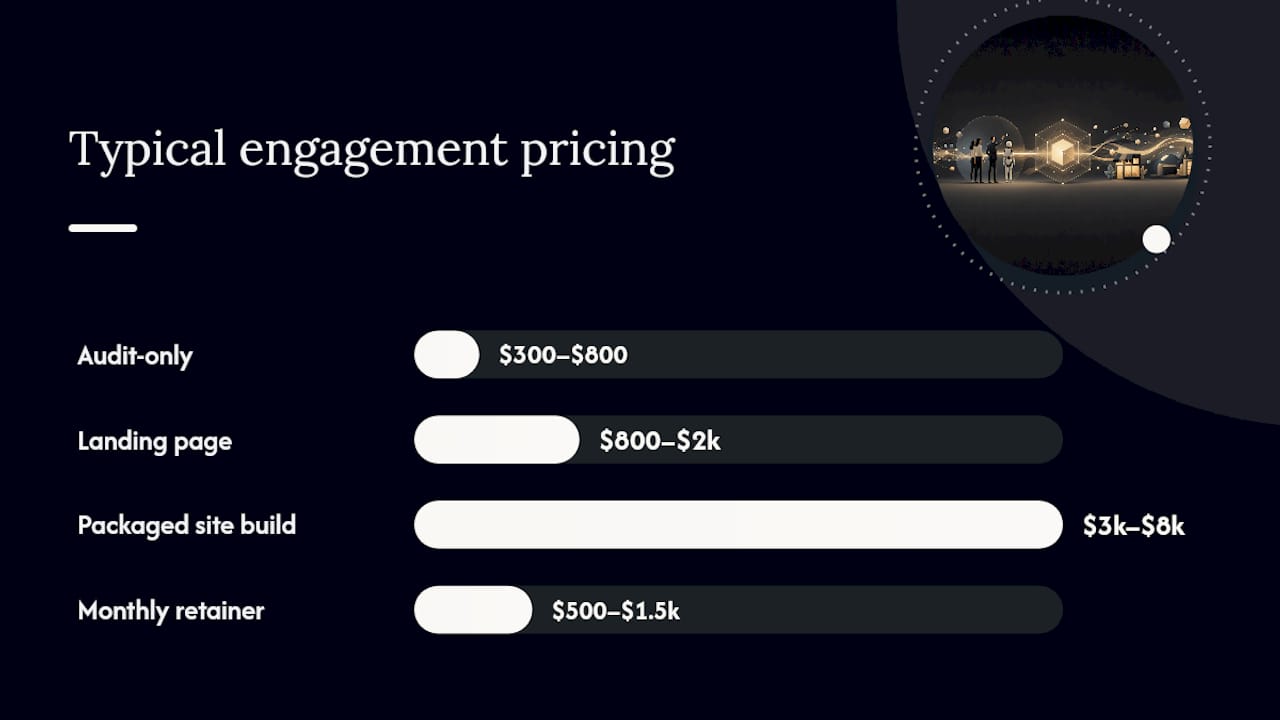
Pricing signals to know:
- An audit-only engagement typically runs $300–$800 and covers a site review, schema gap analysis, and a prioritized action list.
- A single landing page with schema and copy usually falls in the $800–$2,000 range depending on complexity.
- A packaged site build with systems (full site, copy, schema, AI workflows, handoff docs) generally runs $3,000–$8,000.
- Monthly support retainers for content, monitoring, and workflow maintenance typically start around $500–$1,500 per month.
Higher rates are justified when the consultant brings measurable case studies, a defined schema process, and a clear handoff plan. AI SEO investments group into three practical buckets: general-purpose LLM subscriptions, workflow-specific SEO tools, and custom automation. Know which bucket your engagement covers before you sign.
Contract items to require: deliverable definitions with acceptance criteria, data access terms, IP and prompt ownership, response time SLAs, and termination conditions with deliverable transfer.
Pro Tip: Ask for a milestone-based payment schedule tied to deliverable acceptance, not calendar dates. This keeps both sides accountable and gives you a clear exit if scope drifts.
How do you choose the right AI consultant for your business?
The right consultant shows their work. Here are the questions worth asking on a first call:
- Can you show me a before-and-after example with specific metrics (AI citations, traffic, leads)?
- What schema types do you implement, and can you show a Rich Results Test validation screenshot?
- How do you track AI citations, and which tools do you use (ChatGPT, Perplexity, Google AI Overviews)?
- What does your handoff look like, and will my team be able to maintain the workflows independently?
- How do you handle scope changes, and what are your SLA commitments for revisions?
Red flags to watch for:
- Deliverables described in vague terms (“improve your online presence”) with no measurable output
- No sample schema, no Rich Results Test proof, no citation tracking process
- AI used as a buzzword with no defined workflow or toolset behind it
- Contract silence on IP ownership, data access, or termination terms
Pro Tip: Request a sample JSON-LD snippet and ask the consultant to walk you through validating it in Google Rich Results Test. A consultant who cannot do this live has not implemented schema in practice.
A 4–8 week starter plan you can run on a small budget
You do not need a large budget to get meaningful results. This plan works whether you run it yourself or hand it to a consultant.
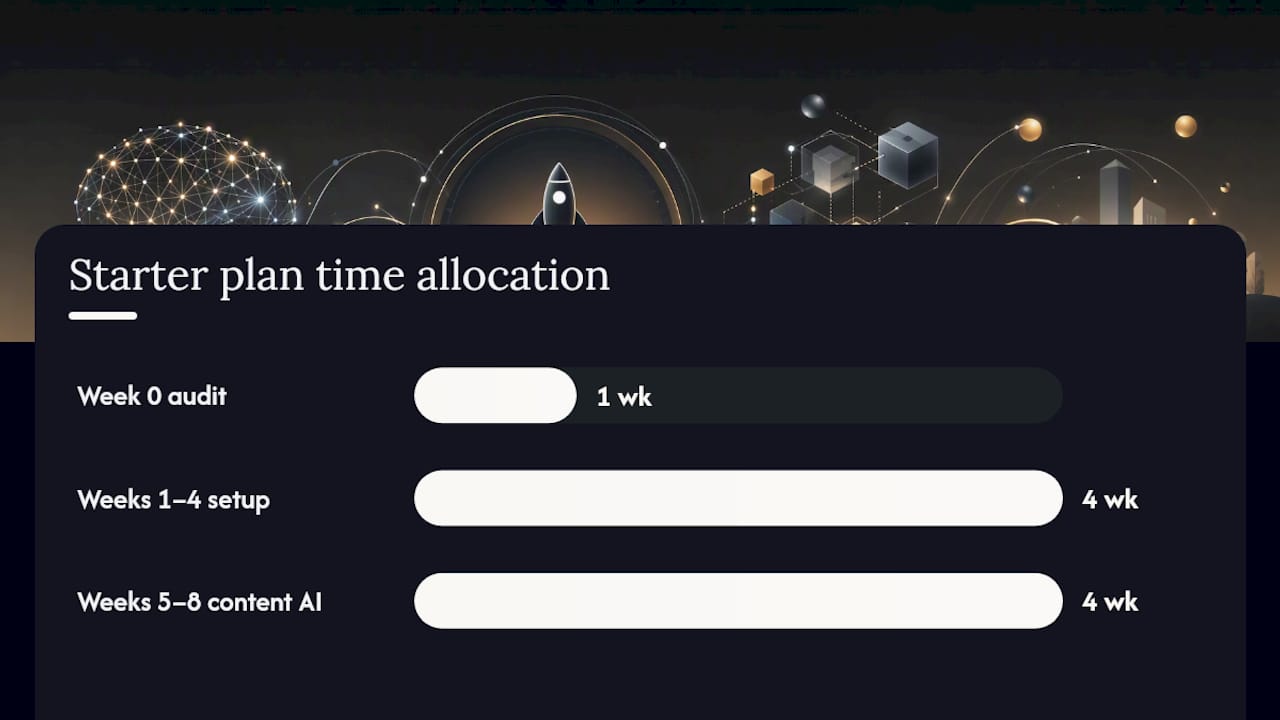
- Week 0: Run a full audit using Google Search Console, Google PageSpeed Insights, and Screaming Frog (free up to 500 URLs). Document your baseline: organic clicks, Core Web Vitals score, and any existing schema errors.
- Week 1: Clean up your Google Business Profile (complete every field, add photos, verify NAP consistency across all directories). Fix the top two PageSpeed issues flagged in the audit.
- Week 2: Build or rebuild your primary landing page. Add JSON-LD schema (LocalBusiness and Service at minimum). Validate in Google Rich Results Test before publishing.
- Week 3: Use AnswerThePublic to find the top five questions your audience asks. Write a FAQ page with 100–200 word answers per question. Add FAQ schema.
- Week 4: Check Google Search Console for impressions and clicks on your new pages. Run manual AI citation checks: search your business name and core service in ChatGPT and Perplexity. Record your baseline citation rate.
- Weeks 5–8: Publish two to four additional SEO content pages targeting narrow questions. Set up one AI workflow (lead follow-up email sequence or GBP response template). Review metrics and adjust.
GEO/AEO does not require a complete marketing overhaul. Schema, FAQ pages, GBP completion, reviews, and NAP consistency get you cited by AI more reliably than extra content volume. Start with the online visibility checklist to confirm you have covered the basics before adding new content.
Pro Tip: Pick one painful workflow and redesign it around AI rather than layering a new tool onto an old process. Pilot it for 30 days and measure the time saved before adding anything else.
Which free and low-cost tools should you use, and when?
These tools cover the full starter workflow without requiring a paid subscription in the first three to six months.
- Google Search Console: Track organic impressions, clicks, and AI Overview appearances. Free.
- Google PageSpeed Insights: Identify Core Web Vitals issues blocking your site’s performance. Free.
- Google Rich Results Test: Validate every schema snippet before and after publishing. Free.
- Screaming Frog SEO Spider: Crawl your site for broken links, missing meta tags, and schema gaps. Free up to 500 URLs.
- AnswerThePublic: Surface the exact questions your audience types into search. Free tier available.
- HubSpot AEO resources: Practical GEO/AEO guidance and templates for SMBs. Free content.
- FAQ schema generators: Tools like Merkle’s Schema Markup Generator or Google’s Structured Data Markup Helper produce valid JSON-LD without coding. Free.
For AI workflow drafting, ChatGPT-style assistants handle content drafts, GBP response templates, and lead follow-up sequences at low cost. Pair one LLM subscription with Screaming Frog and you have a capable two-tool starter stack well under $200 per month. The partner GEO/AEO guide covers schema implementation in detail if you want a technical reference alongside these tools.
Upgrade to paid SEO platforms and managed services only after you confirm GEO/AEO is generating leads, not before.
Why should you trust this guidance, and what proof should you ask for?
The author of this article, Christopher, writes on AI strategy and AI coaching for Moderatemurmurations, with a focus on practical implementation for small businesses and service providers.
When evaluating any consultant’s credentials, ask for portfolio evidence in this specific form:
- Before-and-after screenshots from Google Search Console showing organic click growth
- A Rich Results Test screenshot confirming schema validation on a live client site
- AI citation examples: a named business appearing in a ChatGPT or Perplexity answer
- Conversion rate data from a landing page before and after copy and schema work
The most credible consultants do not just describe their process. They show you a validated schema snippet, a Search Console screenshot with a clear before-and-after window, and at least one example of a client being cited in an AI-generated answer. If a consultant cannot produce any of these, their AI consulting experience is theoretical, not applied.
A strong case study follows this structure: the business’s starting problem (no site, no citations, low traffic), the intervention (site build, schema, workflows), and the measured outcome (AI citations gained, leads per week, organic click growth). Ask for this format specifically. Testimonials and references from past clients add credibility, but metrics are the primary signal.
What the AI consulting industry gets wrong about small businesses
Most AI consulting content is written for enterprise buyers. The frameworks assume large teams, long timelines, and six-figure budgets. For a solo wellness practitioner or a two-person service firm, that framing is not just unhelpful — it actively misdirects the decision.
The real leverage for small businesses is not more software. It is one well-designed workflow, one schema-tagged landing page, and one FAQ page that answers a specific question better than any competitor in your market. A small business that answers narrow questions clearly can out-cite larger brands for those queries, because AI systems favor specificity and structure over domain authority alone.
The other mistake I see consistently: businesses add AI tools to broken workflows instead of redesigning the workflow first. A lead follow-up sequence built on a disorganized inbox just automates the chaos. Start with a workflow map, identify the single most time-consuming manual step, and build the AI layer around that one step. Measure before and after. Then scale.
Scope creep is the practical risk in any consulting engagement. Define your deliverables in writing before kickoff, agree on acceptance criteria for each one, and set a clear measurement window. A 30-day check-in with baseline versus current metrics keeps both sides honest.
What Moderatemurmurations offers and how to get started
Moderatemurmurations builds AI-assisted websites, landing pages, brand copy, SEO content, and digital systems for small businesses, creators, wellness brands, and service providers — the full stack, done for you, without the agency overhead or the open-ended retainer.
A free consultation covers your current site status, your top priority (launch, leads, or visibility), and a clear scope recommendation. From there, you receive a written proposal with defined deliverables, a timeline, and transparent pricing. Engagements move from kickoff to a live, schema-validated, conversion-ready page in as little as two weeks for a single landing page, or four to eight weeks for a full site with AI workflows and handoff documentation.
Book your free consultation at Moderatemurmurations and leave with a clear next step, whether you hire us or run the starter plan yourself.
Sources
- How AI Can Help Small Businesses with SEO (2026 guide) | Aidev