AI Adoption for Small Business Owners: 2026 Guide
AI Adoption for Small Business Owners: 2026 Guide

AI adoption is the strategic integration of artificial intelligence technologies into business operations to enhance efficiency, innovation, and competitiveness. For small and mid-sized business owners, this is no longer a future consideration. Only 19.8% of U.S. establishments have adopted AI as of 2026, yet 88% report using AI in some business function. That gap between usage and real impact tells the whole story. Most owners are experimenting without a plan. This guide gives you the practical framework to move from casual use to genuine, measurable results.
What does successful AI adoption actually require?
Successful AI adoption starts before you install a single tool. The organizations that see real returns treat AI integration as an organizational readiness project first and a technology project second. Three prerequisites determine whether your effort succeeds or stalls.
Readiness assessment means auditing which workflows consume the most time and carry the most measurable output. You are looking for repetitive, rule-based tasks: invoice processing, customer inquiry routing, content drafting, or appointment scheduling. These are your entry points.
Data foundation is the second prerequisite. AI tools perform in proportion to the quality of data you feed them. If your customer records are incomplete or your files are scattered across three platforms, your AI outputs will reflect that disorder. Clean, centralized data is not optional.

Skills inventory rounds out the foundation. 34–53% of mature AI adopters cite skill gaps as their primary challenge. That number signals that even experienced organizations underestimate the training required. Knowing where your team’s capabilities sit before you begin saves you from mid-project surprises.
Essential tool categories for SMEs
| Tool category | Primary function | Minimum resource requirement |
|---|---|---|
| AI writing assistants | Draft copy, emails, and content | Internet access, subscription |
| Workflow automation platforms | Connect apps and trigger actions | Basic process documentation |
| AI analytics tools | Surface patterns in business data | Clean, structured data sets |
| Customer service AI | Handle FAQs and route inquiries | Defined response library |
| AI scheduling tools | Manage bookings and calendar logic | Calendar integration |
Pro Tip: Prioritize infrastructure investment based on where your business loses the most time, not where AI sounds most exciting. A workflow automation tool that saves your team five hours a week beats a sophisticated analytics platform you are not ready to interpret.
How do you execute AI adoption step by step?
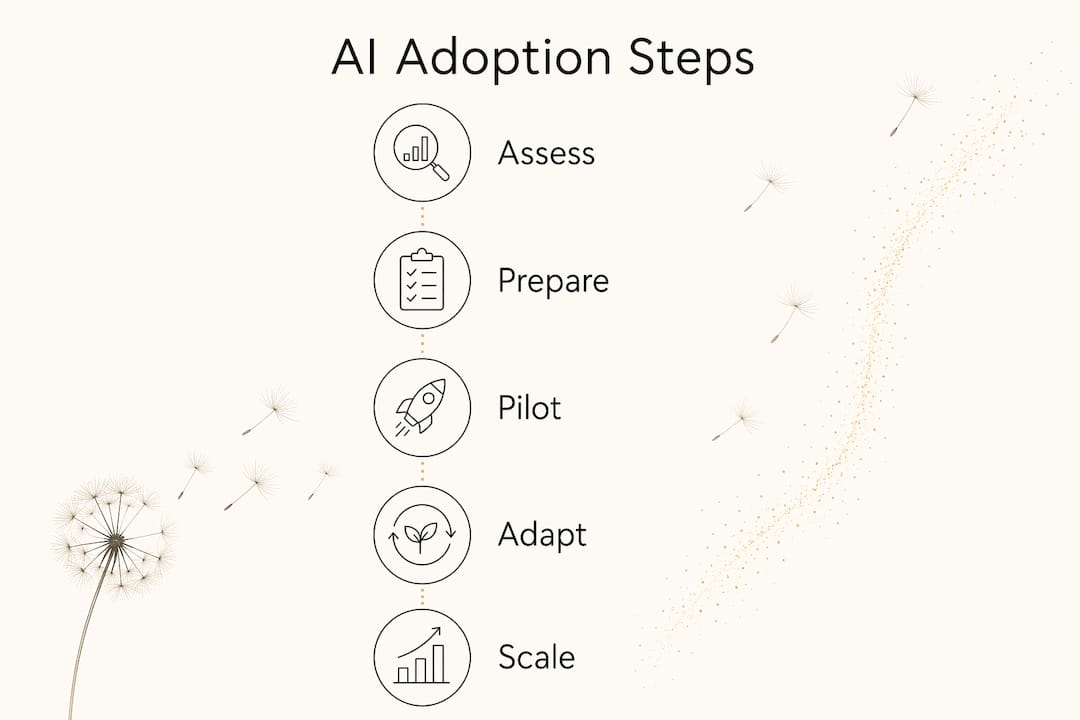
Enterprise AI implementation follows a 5-phase lifecycle: readiness, use-case selection, data foundation, pilot, and scaled rollout. This process typically spans 6–18 months. For small businesses, the phases are the same. The timelines are often shorter, but skipping phases is where most failures begin.
-
Readiness phase. Conduct an honest audit of your current workflows, data quality, and team skills. Assign a point person who owns the AI initiative. Without clear ownership, the project drifts.
-
Use-case selection. Choose one or two specific problems to solve. Aligning AI initiatives to specific business outcomes rather than vague goals is the single biggest predictor of success. “Reduce customer response time by 40%” is a use case. “Use AI to improve operations” is not.
-
Data foundation. Consolidate the data your chosen use case requires. This might mean exporting your CRM contacts into a clean spreadsheet or standardizing your product catalog. Do this before selecting tools.
-
Pilot phase. Run a controlled test on one workflow. Measure the outcome against your baseline. Effective pilots select workflows with high measurable impact but low complexity to build confidence before scaling. A customer FAQ chatbot or an AI email drafting tool fits this profile well.
-
Scaled rollout. Once the pilot proves value, expand to adjacent workflows. Executive sponsorship with budget authority is critical at this stage. Without a decision-maker actively supporting the rollout, momentum stalls at the pilot.
Comparing implementation approaches
| Approach | Best for | Risk level | Time to first result |
|---|---|---|---|
| Pilot-focused | SMEs new to AI | Low | 4–8 weeks |
| Broad rollout | Teams with prior AI experience | High | 3–6 months |
| Function-by-function | Businesses with distinct departments | Medium | 6–12 weeks per function |
Pro Tip: Start your pilot on a workflow that your team already finds frustrating. Solving a real pain point builds buy-in faster than any training session.
What are the biggest challenges of AI adoption?
Most AI project failures stem from cultural resistance, fear of job loss, and misaligned objectives rather than technology problems. This is the finding that surprises most business owners. They budget for software and underbudget for people.
AI adoption requires redesigning workflows and processes, not simply adding a new tool to an existing process. A customer service rep who receives AI-drafted responses still needs to know when to override them. That judgment requires training, not just access.
The five most common pitfalls and how to address them:
- Skill gaps. Assign dedicated learning time. Short weekly sessions on specific tools outperform one-time onboarding workshops.
- Cultural resistance. Involve your team in use-case selection. People support what they help build.
- Workflow integration failures. Map the current process on paper before introducing AI. Gaps in the existing workflow become amplified, not solved, by automation.
- Misaligned incentives. Tie AI performance goals to outcomes your team already cares about, such as faster client turnaround or fewer after-hours emails.
- Lack of transparency. Many organizations fail to embed AI into workflows and lack trust-building transparency, which blocks genuine adoption even when tools are available. Communicate clearly about what the AI does and what it does not do.
Clear communication from leadership reduces fear. When your team understands that AI handles repetitive tasks so they can focus on higher-value work, resistance drops. Pair that message with visible executive sponsorship and consistent follow-through.
Pro Tip: Treat AI adoption as a behavior change program, not a software installation. The technology is the easy part. Getting your team to use it consistently and critically is the real work.
How do you measure whether AI adoption is working?
Measuring AI success means tracking outcomes, not just activity. The number of employees who have access to an AI tool is a usage metric. It tells you nothing about whether the tool is changing results. You need both layers.
Start with business-aligned key performance indicators:
- Operational efficiency: time saved per task, error rate reduction, or throughput increase
- Revenue impact: conversion rate changes, customer retention, or average deal size
- Employee engagement: team satisfaction scores and self-reported time savings
- Cost metrics: reduction in manual labor hours or support ticket volume
Beyond these numbers, watch for adaptation behaviors. The real challenge lies in shifting from AI adoption to AI adaptation, focusing on human behaviors like judgment, experimentation, and divergent thinking that unlock AI value. An employee who questions an AI output, tests a new prompt, or proposes a better workflow is showing adaptation. That behavior is worth more than raw usage data.
Human-in-the-loop review is the mechanism that keeps this balance intact. Build review checkpoints into every AI-assisted workflow. This prevents over-reliance and keeps your team’s expertise sharp. Review your KPIs monthly for the first six months, then quarterly once the workflow stabilizes.
Pro Tip: Set a 90-day review checkpoint after every new AI workflow goes live. Ask two questions: Did the metric move? Did the team’s behavior change? If the answer to both is yes, you have genuine adoption.
Key takeaways
Successful AI adoption requires a readiness foundation, a phased implementation plan, and a culture that supports behavioral change alongside technology.
| Point | Details |
|---|---|
| Start with prerequisites | Assess workflows, data quality, and team skills before selecting any tool. |
| Follow the 5-phase lifecycle | Move through readiness, use-case selection, data foundation, pilot, and scaled rollout in order. |
| Address culture first | Most AI failures trace back to resistance and misalignment, not technology problems. |
| Measure outcomes, not usage | Track efficiency, revenue, and adaptation behaviors, not just tool access rates. |
| Secure executive sponsorship | A decision-maker with budget authority is required to move from pilot to full rollout. |
Why most SMEs are thinking about AI integration the wrong way
I have worked with enough small business owners to spot the pattern quickly. They buy the tool, run a demo, and declare the project done. Six months later, nothing has changed except the monthly subscription bill.
The mistake is treating AI as a one-time technology project. It is not. Continuous adaptation loops driven by human workers’ interaction behaviors are what create sustainable AI transformation. That means your job does not end at launch. It begins there.
The businesses I see getting real results are the ones where the owner stays curious. They check the outputs. They ask their team what is working. They adjust the workflow when the AI produces something off. That iterative mindset is not a personality trait. It is a practice you can build deliberately.
The other thing I will say plainly: do not skip the online visibility checklist work before you layer AI on top of your digital presence. AI amplifies what is already there. If your messaging is unclear or your site structure is weak, AI-generated content will scale the confusion, not fix it. Get the foundation right first, then accelerate.
— Christopher
How Moderatemurmurations supports your AI integration
Moderatemurmurations builds the digital infrastructure that makes AI integration work for small businesses and service providers. We design AI-assisted websites, brand copy, and digital systems that are structured for growth from day one.
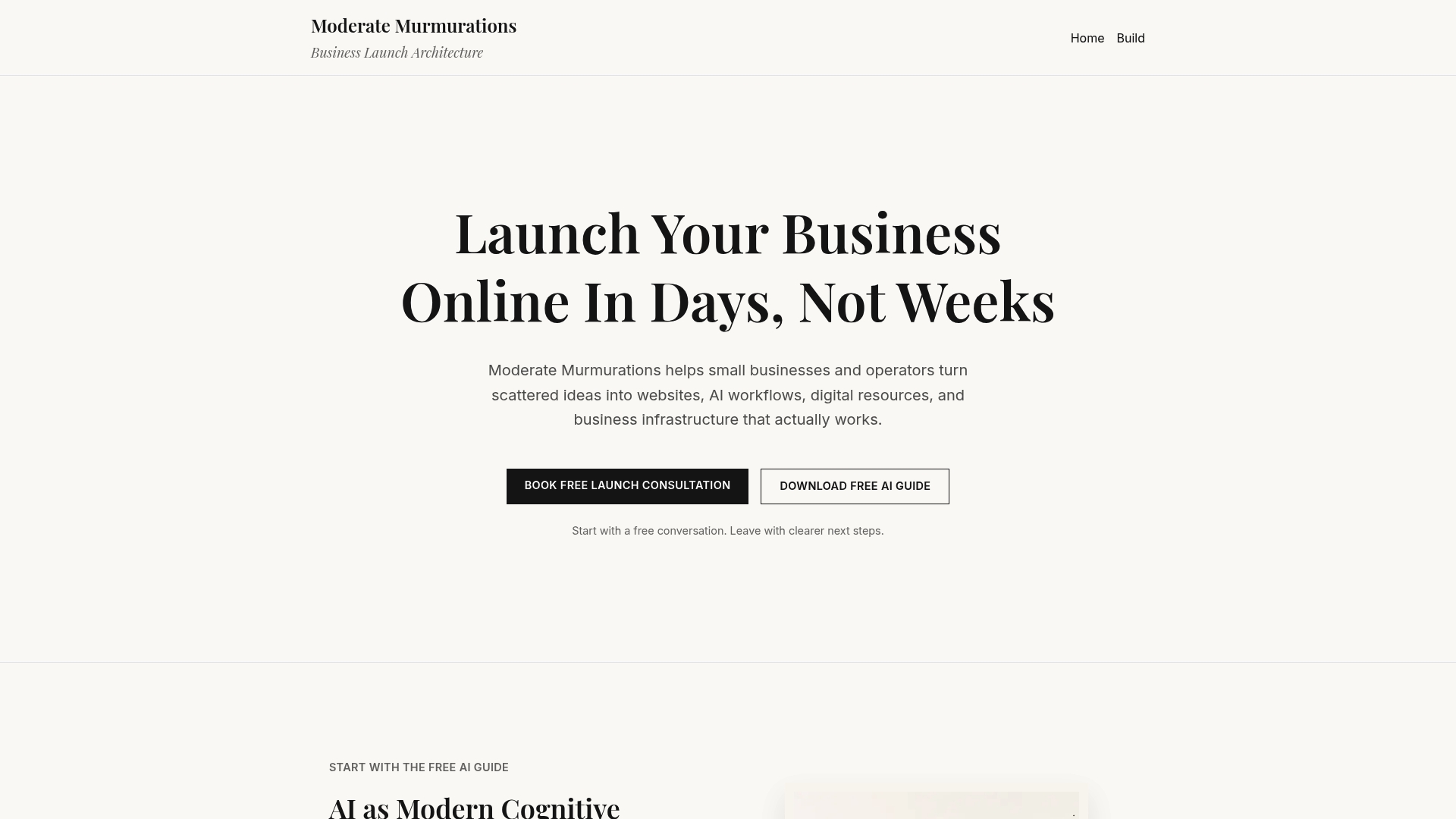
If you are ready to move from experimenting with AI tools to running a business that actually uses them well, we can help you get there faster. Our AI workflow and website services are built specifically for owners who want a clean, functional online presence without spending months figuring it out. You bring the vision. We build the system. Start with our homepage to see what a fast, clear digital launch looks like in practice.
FAQ
What is AI adoption in business?
AI adoption is the process of integrating artificial intelligence tools and workflows into business operations to improve efficiency, reduce manual work, and support better decisions. It requires readiness assessment, data preparation, and ongoing behavioral change, not just tool installation.
How long does AI adoption take for a small business?
The 5-phase AI implementation lifecycle typically spans 6–18 months for larger organizations. Small businesses running focused pilots on one or two workflows can see measurable results in 4–8 weeks.
What are the biggest challenges of AI adoption for SMEs?
Cultural resistance, skill gaps, and misaligned objectives cause most AI project failures. Between 34–53% of mature adopters cite skill shortages as their primary challenge, making team training as critical as tool selection.
How do I know if my AI adoption is working?
Track business-aligned KPIs such as time saved, error rates, and revenue impact alongside adaptation behaviors like employee experimentation and critical review of AI outputs. Usage metrics alone do not confirm success.
Do I need a large budget to start adopting AI?
No. The most effective starting point is a single low-complexity, high-impact workflow such as email drafting or FAQ automation. Many entry-level AI tools require only a monthly subscription and clean data to deliver measurable results.